3D Printer Filament Types and Uses — Complete Guide 2025
From easy-to-print PLA to industrial nylon, this guide breaks down every filament type you'll encounter, what it's good for, and which projects demand which material.
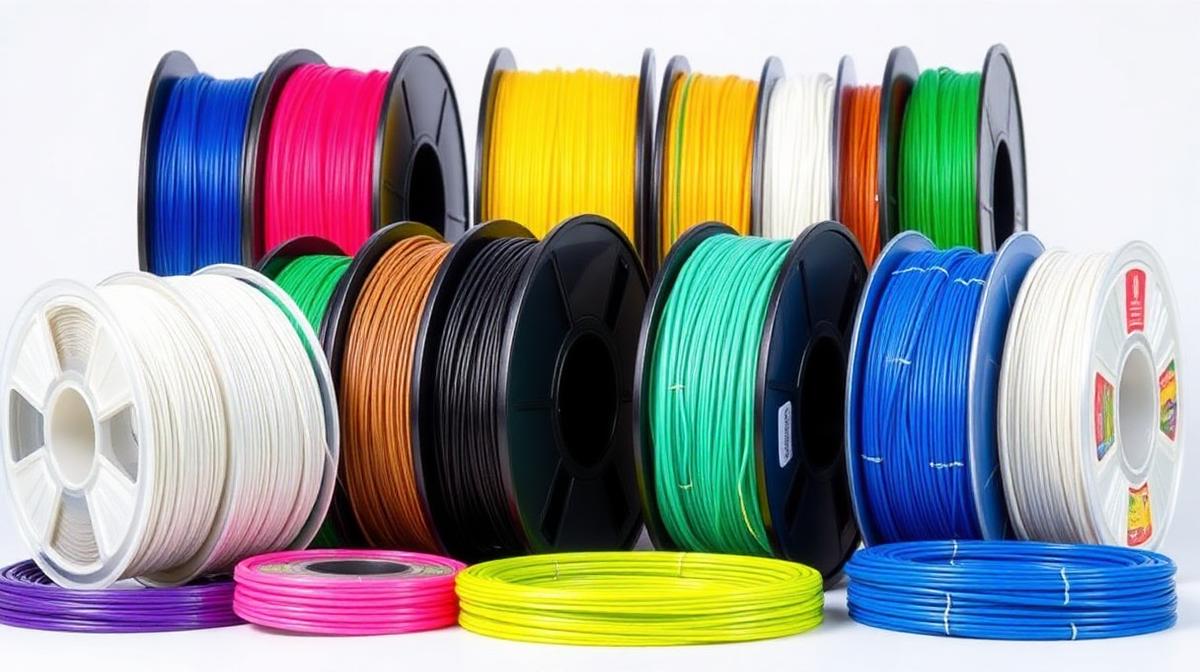
Quick Answer — What Are the Main 3D Printer Filament Types?
The six core 3D printer filament types are PLA (easiest, decorative), PETG (strong, food-safe), ABS (heat-resistant, durable), TPU (flexible, rubber-like), ASA (UV-resistant, outdoor), and Nylon (toughest, industrial). PLA is best for beginners; PETG and ABS handle functional parts; TPU creates flexible items; ASA and Nylon serve demanding engineering applications.
TL;DR — Quick Summary
Here's the short version — pick a filament based on your project's needs, not its popularity.
- 1Best for Beginners: PLA — prints at low temps, minimal warping, huge color range
- 2Best All-Rounder: PETG — strong, heat-tolerant, easy enough for most users
- 3Best for Heat Resistance: ABS — handles 100°C+, ideal for enclosures and functional parts
- 4Best for Flexibility: TPU — rubber-like prints for phone cases, gaskets, wheels
- 5Best for Outdoors: ASA — UV-stable, weather-proof, won't yellow like ABS
- 6Strongest Overall: Nylon — superior impact and wear resistance for engineering parts
📘 Complete Filaments Guide Hub
Visit our master hub for in-depth reviews, comparisons, and buying guides for every filament type.
What Are 3D Printer Filaments Made Of?
3D printer filaments are made from thermoplastic polymers — plastics that soften when heated and harden when cooled. This property allows FDM (Fused Deposition Modeling) printers to extrude them layer by layer into solid objects.
What is Thermoplastic?
Thermoplastic is a type of plastic polymer that becomes soft and moldable above a specific temperature and solidifies upon cooling. Unlike thermosets, thermoplastics can be reheated and reshaped repeatedly, which makes them ideal for 3D printing filaments.
Common thermoplastics used in 3D printing include PLA (polylactic acid), PETG (polyethylene terephthalate glycol), ABS (acrylonitrile butadiene styrene), and Nylon (polyamide).
How Do Thermoplastic Properties Affect Your Prints?
Each thermoplastic has a unique glass transition temperature (the point where it softens) and melting point. These determine your nozzle temperature, bed temperature, and whether you need an enclosure. Higher-temperature filaments like ABS and Nylon produce parts that withstand more heat in use but require more capable printers.
What is Glass Transition Temperature?
Glass Transition Temperature is the temperature at which a polymer transitions from a hard, glassy state to a soft, rubbery state. For 3D printed parts, this determines the maximum service temperature — above this point, the part will begin to deform under load.
PLA's glass transition is ~60°C (too low for car interiors), while ABS reaches ~105°C and Nylon ~70-80°C.
What Are the Standard Filament Types?
What Is PLA and When Should You Use It?
PLA (Polylactic Acid) is the most popular 3D printing filament worldwide. Made from renewable resources like corn starch, it's biodegradable under industrial composting conditions and produces a faint sweet smell when printing.
PLA Key Properties:
- • Nozzle temp: 190–220°C
- • Bed temp: 0–60°C (optional)
- • Enclosure: Not needed
- • Strength: Moderate (brittle under impact)
- • Heat resistance: Low (~60°C glass transition)
- • Best for: Prototypes, decorative items, cosplay props, figurines
PLA is perfect for visual models, prototypes, and anything that won't face heat or heavy mechanical stress. Its low warping and easy printability make it the default choice for beginners and experienced makers printing non-functional parts.
Best Budget PLA Filament Under $15 (2025)
Need affordable PLA that still prints well? See our top picks for reliable budget-friendly brands.
What Is PETG and Why Is It So Popular?
PETG (Polyethylene Terephthalate Glycol) sits between PLA and ABS in difficulty and performance. It combines decent strength, good heat resistance, and chemical resistance in a package that's only slightly harder to print than PLA.
PETG Key Properties:
- • Nozzle temp: 220–250°C
- • Bed temp: 70–90°C
- • Enclosure: Not required but helps
- • Strength: Good (impact-resistant, less brittle than PLA)
- • Heat resistance: Moderate (~80°C glass transition)
- • Best for: Mechanical parts, outdoor items, food-safe containers
PETG is the go-to upgrade from PLA when you need parts that handle some heat and mechanical stress. It's also considered food-safe when printed with a stainless steel nozzle and proper settings.
Best PETG Filament 2025 — Top 5 Picks Reviewed
Our in-depth review of the best PETG filament brands with print settings and buying recommendations.
What Is ABS and Who Should Use It?
ABS (Acrylonitrile Butadiene Styrene) is a classic engineering plastic used in LEGO bricks, automotive parts, and electronic housings. In 3D printing, ABS requires more setup but rewards you with parts that handle real-world heat and impact.
ABS Key Properties:
- • Nozzle temp: 230–260°C
- • Bed temp: 90–110°C
- • Enclosure: Required (emits fumes, warps without one)
- • Strength: High (excellent impact resistance)
- • Heat resistance: High (~105°C glass transition)
- • Best for: Functional parts, automotive components, electronic enclosures
Safety Note: ABS emits styrene fumes when heated. Always print in a well-ventilated area or use an enclosed printer with a HEPA filter.
Best ABS Filament 2025 — Top 5 for Heat-Resistant Prints
Need ABS that prints reliably? Our tested picks minimize warping and deliver consistent results.
What Are Engineering-Grade Filaments?
Engineering filaments require more capable printers (all-metal hotend, direct-drive extruder, enclosure) but produce parts with properties that rival injection-molded plastics.
What Is TPU and What Can You Print With It?
TPU (Thermoplastic Polyurethane) is a flexible, rubber-like filament. It prints soft, bendable parts that snap back to their original shape — perfect for phone cases, gaskets, shoe insoles, and drone bumpers.
TPU Key Properties:
- • Nozzle temp: 210–230°C
- • Bed temp: 40–60°C
- • Enclosure: Not required
- • Flexibility: High (Shore 85A–95A typical)
- • Speed: Slow (20–40 mm/s recommended)
- • Best for: Phone cases, gaskets, vibration dampeners, wheels
What is Shore Hardness?
Shore Hardness is a scale that measures the hardness of flexible materials. Shore A measures softer materials (rubber, TPU) while Shore D measures harder materials. Lower Shore A numbers mean softer, more flexible prints. Most TPU filaments range from 85A (very flexible) to 95A (semi-rigid).
Best TPU Filament 2025 — Top 5 Flexible Filaments Reviewed
Our tested picks for flexible filaments ranging from ultra-soft 85A to semi-rigid 95A.
What Is ASA and How Does It Compare to ABS?
ASA (Acrylonitrile Styrene Acrylate) is essentially UV-resistant ABS. It shares the same strength and heat resistance but won't yellow or degrade in sunlight — making it the top choice for outdoor functional parts like garden tool holders, signage brackets, and automotive trim.
ASA Key Properties:
- • Nozzle temp: 235–260°C
- • Bed temp: 90–110°C
- • Enclosure: Required
- • UV resistance: Excellent (won't yellow outdoors)
- • Heat resistance: High (~105°C glass transition)
- • Best for: Outdoor parts, automotive accessories, signage, garden tools
Best ASA Filament 2025 — Top UV-Resistant Filaments
Our tested recommendations for ASA that prints reliably with minimal warping.
What Is Nylon and When Do You Need It?
Nylon (Polyamide / PA) is the toughest FDM filament readily available. It offers exceptional impact resistance, wear resistance, and fatigue strength. Carbon fiber nylon (PA6-CF) adds stiffness for load-bearing applications like jigs, fixtures, and replacement mechanical parts.
Nylon Key Properties:
- • Nozzle temp: 240–270°C
- • Bed temp: 70–100°C
- • Enclosure: Required (highly hygroscopic)
- • Strength: Excellent (best impact resistance of all FDM filaments)
- • Moisture sensitivity: Very high — must dry before printing
- • Best for: Gears, hinges, snap-fits, jigs, industrial replacement parts
Best Nylon Filament 2025 — Top 5 for Engineering Parts
Our expert picks for nylon and carbon fiber nylon filaments for demanding functional applications.
🔥 Best Filament Dryer 2025
Nylon absorbs moisture fast. A filament dryer is essential — see our top tested picks.
What Are Specialty PLA Filaments?
Specialty PLAs add visual effects or enhanced properties to standard PLA while keeping it beginner-friendly. They use PLA as a base and blend in additives like wood fibers, marble powder, metallic pigments, or toughening agents.
What Makes Silk PLA Different?
Silk PLA contains metallic pigments that create a glossy, shiny surface finish resembling polished metal. It's ideal for vases, display pieces, and decorative items where visual impact matters more than mechanical strength. Silk PLA is slightly weaker than standard PLA but prints at similar temperatures.
Best Silk PLA Filament 2025 — Top Shiny Filaments
Our reviewed picks for metallic-finish filaments that create stunning decorative prints.
Is Wood PLA Real Wood?
Wood PLA contains 10–40% real wood fibers (often bamboo, pine, or birch) mixed into a PLA base. Printed parts have a genuine wood texture and can be sanded, stained, and finished like real wood. Higher nozzle temperatures produce darker "grain" effects.
Best Wood PLA Filament 2025 — Realistic Wood-Fill Picks
Top wood-fill filaments tested for texture, printability, and finishing results.
What Is Marble PLA Best For?
Marble PLA uses stone powder or contrasting color filaments to mimic natural marble and granite patterns. It's popular for planters, vases, busts, and architectural models where a stone-like aesthetic adds value.
Best Marble PLA Filament 2025 — Top Stone-Effect Picks
Stunning stone-look filaments tested for pattern quality and print reliability.
Why Does Carbon Fiber PLA Need a Hardened Nozzle?
Carbon fiber PLA contains chopped carbon fibers that dramatically increase stiffness and reduce weight. These fibers are extremely abrasive and will destroy a standard brass nozzle within a few hours. A hardened steel or ruby-tipped nozzle is mandatory.
Best Carbon Fiber PLA 2025 — Stiff, Lightweight Prints
Our top CF-PLA picks for rigid functional parts that need minimal flex.
🔧 Best Hardened Steel Nozzle 2025
Printing abrasive filaments? You need a wear-resistant nozzle. See our tested picks.
Can You Print Glow-in-the-Dark Filament Easily?
Glow-in-the-dark PLA prints similarly to standard PLA but contains strontium aluminate phosphorescent particles. Like carbon fiber PLA, these particles are abrasive — a hardened nozzle is recommended for extended use. Glow intensity varies significantly between brands.
Best Glow-in-the-Dark Filament Brands
Which brands actually glow bright and long? Our tested results may surprise you.
What Is PLA+ and Is It Worth the Extra Cost?
PLA+ (also called PLA Pro or Tough PLA) is modified PLA with impact modifiers that increase toughness 2–3x over standard PLA. It bridges the gap between PLA's easy printability and PETG's mechanical performance. For functional prints that don't need high heat resistance, PLA+ is often the sweet spot.
Best PLA+ Filament 2025 — Top 5 Strong PLA Picks
Enhanced PLA that's tougher without the print difficulty of PETG or ABS.
Tough PLA vs PETG — Which Is Better?
Can't decide between PLA+ and PETG? Our head-to-head comparison breaks it down.
Filament Comparison Chart — All Types at a Glance
| Filament | Nozzle °C | Bed °C | Enclosure? | Strength | Difficulty | Best Use |
|---|---|---|---|---|---|---|
| PLA | 190–220 | 0–60 | No | Low | ⭐ | Decorative, prototypes |
| PLA+ | 200–230 | 50–70 | No | Medium | ⭐ | Functional PLA parts |
| PETG | 220–250 | 70–90 | Optional | Good | ⭐⭐ | Mechanical, food-safe |
| ABS | 230–260 | 90–110 | Required | High | ⭐⭐⭐ | Heat-resistant parts |
| ASA | 235–260 | 90–110 | Required | High | ⭐⭐⭐ | Outdoor, UV-exposed |
| TPU | 210–230 | 40–60 | No | Flexible | ⭐⭐⭐ | Cases, gaskets, wheels |
| Nylon | 240–270 | 70–100 | Required | Excellent | ⭐⭐⭐⭐ | Gears, jigs, tools |
| Silk PLA | 200–220 | 50–60 | No | Low | ⭐ | Display, decorative |
| Wood PLA | 190–220 | 50–60 | No | Low | ⭐⭐ | Artistic, furniture accents |
| CF-PLA | 200–230 | 50–70 | No | Stiff | ⭐⭐ | Rigid structural parts |
How to Choose the Right Filament for Your Project
Start with your project's requirements, not the filament's popularity:
Will the part face heat above 60°C?
Skip PLA. Choose ABS (105°C), ASA (105°C), or PETG (80°C) based on your temperature needs.
Does it need to flex or absorb impact?
TPU for flexible parts, Nylon for tough rigid parts, PLA+ for moderate toughness with easy printing.
Will it live outdoors?
ASA is the clear winner. PETG is acceptable for moderate outdoor exposure. PLA and ABS will degrade.
Is visual appearance the priority?
Silk PLA for shine, Wood PLA for organic texture, Marble PLA for stone aesthetics, standard PLA for widest color range.
Just getting started?
Begin with PLA. Learn your printer's quirks, then graduate to PETG, then ABS/ASA/Nylon as your skills and equipment grow.
Best PLA for High-Speed Printing
Running a fast printer at 300-600mm/s? Not all PLA can keep up. See which brands handle the speed.
Best Filament for Large Prints Without Warping
Printing big? Warping is the #1 enemy. See which filaments stay flat on large build plates.
Best PLA for Lithophanes 2025
Printing photo lithophanes? You need specific white or translucent PLA — see our top picks.
📘 3D Printers Buyer's Guide
Need a printer that can handle the filament you've chosen? Our buyer's guide covers all budgets.
Frequently Asked Questions
What is the best filament type for beginners?
PLA is the best filament for beginners. It prints at low temperatures (190–220°C), doesn't require a heated bed or enclosure, produces minimal warping, and is available in hundreds of colors. It's also one of the most affordable filament types.
What filament is strongest for functional parts?
Nylon is the strongest FDM filament for functional parts, offering excellent impact resistance, flexibility, and wear resistance. For easier printing, PETG and PLA+ provide good strength without the moisture sensitivity and high temperatures nylon requires.
Can you use any filament in any 3D printer?
No. Each filament has specific temperature requirements. Basic printers handle PLA and PETG. ABS, ASA, and Nylon need an all-metal hotend (250°C+) and ideally an enclosure. TPU requires a direct-drive extruder for reliable printing. Always check your printer's max nozzle temperature before buying filament.
What is the difference between PLA and PLA+?
PLA+ (also called PLA Pro or Tough PLA) is modified PLA with additives that improve impact resistance, layer adhesion, and heat tolerance. PLA+ is 2–3x tougher than standard PLA but prints at similar temperatures. It costs slightly more but is worth it for functional parts.
Which filament is best for outdoor use?
ASA is the best filament for outdoor use. It offers excellent UV resistance and weather stability, unlike ABS which yellows in sunlight. PETG is a good alternative with moderate UV resistance and easier printing requirements.
Choosing Filament Doesn't Have to Be Complicated
Match the filament to the job. Decorative prints → PLA or specialty PLA. Functional parts needing some heat tolerance → PETG or PLA+. Engineering applications → ABS, ASA, or Nylon. Flexible parts → TPU. The comparison chart above is your quick reference — bookmark it.
As your skills grow, you'll naturally graduate from PLA to engineering filaments. The key is starting simple, learning your printer's behavior, and expanding your material repertoire one filament at a time.
💰 Cheapest Good Quality Filament Bulk Deals
Ready to stock up? Save up to 40% buying filament in bulk — see our curated deals.
Best 3D Printer Enclosure 2025
Printing ABS, ASA, or Nylon? An enclosure is essential. See our top picks.