Quick Answer
You need a hardened or otherwise wear-resistant nozzle if you print abrasive filament — carbon- or glass-fiber-filled materials, many glow-in-the-dark filaments, and other composites whose makers call for one. If you only print ordinary PLA, PETG, ABS or TPU, a standard brass nozzle is usually fine.
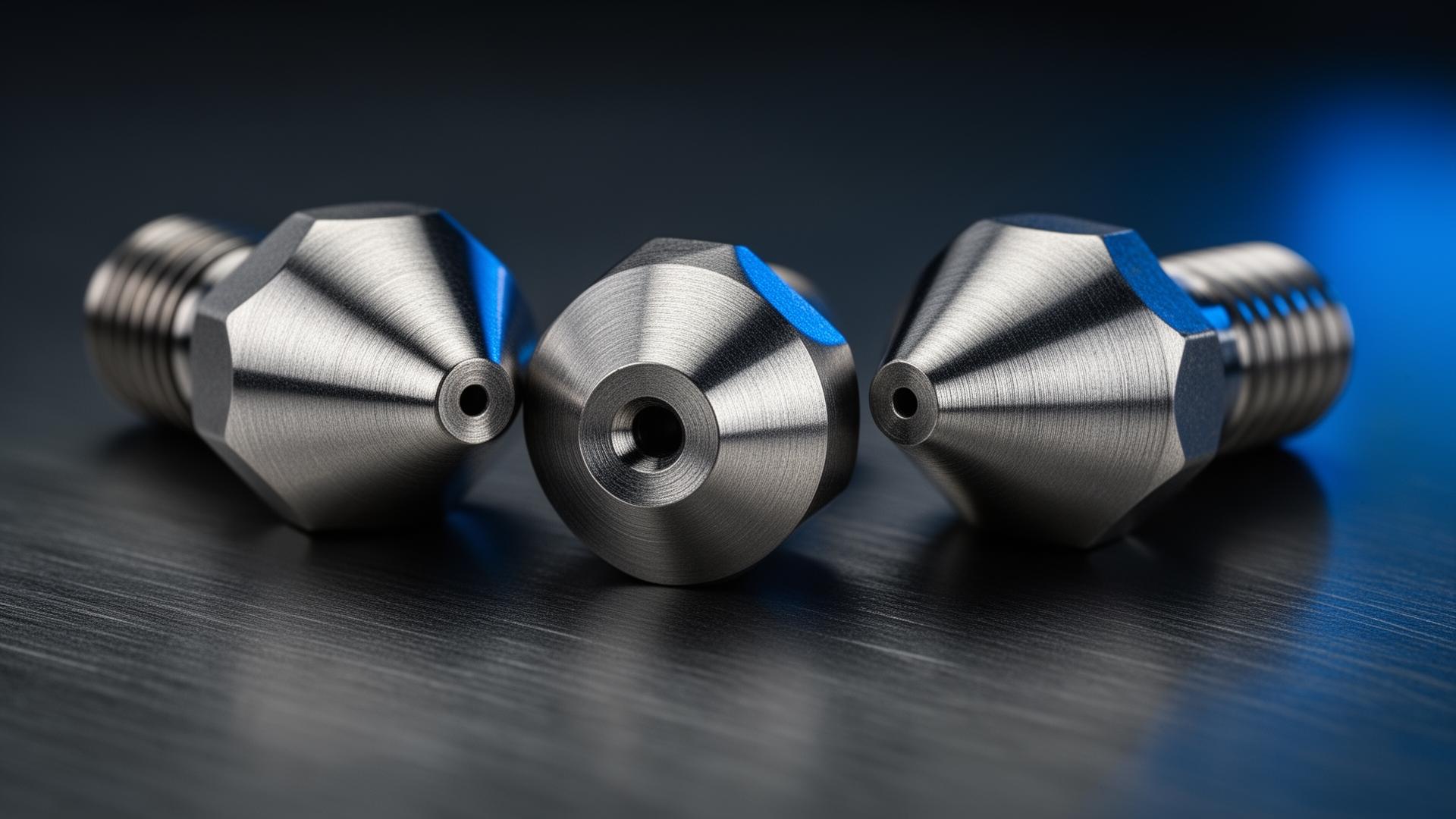
The best hardened steel nozzle is one that is listed as compatible with your exact hotend, comes in the diameter your filament needs, and suits how often you print abrasives. Hardened steel is the common, affordable choice; premium wear-resistant designs trade higher cost for other benefits such as thermal performance.
Why Nozzle Wear Matters
A nozzle's bore is a precise opening, typically well under a millimeter across. Abrasive particles in filament scrape that bore as plastic flows through. In a soft brass nozzle this gradually enlarges the opening and can make it out-of-round.
- Dimensional change: a larger bore extrudes wider lines than your slicer expects.
- Extrusion consistency: uneven wear gives inconsistent flow and surface texture.
- Print quality: fine details soften, and dimensional accuracy and first-layer behavior drift.
- Hidden effect: a worn nozzle keeps affecting every later print, including non-abrasive filament.
How quickly this happens depends on the filament, how much you print and the nozzle, so there's no honest universal lifespan figure. What's consistent is that wear-resistant materials slow the process considerably compared with brass.
Do You Actually Need One?
Wear resistance is relevant for
- Carbon-fiber-filled filaments — see our CF-PLA guide for a practical example
- Glass-fiber-filled filaments
- Many glow-in-the-dark filaments
- Other composites whose manufacturer recommends a wear-resistant nozzle
Some filled materials — certain wood-, metal- or mineral-filled products — vary in how abrasive they are. Follow the filament maker's recommendation rather than the category name. Unfilled nylon is not generally considered abrasive, but fiber-filled nylons are.
Nozzle Material Types
Brass. The default on most printers. Excellent heat transfer and low cost, but soft, so it wears with abrasive filament.
Hardened steel. The most common upgrade for abrasives. Much more wear-resistant than brass and relatively affordable. It generally transfers heat less readily, so a small temperature or maximum-flow adjustment is sometimes needed.
Coated or plated designs. Some nozzles use surface treatments intended to add wear resistance or reduce sticking. Performance depends on the specific coating and its durability; don't assume all coated nozzles are equivalent.
Other wear-resistant designs. Premium options include nozzles with hard inserts or tips (for example ruby or tungsten carbide) and proprietary alloys. These aim to combine wear resistance with better thermal behavior than hardened steel, at higher cost. Their properties differ from one another — compare each maker's published information rather than treating them as a single category.
Nozzle Decision Table
Qualitative comparison; specific products vary.
| Factor | Brass | Hardened steel | Premium wear-resistant (insert/coated) | Other alloys |
|---|---|---|---|---|
| Abrasion resistance | Low | Good | Good to very good (depends on design) | Varies by material |
| Thermal behavior | Conducts heat well; the reference point | Lower conductivity; may need small temperature or flow changes | Varies — some designs aim to keep brass-like heat transfer | Varies; check maker data |
| Cost category | Lowest | Low to moderate | Moderate to high | Moderate to high |
| Maintenance | Replace when worn | Long-lived with abrasive filament; clean as usual | Coatings/inserts must not be damaged by harsh cleaning | Follow maker guidance |
| Intended filaments | Non-abrasive PLA, PETG, ABS, TPU | CF-, GF-filled, glow, other abrasives; also everyday filament | Abrasive and everyday filaments, often high-flow use | Specific abrasive or high-temperature use |
| Sizes | Widest range | Common sizes widely available | Narrower range per model | Narrower range |
| Main trade-off | Wears with abrasives | Thermal performance vs brass | Cost and fewer size options | Cost; properties not interchangeable |
In short: occasional abrasive printing on a budget points to hardened steel; frequent abrasive printing at high flow may justify a premium wear-resistant design.
Compatibility Checklist
A nozzle that doesn't match your hotend can leak, jam or sit at the wrong height. Before buying, confirm:
- Hotend / nozzle standard: nozzles are designed for specific systems; a nozzle for one standard won't necessarily fit another.
- Thread and geometry: thread size, overall length and tip shape must match your heater block.
- Printer maker's requirements: some printers use proprietary or quick-swap nozzles; follow the manufacturer's list of compatible parts.
- Diameter: available in the size your filament recommends (see below).
- Maximum temperature: rated for the highest temperature you intend to print at.
- Material being printed: matches the abrasiveness and temperature of your filament.
Only buy a nozzle that is explicitly listed as compatible with your printer or hotend. After installing, re-check your first layer — see first layer problems.
Choosing a Diameter for Fiber-Filled Filament
| Factor | Smaller nozzle | Larger nozzle |
|---|---|---|
| Detail | Finer | Coarser |
| Flow / speed | Lower maximum flow | Higher flow, faster large parts |
| Clogging risk with fibers | Higher | Lower |
| Layer / line width | Narrower | Wider, often stronger walls |
There's no single right size. Many fiber-filled filaments state a minimum nozzle diameter — use that as your floor for that product, and go larger if detail isn't critical.
Nozzles Commonly Discussed
These are editorial references, not a ranking, and we have no affiliate relationship with any of these nozzle makers. Check each maker's current compatibility list and specifications.
Slice Engineering Vanadium
Why it's discussed: a premium wear-resistant nozzle from a hotend specialist. Verify: fit for your hotend standard and available sizes.
E3D Nozzle X
Why it's discussed: a coated hardened-steel design from a long-established hotend maker. Verify: which E3D hotends and third-party blocks it's listed for.
Bondtech CHT (coated hardened steel)
Why it's discussed: a high-flow nozzle geometry in a wear-resistant variant. Verify: thread and length compatibility and the variant's material.
Trianglelab ZS
Why it's discussed: a hardened option popular with self-built printers. Verify: thread options and your hotend's requirements.
BIQU H2 hardened steel nozzle
Why it's discussed: a lower-cost hardened steel option. Verify: whether it matches your hotend; consistency in recent reviews.
Own a Sovol printer?
Sovol runs its own store for Sovol printer parts. It does not sell the nozzles named above; check Sovol's listings for parts that match your specific Sovol model.
Shop Sovol 3D Printer Parts (Sovol's store)Affiliate link — we may earn a commission at no extra cost to you.
Frequently Asked Questions
Do I need a hardened steel nozzle for carbon fiber filament?
It is the common recommendation. Carbon-fiber-filled filament is abrasive and can wear a soft brass nozzle over time, changing its bore and extrusion. Most makers of CF-filled filament recommend a wear-resistant nozzle; check the guidance for your exact filament.
Does a hardened steel nozzle print differently from brass?
Often slightly. Hardened steel generally conducts heat less readily than brass, so some users need a small temperature increase or lower maximum flow to get the same extrusion. Re-check your settings after switching and follow your hotend maker's guidance.
How long does a brass nozzle last with abrasive filament?
There's no reliable universal figure. Wear depends on the filament, fiber content, how much you print, nozzle size and temperature. Signs of wear include wider lines, inconsistent extrusion and loss of fine detail.
Can I print normal PLA with a hardened nozzle?
Yes. Hardened and other wear-resistant nozzles print non-abrasive filaments too. Some people leave one installed permanently; others swap back to brass for the best thermal performance on everyday materials.
Will any hardened nozzle fit my printer?
No. Nozzles are made for specific hotend standards, thread types and lengths. Confirm that a nozzle is listed as compatible with your exact hotend or printer before buying, and check your printer maker's guidance on replacement nozzles.
Is glow-in-the-dark filament abrasive?
Many glow-in-the-dark filaments contain hard luminescent particles and are commonly described as abrasive. Check the filament manufacturer's nozzle recommendation for the exact product.
Verdict
Buy a wear-resistant nozzle when you print abrasive filament, not as a default upgrade. For most people that means a hardened steel nozzle that is listed for their exact hotend, in the diameter their filament calls for. Consider a premium wear-resistant design if you print abrasives often or at high flow. If you're weighing whether an abrasive material is worth it in the first place, start with our carbon fiber PLA guide.
Sovol printer owners can check Sovol's own printer-parts store (affiliate link) for parts listed for their model.


