Strongest 3D Printer Filament (2026): Which Material Is Actually Strongest?
By Chris Avery, Publisher / Editor
The strongest 3D printer filament for a rigid fixture may be the wrong material for a gear, a dropped tool or a sunny outdoor bracket. Start with how the part could fail—not the biggest number on a spool's product page.
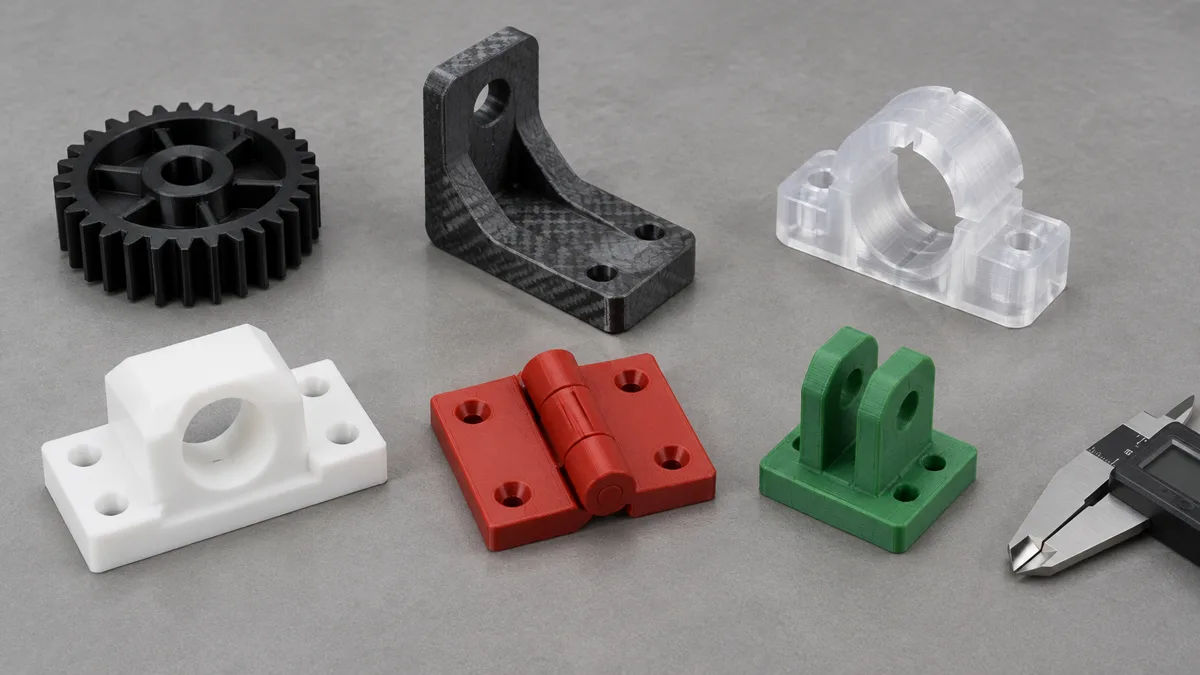
Quick Answer
There is no universally strongest 3D printer filament. Compare PC for toughness and heat, reinforced nylon for stiffness, unfilled nylon for wear and some flexibility, and ASA for outdoor durability. PETG and tough PLA are practical consumer-printer options. Grade, moisture, print orientation and test conditions can change the answer as much as the material name.
Basis of this comparison: manufacturer data sheets and technical documentation checked on November 25, 2026. We have not performed hands-on or independent laboratory testing. Recommendations are application-based judgments, not a ranked strength contest. Amazon US listing evidence exists for the named Amazon options; exact seller, stock and delivery are not guaranteed. No prices, ratings or load capacities are claimed.
Affiliate disclosure: As an Amazon Associate I earn from qualifying purchases. Amazon buttons on this page open Amazon search results for the product or material named on the button, not a specific listing, so check the exact product, price and seller before buying.
We may also earn from Polymaker links, which open its approved store destination. Amazon buttons beside them search a material category, not that exact Polymaker product.
TL;DR — Quick Summary
Buy for the failure mode, then check your printer.
- 1Open printer: Compare PETG and tough PLA for everyday work; neither is a universal winner.
- 2Rigid engineering fixture: Consider reinforced nylon, with conditioned Z/XY data and the drying workflow.
- 3Wear or flex: Compare unfilled nylon; fiber fill is not automatically better.
- 4Heat or sunlight: PC or ASA may fit, but HDT is not a continuous-use rating.
Strength comparison: what changes in real parts?
These are qualitative tendencies for documented material families, not measured ratings or a best-to-worst ranking. Each row's source-linked section gives the caveats. “High stiffness” means resistance to deflection, not high toughness. No family gets a universal layer-strength or creep score because grade, moisture, temperature and processing change the result.
Nylon: PA6, PA12 and blends
- Tensile
- Grade, moisture and orientation dependent
- Layer behavior
- Can bond well when dry and properly printed
- Impact
- Often a useful toughness option
- Stiffness
- Unfilled grades can flex; moisture lowers rigidity
- Heat
- Not uniformly high; check the exact grade and load
- Moisture
- High priority; PA family and formulation matter
- Hardware
- High-temperature hotend, suitable bed surface, drying; enclosure often useful
Carbon-fiber nylon: PA6-CF and PA12-CF
- Tensile
- Potentially high along printed roads; not universal
- Layer behavior
- Check Z data separately; fiber does not bridge all layers
- Impact
- Formulation and conditioning dependent
- Stiffness
- High in favorable orientation
- Heat
- Some high HDT figures require annealing
- Moisture
- PA6 remains sensitive; PA12 still needs dry handling
- Hardware
- Wear-resistant nozzle and drive path; documented temperature profile; drying equipment
Glass-fiber nylon: PA6-GF25
- Tensile
- Strong dry XY example; substantial wet/Z change
- Layer behavior
- Separate XY and Z values published
- Impact
- Wet sample toughness can rise as stiffness falls
- Stiffness
- High dry rigidity; not constant in service
- Heat
- HDT depends on test load and specimen treatment
- Moisture
- Dry spool and conditioned part are separate concerns
- Hardware
- Abrasive: wear-resistant nozzle; 280–300°C example; high-temperature drying
Polycarbonate (PC) and PC blends
- Tensile
- Often useful, but PC blends vary widely
- Layer behavior
- Sensitive to chamber, temperature and geometry
- Impact
- Tough grades worth comparing
- Stiffness
- Rigid without needing fiber fill
- Heat
- More margin than ordinary PLA/PETG; not unlimited
- Moisture
- Drying and dry storage matter
- Hardware
- Capable hotend/bed, enclosure; some grades and parts need heated chamber
PETG
- Tensile
- Useful, not universally above PLA or ABS
- Layer behavior
- Can bond well with suitable heat/flow/cooling
- Impact
- Often forgiving; not always above tough PLA
- Stiffness
- Some give; poor fit when deflection must be tiny
- Heat
- Moderate margin; hot cars can still be too much
- Moisture
- Dry when needed; not moisture-proof
- Hardware
- Ordinary heated-bed printer; unfilled PETG does not require hardened nozzle
ABS
- Tensile
- Not inherently higher than PLA/PETG
- Layer behavior
- Warps/cracks if the print environment is unsuitable
- Impact
- Useful for knocks in suitable formulations
- Stiffness
- Good practical rigidity
- Heat
- More margin than typical PLA/PETG; grade dependent
- Moisture
- Follow grade-specific storage/drying guidance
- Hardware
- Heated bed, draft control/enclosure, ventilation; unfilled grade not abrasive
ASA
- Tensile
- Grade dependent; no automatic win over ABS
- Layer behavior
- Needs thermal control like other warp-prone materials
- Impact
- Useful but formulation dependent
- Stiffness
- Suitable rigidity for many housings/brackets
- Heat
- Useful outdoor/warm-service margin; not a load rating
- Moisture
- Use maker storage/drying instructions
- Hardware
- Heated bed, enclosure/draft control, ventilation; unfilled ASA not abrasive
Tough PLA / PLA+
- Tensile
- May fall while toughness improves
- Layer behavior
- Often straightforward; formulation/profile dependent
- Impact
- Some modified grades improve substantially
- Stiffness
- Useful indoor rigidity; modifiers can change it
- Heat
- Most ordinary grades retain low PLA-like heat limits
- Moisture
- Dry storage useful; follow exact grade
- Hardware
- Consumer printer; no enclosure or abrasive nozzle for unfilled examples
For the day-to-day shopping shortlist, see best filament for functional parts. This page instead explains why different strength characteristics lead to different choices.
How do you compare manufacturer strength figures fairly?
What is Strength, stiffness and toughness?
Strength, stiffness and toughness describe different things: strength is resistance to yielding or breaking under stress, stiffness is resistance to elastic deflection, and toughness is energy absorbed before fracture. A stiff part can still break abruptly under a knock.
- Match the measurement: tensile strength is not flexural strength or modulus. Check whether tensile is measured at yield or break. ISO 527 and ASTM D638 use specified specimens and procedures; citing different methods without checking specimen details does not establish equivalence.
- Match orientation: XY usually describes loading within the printed layer plane, while Z evaluates a different orientation. Check the manufacturer's specimen drawing. A generic “strength” value without orientation is not evidence for your upright bracket.
- Match preparation: printed and injection-molded specimens differ. Annealed, dry and conditioned specimens differ. Match infill, walls, layer height, temperature, speed and cooling when the sheets disclose them.
- Match impact tests: notched versus unnotched Charpy and Izod results are not interchangeable, even when units look alike. A notch deliberately changes how fracture starts.
- Match heat tests: HDT at 0.45 MPa is not HDT at 1.8 MPa, glass transition, melting temperature or continuous-service temperature. Creep over months is not established by a brief HDT test.
A useful example: the same glass-filled nylon, different condition
Fiberon PA6-GF25 v1.1 reports mean ISO 527 tensile strength of 80.1 MPa XY and 60.7 MPa Z dry, versus 40.2 MPa XY and 26.3 MPa Z wet. Both specimen groups were annealed at 100°C for 16 hours; the wet group was then immersed at 60°C for 48 hours. These are condition-specific typical values, not allowable design stresses.
The same sheet's ISO 179 notched XY impact figure increases from 10.0 to 28.0 kJ/m² after that conditioning. Moisture can reduce stiffness and tensile strength while improving impact behavior. “Moisture makes nylon weaker” is therefore too vague; damp filament during printing and conditioned plastic during use are related but distinct issues.
Its ISO 75 HDT is 191°C at 0.45 MPa versus 157°C at 1.8 MPa. Neither figure means your bracket can carry its intended load continuously at that temperature. The source sheet explicitly warns that typical values are not design specifications.
Another easy trap: eSUN ePA's older sheet says its mechanical properties are from injection-molded specimens. We do not place its tensile number beside printed Fiberon XY data to declare a winner. Likewise, Polymaker's overview and Fiberon comparison can show different conditioning states; the underlying current data sheet and its notes take precedence.
Start here for wear surfaces and parts that need some give
Nylon: PA6, PA12 and blends
Nylon is a family, not a single spool. PA6, PA12, PA11 and copolymers have different moisture uptake, crystallization and mechanical behavior. Unfilled nylon is worth investigating for a gear, bushing or flexible mechanical clip because its wear behavior and ability to deform can be more useful than a high stiffness number. That is not a promise that every nylon beats every PETG or PLA in tensile strength.
PA6 is especially sensitive to moisture-induced changes. PA12 generally has lower moisture uptake than PA6, but a PA12 part is not moisture-proof; reinforcement and formulation still need their own conditioned data. Blends such as PA6/66 and PA612 deliberately change the balance. Check whether the maker identifies the base polymer; a product sold only as ‘nylon’ does not tell you enough to predict dimensional changes in a humid workshop.
The eSUN ePA sheet identifies a nylon 6/66 copolymer and recommends 250–290°C nozzle, 70–90°C bed, and drying at 70°C for more than 12 hours. Its mechanical figures come from injection-molded specimens, not a verified XY/Z printed-part comparison. The sheet is from 2021, and an Amazon listing shows a different extrusion range: use the current spool instructions or ask the maker rather than treating either range as universal. We include it as a documented wear-oriented example, not a tensile champion.
Printing unfilled nylon can involve warping, difficult bed adhesion and a damp spool by the end of a long job. Use a maker-approved build surface and dry feed path. An enclosure may help, but special low-warp grades can differ. For gears, also check backlash, tooth geometry, mating material, lubricant compatibility and expected temperature. A tough material alone cannot rescue an inaccurate gear profile.
Where it fits—and the mistake to avoid
Light-duty gears, bushings, sliding guides and flexing clips after fit and wear checks; not a load rating or safety certification.
Common mistake: Buying PA6 for a precision fit, measuring it immediately after drying, then assuming those dimensions and stiffness will stay unchanged in humid service.
Sources: Prusa polyamide/nylon guidance · eSUN ePA TDS v4.0 (November 2021; injection-molded mechanical figures) · Bambu Lab engineering-fiber filament guide (dry versus humid, hardware)
Opens Amazon.com search results for this product in a new tab, not a specific listing. Confirm the exact product name on the listing. Amazon affiliate link.
A stiffness-oriented upgrade, not an automatic toughness upgrade
Carbon-fiber nylon: PA6-CF and PA12-CF
A reinforced nylon bracket can hold its shape better than an unfilled nylon bracket of the same geometry. That is why chopped-carbon-fiber nylon is useful for fixtures and rigid mounts. It does not follow that the reinforced part will survive a harder drop, stretch farther, or resist a load pulling its layers apart. ‘Carbon fiber nylon strength’ needs a direction and a failure mode attached to it.
Polymaker Fiberon PA6-CF20 contains 20% carbon fiber; PA12-CF10 contains 10% in a different nylon base. The percentages are not a league table. Fiber length, bonding, polymer formulation, moisture and print conditions influence the result. PA12-CF is worth comparing when dimensional stability in changing humidity matters, but verify conditioned data rather than assuming a smaller moisture effect means no effect.
Fiberon's comparison specifies 280–300°C nozzles and 100°C for 10 hours of drying for PA6-CF20 and PA12-CF10, with an enclosure recommended rather than an actively heated chamber required. Its low-warp formulation is not permission to apply Bambu's or another maker's PA profile unchanged. Bambu's own PA6-CF guidance requires an enclosed compatible printer and uses different drying instructions. The exact brand and grade decide the workflow.
Keep annealing in the plan if you are relying on annealed manufacturer figures. It can change dimensions, so leave tolerance allowance and remeasure after the part reaches its intended moisture condition. This is a process commitment: a hardened nozzle, high-temperature dryer, calibrated profile and inspection can cost more effort than the filament itself. For an indoor tool organizer, that effort is usually unnecessary.
Where it fits—and the mistake to avoid
Rigid jigs, fixtures and non-safety-critical mounts on a validated process; compare unfilled nylon for contacting wear surfaces.
Common mistake: Using a dry, annealed XY number to justify an unannealed Z-loaded bracket in a humid room.
Sources: Fiberon PA6-CF20 manufacturer documentation · Fiberon material comparison and hardware guidance · Bambu Lab engineering-fiber filament guide (dry versus humid, hardware) · Prusa composite-material guidance
Another reinforced option with a useful dry/wet data sheet
Glass-fiber nylon: PA6-GF25
Glass fiber can reinforce nylon too. It deserves a place in the shortlist when the goal is stiffness and thermal performance, not just the carbon-fiber look. A glass-filled grade is still abrasive and still governed by its nylon base. Do not buy it expecting to avoid nozzle wear, moisture conditioning or the directional behavior of an FDM print.
Fiberon PA6-GF25 is especially useful as a teaching example because its v1.1 sheet publishes dry and wet XY/Z results with preparation notes. Both groups were annealed at 100°C for 16 hours. The wet samples were then immersed at 60°C for 48 hours, reaching average moisture content of 4.57%. That is a defined laboratory condition, not a prediction of how much water your garage part will absorb overnight.
The sheet recommends 280–300°C nozzle, 40–50°C bed, room-temperature chamber, fan off, drying at 100°C for 10 hours and annealing at 100°C for 16 hours. Its specialized low-warp process explains the unusually low bed temperature. Do not ‘correct’ it to a generic nylon profile. Confirm your build surface and spool tolerate the process, and do not confuse the annealing schedule for the finished part with the drying schedule for the spool.
Where it fits—and the mistake to avoid
Stiff tooling and noncritical engineering fixtures when conditioned dimensions, process and load direction have been checked.
Common mistake: Assuming glass fiber is nonabrasive or that a 70°C household filament dryer meets a 100°C drying instruction.
Sources: Fiberon PA6-GF25 TDS v1.1 (dry/wet, XY/Z, specimen preparation) · Fiberon material comparison and hardware guidance
Compare for tougher warm-service parts on suitably equipped printers
Polycarbonate (PC) and PC blends
A documented tough PC grade is a serious candidate when a part needs impact tolerance and more heat margin than ordinary PLA or PETG; the PC label alone proves neither. Compare a tough PC formulation for a machine cover or impact-prone warm fixture rather than assuming carbon-fiber nylon is the answer. Pure PC, easier-printing PC blends and PC-ABS are not interchangeable; their print requirements and failure behavior differ.
PolyMax PC is a documented example, not a claim that every PC spool behaves alike. Polymaker's current US page specifies 250–270°C nozzle and 90–105°C bed, drying at 75°C for 6 hours when moisture has been absorbed, and annealing at 90°C for 2 hours. It requires a heat-trapping enclosure, highly recommends an actively heated chamber of at least 70°C, and says large, dense parts require a heated chamber. A passive enclosure with a 270°C nozzle is therefore not automatically a complete setup.
The manufacturer's overview lists PolyMax PC HDT of 114°C at 0.45 MPa. That is a specific deflection test, not a continuous-use rating for a bolted bracket. The US store source showed conflicting availability messages across variants, so no stock claim is made. Check the exact 1.75mm variant; the page says 2.85mm filament is being discontinued. This option is for readers prepared to verify the material and printer together.
Where it fits—and the mistake to avoid
Impact-prone warm fixtures and technical housings, subject to chemical, geometry and long-term load validation.
Common mistake: Buying an ‘easy PC’ spool based only on nozzle temperature while ignoring chamber and part-size requirements.
Sources: PolyMax PC current US manufacturer page and printing requirements · Polymaker technical data at a glance (product-specific, some annealed) · Prusa filament material guide (printer-profile-specific settings)
The practical open-printer starting point for many everyday parts
PETG
For a utility clip, damp-area holder or noncritical bracket on an open printer, PETG is often the sensible first spool. It generally offers low warping and some willingness to bend without demanding a high-temperature engineering setup. That convenience is its advantage. Calling it ‘the strongest practical filament’ hides too many exceptions.
A PETG part can deflect or creep even when it does not break. If your fixture must hold a precise angle, a stiffer material or thicker geometry may matter more than impact resistance. PETG is not automatically the impact winner either: impact-modified PLA and PETG products vary substantially. Compare the exact grade rather than reusing generic internet numbers.
Prusa's guide shows PETG profiles spanning 215–270°C nozzle and 70–90°C bed; those are guide/profile ranges, not instructions for every eSUN or Polymaker spool. PETG can grip smooth PEI or glass too strongly, so use the surface maker's release-layer guidance. Its higher heat margin than typical PLA does not make a dashboard mount or under-hood clip safe. ASA or PC may be more relevant after checking actual service conditions.
Where it fits—and the mistake to avoid
Everyday holders, clips, prototypes and moderate-duty brackets where some flexibility is acceptable.
Common mistake: Assuming PETG cannot soften in a hot vehicle or that low warping means an opened spool never needs drying.
Sources: Prusa filament material guide (printer-profile-specific settings) · Polymaker technical data at a glance (product-specific, some annealed)
Opens Amazon.com search results for this product in a new tab, not a specific listing. Confirm the exact product name on the listing. Amazon affiliate link.
A warm-service indoor option, not a universal tensile upgrade
ABS
ABS still makes sense for indoor housings and parts where warmth and knocks matter. It should not be presented as the strongest material merely because it is harder to print. A material can have lower tensile strength than PLA yet better impact behavior and a higher heat-deflection temperature. Those are different advantages.
The tradeoff is process control. Warping and layer cracks can erase the theoretical advantage of the material. Prusa's reference ABS profiles use 230–255°C nozzle and 95–110°C bed with an enclosure recommended; other brands publish different ranges. The HATCHBOX ABS shopping option is an established unfilled example, not a claim that the Prusa profile is its required setting.
For long outdoor exposure, compare ASA rather than assuming ABS is weatherproof. Provide ventilation and consult the material SDS; trapping heat is not the same as controlling emissions. Do not solve warping by sealing a printer into an unsafe improvised heated box.
Where it fits—and the mistake to avoid
Indoor covers, housings and warm mechanical prototypes on an appropriate enclosed, ventilated setup.
Common mistake: Treating ‘harder to print’ as evidence of higher strength, or using ABS outside without checking UV behavior.
Sources: Prusa filament material guide (printer-profile-specific settings) · Polymaker technical data at a glance (product-specific, some annealed)
Opens Amazon.com search results for this product in a new tab, not a specific listing. Confirm the exact product name on the listing. Amazon affiliate link.
The first family to compare for outdoor mechanical parts
ASA
For a bracket or equipment cover that stays outdoors, ASA earns attention because of UV and weather resistance, not because it wins every mechanical test. A sunny part needs to keep its properties over time. Choosing an impressive dry tensile number while ignoring sunlight and temperature is the wrong comparison.
Prusa's ASA guide profiles use 220–275°C nozzle and 90–110°C bed, with enclosure recommended. Treat these as context and use your exact filament's instructions. Large flat parts are more demanding than a small clip. Published HDT is not a guarantee that a heavily tightened mount will stay straight during years of summer heat.
eSUN ASA is an Amazon-listed example; its search button does not guarantee that a seller has the same grade or color you researched. For a deeper ABS-versus-ASA decision, use the linked comparison guide rather than duplicating its outdoor analysis here. Neither material makes a printed automotive structural part suitable for road use without appropriate engineering validation.
Where it fits—and the mistake to avoid
Noncritical outdoor mechanical housings, sensor mounts and brackets after orientation and temperature checks.
Common mistake: Choosing ASA as a blanket ‘strongest’ upgrade instead of paying for it because outdoor durability is the actual requirement.
Sources: Prusa filament material guide (printer-profile-specific settings) · Polymaker technical data at a glance (product-specific, some annealed)
Opens Amazon.com search results for this product in a new tab, not a specific listing. Confirm the exact product name on the listing. Amazon affiliate link.
A useful indoor option when easy printing and stiffness count
Tough PLA / PLA+
An impact-modified PLA is a reasonable starting point for a room-temperature jig, tool holder or fixture that must print cleanly, provided its deflection and long-term creep suit the load. ‘PLA+’ is not a standardized recipe. Some formulations emphasize toughness, some print speed, and some surface finish. The plus sign does not establish impact strength, creep resistance or heat performance.
PolyMax PLA's v5.5 sheet publishes XY and Z tensile data using ISO 527, impact using ISO 179, and HDT using ISO 75. Its recommended nozzle range is 190–230°C, bed 25–60°C, no enclosure, and drying at 55°C for 6 hours. The 0.45 MPa HDT is 55°C. That is a useful reminder: improved impact behavior does not remove the low heat limit of an ordinary tough PLA.
The eSUN PLA+ button offers another documented product line to compare, not an assurance that it matches PolyMax. For a stiff indoor fixture, start with geometry and the exact sheet. For repeated flexing, sustained load near heat or an outdoor mount, look beyond a generic tough-PLA recommendation. Annealable HT-PLA is a separate workflow, not a hidden property of every PLA+ spool.
Where it fits—and the mistake to avoid
Indoor fixtures, jigs and moderate-duty tool holders away from heat; evaluate creep under sustained loading.
Common mistake: Assuming impact modifiers or a PLA+ label make a material heat-resistant enough for a vehicle interior.
Sources: PolyMax PLA TDS v5.5 (January 6, 2026) · Polymaker technical data at a glance (product-specific, some annealed)
Opens Amazon.com search results for this product in a new tab, not a specific listing. Confirm the exact product name on the listing. Amazon affiliate link.
Which material fits your part's job?
Use these as starting points for noncritical designs, not a substitute for checking a real load and service environment. Budget matters too: include failed prints, drying, nozzles and post-processing rather than comparing spool cost alone.
- Functional brackets
Start by comparing: PETG or tough PLA for modest cool indoor work; PC or reinforced nylon for more demanding conditions.
Deflection, load direction and creep matter. Add fillets and local fastener support before changing material.
- Load-bearing parts
Start by comparing: A validated material/process, not a shopping-list winner.
Use expected load, environment, service life and a suitable safety margin. Do not use this article as a load rating.
- Impact-resistant components
Start by comparing: Compare tough PC, unfilled nylon and documented impact-modified PLA.
Match notched/unnotched test and orientation. More stiffness is not automatically more impact tolerance.
- Automotive interior parts
Start by comparing: Compare ASA, PC or a documented heat-capable engineering grade.
Measure service temperature and consider sustained fastening loads; no structural, crash, pedal or restraint parts.
- Outdoor mechanical parts
Start by comparing: ASA as the first family to compare.
UV/weather retention, creep, water and temperature matter alongside initial strength; link to the ABS/ASA guide below.
- Gears and moving components
Start by comparing: Unfilled nylon worth investigating; reinforced grades only with wear evidence.
Check tooth accuracy, mating surface, lubrication and conditioned dimensions; fibers can change wear of the opposing surface.
- Parts needing stiffness
Start by comparing: Reinforced nylon, PC, or cool-service stiff PLA depending on hardware.
A thicker section can outperform a premium spool. Check XY/Z modulus rather than relying on feel.
- Parts requiring some flexibility
Start by comparing: Unfilled nylon or PETG for limited give; TPU or PP for a deliberately flexible design.
Flexibility depends on geometry and grade; a repeatedly bending hinge needs fatigue evidence, not just elongation at break.
- Everyday functional prints
Start by comparing: PETG or documented tough PLA.
Choose ease and repeatability when the job does not justify engineering materials. Keep heat and creep limits in view.
- Engineering parts on capable printers
Start by comparing: PC, PA-CF/GF, PET-CF, PPA-CF or PPS-CF as the application warrants.
Verify full temperature, drying, annealing and moisture workflow. Specialty labels do not confer certification.
For outdoor tradeoffs, see ABS vs ASA. For selecting a nylon spool, see the nylon buying guide.
Why carbon fiber can increase stiffness without improving toughness
Desktop fiber-filled filament normally contains chopped fibers, not continuous reinforcement spanning your whole part. Fibers tend to orient with the flow through the nozzle, producing useful reinforcement along deposited roads. Layer interfaces still have to bond. Filling the polymer does not turn an FDM bracket into a continuous-fiber composite.
A formulation may trade stretch and impact absorption for reduced deflection. The fiber/polymer interface, fiber loading and printing conditions influence how cracks propagate. Prusa's composite guidance describes common reductions in Charpy impact resistance and layer-to-layer adhesion; that is a tendency, not proof that every reinforced product performs worse. Use the exact grade's matched data.
Carbon-fiber PLA keeps a PLA base; carbon-fiber PETG keeps a PETG base. The label does not erase heat limits. See what CF-PLA actually changes before treating a matte surface as evidence of engineering performance.
Print orientation and layer adhesion can decide the outcome
A tall upright hook loaded across its layer interfaces is not the same part mechanically as a hook laid flat with continuous roads following its curve. Where possible, place the main tensile load within the layer plane instead of peeling layers apart. Real brackets have mixed bending and shear loads; do not reduce orientation to a slogan that applies to every shape.
- Build useful walls: perimeters and solid areas around bolts contribute directly to the load path. Add local thickness and broad fillets rather than assuming dense infill fixes thin fastener bosses.
- Use infill deliberately: pattern, density and connection to the shell affect stiffness and weight. There is no universal wall/infill recipe that guarantees strength.
- Stay within melt capacity: a high speed setting can outrun the hotend and reduce bonding. Tune temperature, volumetric flow and cooling inside the manufacturer's limits.
- Inspect the actual part: gaps, under-extrusion, warping and visible separation are reasons to stop and correct the process, not to buy a more expensive spool.
- Plan for fasteners: do not overtighten against thin plastic. Washers and supported bosses can spread load; inserts require correct hole design and installation.
For a closer two-material decision, read Tough PLA vs PETG for functional parts. For basic printability tradeoffs, use PLA vs PETG.
What is the strongest filament for an ordinary open printer?
The useful question is what you can print repeatably for your part. For an unmodified brass-nozzle printer, compare unfilled PETG and a documented tough PLA. A cool indoor alignment jig can favor easy-printing PLA-based stiffness; a utility clip that needs some give can favor PETG. Both have limits around heat, sustained load and repeated flex.
Do not jump to nylon or PC just because the machine's maximum nozzle setting appears high enough. Check the bed surface, permitted continuous hotend temperature, extrusion path, drying and enclosure guidance. Some specialty low-warp composites can print without active chamber heating, but they still need compatible abrasive hardware and the documented process. Beginner-friendly does not mean strong enough for every job.
What changes on an enclosed engineering printer?
An engineering workflow needs a rated hotend and bed, chamber conditions suitable for the exact material, wear-resistant hardware when filled, reliable feeding from dry storage, and repeatable calibration. Passive enclosure and actively heated chamber are different capabilities. Confirm that motors, electronics, belts and surrounding parts are rated for the intended chamber temperature; do not retrofit heat on guesswork.
Other relevant materials: PET-CF, PPA-CF, PPS-CF, PP and TPU
PET-CF—not PETG-CF—can be worth comparing where rigidity and humidity stability matter. Bambu's documentation reports a smaller dry-to-humid flexural change for its PET-CF than its PA6-CF; this is evidence about those grades, not every polyester versus nylon. PPA-CF and PPS-CF can suit specialized heat or chemical requirements, but require the exact printer and processing capabilities. Fiberon's PPS-CF10 comparison specifies 310–350°C nozzle and annealing, beyond many consumer machines.
PP is worth investigating for deliberately flexing parts and chemical exposure, but bed adhesion and warping can complicate printing. TPU suits bumpers, grips and compliant parts, not a fixture that must stay rigid. A high elongation result does not establish fatigue life. PEEK and PEI belong to a more demanding industrial process; an expensive spool does not turn an ordinary enclosed printer into one that can process them reliably.
These are relevant families, not extra shopping recommendations. No exact product button is added where this guide has not established a useful documented match. See enclosed printer capabilities before assuming a box around the machine is enough.
Dry the spool; understand the conditioned finished part
Drying helps prevent moisture-related extrusion defects. It does not permanently stop a nylon part absorbing water in service. Design around the moisture state the finished part will actually reach. Conditioned dimensions, stiffness and toughness can differ from freshly dry measurements.
Use the exact product's drying temperature and time, and check both the dryer and spool ratings. Fiberon PA6-GF25 specifies 100°C for 10 hours. PolyMax PC's page specifies 75°C for 6 hours when damp; PolyMax PLA specifies 55°C for 6 hours. Those examples show why a single “nylon/PC” preset is not enough.
A useful dryer—but not a high-temperature nylon solution
The SUNLU FilaDryer S4 holds up to four 1kg spools and its maker lists a 70°C maximum. It is an option for spools whose documented schedule fits that limit, not a solution for the 100°C Fiberon schedule or the cited 75°C PC schedule. More time at a lower temperature is not automatically equivalent. Check the exact instructions, maintain a dry feed path and use the dryer guide to compare capabilities.
Opens Amazon.com search results for this product in a new tab, not a specific listing. Confirm the exact product name on the listing. Amazon affiliate link.
Keep dried spools sealed with suitable desiccant. Do not use a food oven for material processing. A purpose-rated drying or annealing setup needs temperature control and appropriate ventilation; annealing may distort parts. Follow the manufacturer's instructions rather than transferring a schedule from a different polymer.
Hardened nozzles: check the complete abrasive-filament path
Carbon and glass fibers are abrasive. Use the filament maker's wear-resistant nozzle recommendation and confirm drive gears and the feed path tolerate abrasion. Minimum nozzle diameter is product-specific; a larger opening can reduce clogging but changes detail and profile requirements. Do not assume every composite is compatible with a multi-material feeder.
E3D Nozzle X is a documented wear-resistant option for compatible E3D systems, not a universal replacement. V6 and Volcano versions have different geometry; neither is automatically a fit for a proprietary integrated hotend. Check thread, length, sealing surface and the complete assembly. Recalibrate the print profile after a nozzle change rather than applying a fixed temperature increase to every hardened nozzle.
Opens Amazon.com search results for this product in a new tab, not a specific listing. Confirm the exact product name on the listing. Amazon affiliate link.
See the wear-resistant nozzle guide for compatibility decisions. Handle and sand filled parts with suitable protection per the maker's safety guidance. An enclosure controls drafts; it is not proof that particles or vapors are safely controlled. Read the material SDS and ventilation guidance.
Common buying mistakes that make this decision worse
- Ranking incompatible numbers: an injection-molded tensile result and a printed Z result do not belong in a winner table.
- Ignoring creep: a part that survives a short pull test can sag under a smaller permanent load. Heat accelerates the problem.
- Buying stiffness for a flexing job: a rigid composite can be the wrong choice for a snap fit that must bend repeatedly.
- Buying a spool before checking equipment: nozzle, bed, chamber, dryer and annealing requirements are part of the purchase.
- Confusing HDT with a service rating: laboratory load, specimen treatment and test duration matter.
- Treating brand names as certifications: no filament name makes an unvalidated design safe for lifting, climbing, structural automotive or regulated use.
Frequently asked questions
What is the strongest 3D printer filament?
There is no universal winner. Compare PC for toughness and heat, reinforced nylon for stiffness-oriented engineering parts, unfilled nylon for wear and flexibility, and ASA for outdoor exposure. PETG and tough PLA are convenient options for many ordinary printers, not the strongest in every mechanical property.
Is nylon stronger than polycarbonate filament?
Not in every sense. The specific grades, moisture condition, annealing and print direction decide the comparison. Nylon is useful for wear surfaces and some flexing parts; a tough PC formulation can suit impact-prone warm fixtures. Compare matched tensile, impact and heat tests instead of one headline number.
Does carbon fiber nylon always have better layer strength?
No. Short fibers can improve stiffness along deposited roads without producing the same gain between layers. Check the exact product's Z tensile or interlayer data, moisture condition and specimen preparation. Neither carbon fiber content nor a high XY number proves that a Z-loaded part will be stronger.
What is the strongest filament for an ordinary open printer?
For many everyday functional parts, start by comparing unfilled PETG with a documented tough PLA. Pick PETG when some give and moderate heat margin help; consider tough PLA for cool indoor fixtures with easy printing. Neither is a universal strength winner, and neither removes creep or hot-car limitations.
What is the strongest filament for gears?
Unfilled nylon is often worth comparing because wear behavior and some flexibility matter for gears. There is no universal gear winner: check load, speed, tooth geometry, mating material, lubricant compatibility, temperature and moisture-driven dimensional changes. Reinforced nylon is not automatically better at a contacting wear surface.
Is PETG stronger than ABS?
It depends on the grade and the test. PETG may have higher tensile strength in a particular comparison while ABS offers better impact or heat performance. An ABS part with poor layer adhesion can perform worse than a well-printed PETG part. Use compatible test conditions and the failure mode that matters.
Can a 70°C filament dryer dry every nylon?
No. Some nylon grades specify higher drying temperatures. Fiberon PA6-GF25, for example, specifies 100°C for 10 hours; a dryer limited to 70°C cannot reproduce that instruction. Follow the exact spool's schedule, dryer rating and spool temperature limit rather than extending time and assuming equivalence.
Does more infill make a part safe to carry a heavy load?
No. Infill is only one variable. Geometry, walls, print orientation, layer bonding, moisture, temperature and creep all affect capacity. A filament data sheet does not provide a load rating for your design. Safety-critical or load-rated parts need appropriate engineering validation and a controlled manufacturing process.
The practical conclusion: choose the property you actually need
On an ordinary printer, start with PETG or a documented tough PLA for modest functional work. For a wear surface, compare unfilled nylon and its conditioned dimensions. For rigidity, consider reinforced nylon or PC only if your process can reproduce useful results. For outdoor exposure, compare ASA. Heat, impact and creep still need separate checks.
The best purchase is not the spool with the highest isolated number. It is a material you can process correctly whose relevant properties match the part's job. Specify the load direction, temperature, humidity and expected service life first; then choose the spool and printing workflow. If failure could injure someone, move beyond shopping advice to appropriate engineering validation.
Manufacturer and technical sources
Checked November 25, 2026. Source dates and versions differ; older sheets are identified rather than passed off as new laboratory evidence. Use the current exact-grade documentation before a purchase.
- Polymaker technical data at a glance (product-specific, some annealed)
- Fiberon PA6-GF25 TDS v1.1 (dry/wet, XY/Z, specimen preparation)
- Fiberon PA6-CF20 manufacturer documentation
- Fiberon material comparison and hardware guidance
- PolyMax PLA TDS v5.5 (January 6, 2026)
- PolyMax PC current US manufacturer page and printing requirements
- Prusa filament material guide (printer-profile-specific settings)
- Prusa polyamide/nylon guidance
- Prusa composite-material guidance
- Bambu Lab engineering-fiber filament guide (dry versus humid, hardware)
- eSUN ePA TDS v4.0 (November 2021; injection-molded mechanical figures)
- E3D V6 Nozzle X manufacturer material and compatibility details
- SUNLU FilaDryer S4 manufacturer specifications