ABS vs ASA Filament: Which Is Better for 3D Printing? (2026)
By Chris Avery, Publisher / Editor
ASA is ABS with the weak spot for sunlight engineered out. ABS gets its toughness from butadiene rubber, and that rubber oxidizes in UV light, which is why ABS left outside yellows and turns brittle. ASA swaps it for an acrylic rubber that holds up much better outdoors.
At the printer, you'd struggle to tell them apart: similar temperatures, the same tendency to warp and the same need for an enclosure and real ventilation. So the useful question isn't which plastic is better. It's where the part is going to live.
Quick Answer: ABS or ASA?
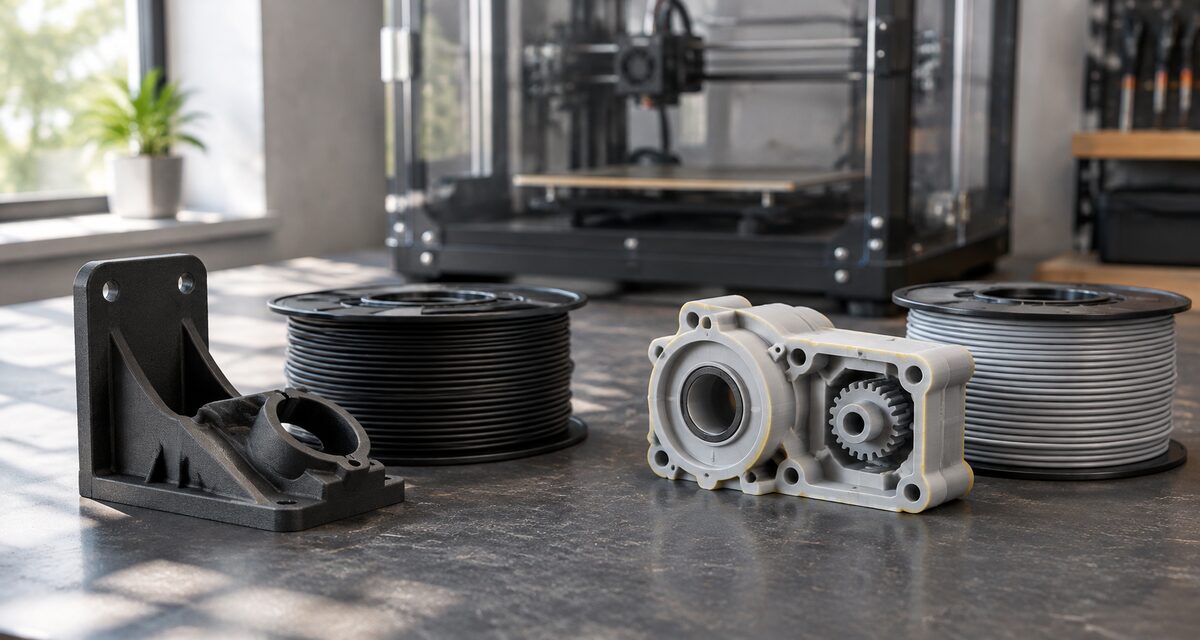
Choose ASA for anything that will sit in sunlight or weather. It's made to resist UV, and on makers' data sheets it matches or beats ABS on heat resistance. ABS still makes sense for indoor functional parts, especially if it's the spool you already own or the part needs to flex before it breaks. Both need an enclosure and proper ventilation.
How this comparison was put together: we compared manufacturer data sheets and print guides from Polymaker, Prusa and Bambu Lab with published research on weathering and printer emissions, listed at the end. We did not run our own lab tests. The shopping section links to Polymaker and Amazon, and we may earn a commission from those links.
ABS vs ASA Comparison Table
Plain-language ratings rather than scores. Where a number appears later in the article, it names the maker and the test, because ABS and ASA from different brands can differ more than ABS and ASA from the same brand.
UV resistance
ABS: Poor. Sunlight attacks its butadiene rubber, so outdoor parts yellow and turn brittle over time
ASA: Good. The rubber that fails in ABS is replaced with an acrylic rubber that resists UV far better
Outdoor use
ABS: Shaded or short-term only, or painted
ASA: The default choice among common filaments for sun and weather
Heat resistance
ABS: High, and similar to ASA on some data sheets, lower on others
ASA: High; equal to or above ABS on the makers' sheets we checked
Strength and toughness
ABS: Behind ASA on flat strength in makers' data; some ABS stretches much further before breaking
ASA: Ahead on flat tensile or bending strength in Polymaker's and Bambu Lab's data
Layer adhesion
ABS: Better across layers in Bambu Lab's impact data
ASA: Weaker across layers in Bambu Lab's data; slightly ahead in Polymaker's
Warping
ABS: High
ASA: High; Prusa says slightly less than ABS, Bambu Lab says about the same
Printing difficulty
ABS: Moderate to hard
ASA: Moderate to hard; essentially the same process
Enclosure
ABS: Needed for anything beyond small parts
ASA: Needed for anything beyond small parts
Ventilation
ABS: Plan for it; styrene is the main VOC
ASA: Plan for it; styrene is still the main VOC, though lower in one study
Surface finish
ABS: Depends on the brand; sands well and smooths with acetone
ASA: Depends on the brand; sands well and smooths with acetone
Typical uses
ABS: Indoor brackets, jigs, printer parts, electronics housings, clips
ASA: Outdoor mounts, garden parts, car exterior trim, signs, outdoor housings
Relative cost
ABS: Often close to ASA from the same brand; the more widely stocked of the two
ASA: Often close to ABS from the same brand; check per-kilogram prices
What Is ABS Filament?
ABS (acrylonitrile butadiene styrene) is the plastic in LEGO bricks, power-tool housings and a lot of car interior trim. For years it was the hobby printer's only real step up from PLA, and it's still a sensible material for parts that need to take heat and knocks indoors.
What it does well: it's tough, it handles far more heat than PLA or PETG, it sands and drills cleanly, it glues and smooths with acetone, and almost every filament brand sells it. Prusa describes it as a material for "mechanically stressed parts."
What it does badly: it warps, it smells, and it doesn't like the sun. Prusa notes that ABS parts used outdoors turn yellowish and more brittle over time. The fumes are the bigger day-to-day issue: printing ABS releases styrene and large numbers of ultrafine particles, so it isn't something to run on a desk in the living room.
Not all ABS is the same, either. Polymaker makes PolyLite ABS from a bulk-polymerized resin that it says has significantly lower volatile content than traditional ABS, and other brands sell "ABS+" blends with their own settings. Read the label on the spool you actually bought.
Settled on ABS?
Our ABS filament guide compares brands, settings and the printer setup ABS needs.
What Is ASA Filament?
ASA (acrylonitrile styrene acrylate) was developed in the late 1950s for one reason: to fix ABS's weakness in sunlight by replacing butadiene with more UV-resistant acrylate. It keeps most of what makes ABS useful, the toughness, heat resistance and easy finishing, and adds much better resistance to fading, yellowing and surface breakdown outdoors.
Polymaker says its PolyLite ASA has the same mechanical and thermal properties as PolyLite ABS with the ability to resist sunlight and weather. Bambu Lab describes the pair the same way: almost the same strength, toughness and stiffness, with ASA resisting fading and yellowing.
The drawbacks are the ABS drawbacks. ASA warps, needs a hot bed and an enclosure, and still gives off fumes. Both Prusa and Bambu Lab say the smell is milder than ABS. That makes it more pleasant to print, but read the safety section below before you take it as a sign the air is cleaner.
Settled on ASA?
Our ASA filament guide compares five ASA spools by documented settings, enclosure needs and finish.
Strength and Durability: ABS vs ASA
People asking which one is stronger usually want a one-word answer, and there isn't one. Strength is several different properties, and the two materials trade places depending on which one you measure. The figures below are from manufacturer data sheets, each measured on printed bars the maker's own way.
Tensile and bending strength
ASA comes out ahead on both makers' sheets, by a little or by a fair margin depending on the brand. Bambu Lab's published comparison lists 65 MPa bending strength for its ASA against 62 MPa for its ABS, a near tie. Polymaker's data sheets show a bigger gap in tensile strength printed flat, even though its product page calls the two mechanically the same: 43.8 MPa for its ASA against 33.4 MPa for PolyLite ABS. Wall count, infill and print orientation can still move a real part's strength more than that.
Impact resistance and flexibility
Bambu Lab lists 41.0 kJ/m² impact strength for its ASA and 39.3 kJ/m² for its ABS on bars printed flat, which is a near tie. Polymaker's data points the other way on flexibility: its PolyLite ABS sheet lists about 18% elongation at break, while its ASA documents list roughly 4–7%. In practice that suggests the ABS gives a little before it snaps, which matters for clips, living hinges and snap-fits.
Layer adhesion
This is where ABS has its clearest win in published data. Bambu Lab's impact test across the layers (the Z direction) gives 7.4 kJ/m² for ABS and 4.9 kJ/m² for ASA. Polymaker's Z-direction tensile figures are close, with its ASA slightly ahead (32 vs 29.7 MPa). Either way, the weakest direction of any FDM part is between layers, so if a bracket will be pulled or levered, orient it so the load runs along the layers, not across them.
Heat resistance
What is Heat Deflection Temperature (HDT)?
Heat Deflection Temperature (HDT) The temperature at which a standard test bar bends by a set amount under a set load. Data sheets usually give it at 0.45 MPa (light load) or 1.8 MPa (heavier load), so only compare HDT figures measured at the same load.
Both handle far more heat than PLA or PETG, and on the data sheets ASA comes out equal or ahead. Polymaker lists heat deflection at 1.8 MPa of 100°C for its ASA and 98°C for PolyLite ABS, which is a tie for practical purposes. Bambu Lab's numbers at 0.45 MPa show a real gap: 100°C for ASA and 87°C for ABS. Prusa rates ASA's temperature resistance at up to 93°C. None of these figures mean a part will hold its shape under load at that temperature, so leave a margin.
Long-term outdoor durability
Here the materials stop being close, because data sheet numbers describe a fresh part. Researchers at CSIRO traced ABS's UV damage to the surface layer and found that brittle fracture occurs once that surface damage reaches a critical depth. So an ABS part can test nearly as strong as an ASA part on day one and be the one that cracks in its second summer.
UV and Weather Resistance
Sun and weather are where the two really split. Bambu Lab markets its ASA for long-term outdoor use and names plant signs, mailboxes and wind vanes as typical prints. Prusa calls ASA suitable for outdoor use and lists ABS's lack of UV resistance as one of its main drawbacks.
Where that difference shows up:
- Outdoor brackets: camera mounts, light fixtures, fence and gutter clips. They carry a load and sit in the sun, the combination that cracks degraded ABS.
- Garden equipment parts: hose guides, sprinkler adapters, tool hangers and plant labels that stay out all year.
- Car exterior accessories: trim pieces, mirror caps and badge backings, where yellowing would be obvious and the part runs hot in the sun.
- Outdoor electronics enclosures: boxes for sensors, a weather station or a doorbell camera. ASA keeps its color and surface; you still need a gasket, a drain hole and a design that keeps water off the electronics.
ASA is not indestructible outdoors. In a 2022 Polymer Testing study of commercial plastics used in cars, ABS and ASA both degraded faster than acrylic (PMMA) over a year outdoors, and weathered samples stretched less before breaking. Color matters too: pigments and stabilizers differ by brand and color, and a dark part in direct sun gets much hotter than a light one. Treat ASA as a material that lasts much longer outside than ABS, not one that lasts forever, and inspect anything load-bearing each season.
No enclosure yet?
PETG prints on an open printer and handles moderate outdoor use where heat and constant sun are limited. Our PETG guide covers when that's enough.
Printing ABS vs ASA: Settings and Setup
If your printer handles one, it'll handle the other. The recommended settings differ by only a few degrees, and the bigger differences are between brands. These are the published starting points from three makers. Use the numbers on your own spool's label or data sheet first; they take priority over anything here.
Polymaker PolyLite ABS
Nozzle: 245–265°C
Bed: 90–100°C
Part fan: Off
Enclosure: Data sheet: closed chamber needed
Polymaker PolyLite ASA
Nozzle: 240–260°C
Bed: 75–95°C
Part fan: Off
Enclosure: Recommended to prevent warping
Prusa ABS profile
Nozzle: 255°C
Bed: 100°C (80–110°C by part size)
Part fan: Not listed
Enclosure: Listed as a requirement
Prusa ASA profile
Nozzle: 260°C
Bed: 105°C first layer, 110°C after
Part fan: Not listed
Enclosure: Higher ambient temperature needed
Bambu Lab ASA
Nozzle: 240–270°C
Bed: 80–100°C
Part fan: 0–80% by printer
Enclosure: Enclosed printer required; 45–60°C chamber
Sources: Polymaker PolyLite ABS and ASA data sheets and product pages, Prusa Knowledge Base ABS and ASA articles, Bambu Lab ASA technical data sheet. Checked November 24, 2026.
Temperatures
If a spool arrives with nothing useful on the label, about 250°C at the nozzle and 95–100°C on the bed sits inside every range above and is a reasonable first try for either material. Print a small temperature tower from there. Too cold often shows up later as layers that split, not as a failed print.
Enclosure and warping
Warping is the main fight with both. As the part cools, upper layers shrink and pull the corners off the bed or split the part partway up. Prusa's enclosure guide puts ABS and ASA on its list of filaments that may need one, and Polymaker's ABS data sheet says outright that a closed chamber is needed. Close the door, let the heated bed warm the enclosure before a large part starts, and resist opening it mid-print to check. Bambu Lab's usage guide has a whole section on raising chamber temperature for these materials, a reminder that the air around the part matters as much as the bed.
Shopping for an enclosed printer?
Our enclosed printer guide explains passive vs heated chambers and which printers suit regular ABS and ASA.
Bed adhesion
Polymaker recommends textured PEI or a PC surface for both materials. Prusa recommends smooth or powder-coated PEI with a glue stick, which also acts as a release layer so the part doesn't bond too hard. Add a brim to parts with sharp corners, and round those corners in the design if you can; a radius warps less than a point.
Cooling
Polymaker lists the part fan as off for both. Bambu Lab's ASA profile allows up to 80% depending on the printer model, so "fan off" isn't a universal rule. On a typical enclosed printer, start with the fan off or very low, and only bring a little in for bridges and overhangs.
Drying and storage
Neither is as moisture-hungry as nylon, but both pick up some water. Polymaker suggests drying either at 70°C for 6 hours, only if the spool has absorbed moisture; Bambu Lab gives 80°C for 8 hours in a drying oven for its ASA. Popping, fuzzy surfaces or stringing on a spool that used to print cleanly are the usual signs. Store opened spools sealed with desiccant.
Fumes, Safety and Ventilation
Both materials release ultrafine particles and volatile organic compounds while they print, and styrene is the main one for both. A 2016 chamber study of desktop printers found that particle emissions varied mainly by filament material, with ABS among the styrene emitters. A smaller 2022 study comparing four filaments found ASA's styrene emission was less than a quarter of ABS's under its test conditions, though ASA's mix of compounds was otherwise similar. That's one study with one filament of each, so treat ASA as somewhat lower, not as safe.
An enclosure helps, but it doesn't make printing safe by itself. It holds the fumes in one place, and they come out when you open the door or through any gap. UL's Chemical Insights guidance for schools ranks the options: dedicated ventilation that exhausts outdoors first, then a HEPA filter for particles plus activated carbon for VOCs, with filters replaced on the maker's schedule. Bambu Lab's own guide adds that if anyone with asthma or a respiratory condition, a pregnant person or children are around, you should increase ventilation or pause ABS and ASA printing.
- Run the printer in a room you're not sitting in, or vent the enclosure outdoors.
- Vent the enclosure, not the print. Prusa warns that a draft across the part will hurt the result.
- If you rely on a filter, check that it has activated carbon as well as HEPA, and replace it on schedule.
- Let the printer finish and sit for a while before opening the door.
- Don't judge the air by smell. Low-odor filament still puts out particles.
Planning ventilation for ABS or ASA?
Our ventilation guide compares exhaust fans and air purifiers, and explains where HEPA and carbon filters help and where they fall short.
Which Should You Choose? Six Real Projects
The choice usually comes down to sunlight, and occasionally to flex. Here's how that plays out on the kinds of parts people actually print.
Indoor mechanical bracket
A shelf bracket in the garage, a mount inside a printer frame, a jig on the bench: none of these see sunlight, so ASA's main advantage doesn't apply. Use whichever spool you have. If the part has a clip or snap-fit that has to flex, ABS has an edge on paper: Polymaker's PolyLite ABS sheet lists far more stretch before breaking than its ASA. For a heavy load, part orientation matters more than the material choice, because both are weakest across their layers.
Outdoor mounting bracket
A camera mount on a fence, a bracket for a solar light, a cable clip on the eaves. This is exactly the job ASA exists for. ABS can look fine for a while, but sunlight keeps working on its surface, and a bracket under load can crack once that damage goes deep enough, often before it looks badly faded. Print ASA with thicker walls rather than more infill, and orient it so the load doesn't pull layers apart.
Car interior part
Out of direct sun, like an under-dash phone mount, a console organizer or a trunk hook, ABS is fine; it's a common car-interior plastic to begin with. For anything sitting on top of the dashboard or on the rear shelf, choose ASA: sunlight still gets through the glass, and the cabin gets hot. A black part on a summer dash can get hot enough to test either material's limits, so try it before you trust it. Keep printed parts away from airbags, pedals, seatbelts and anything else safety-related.
Car exterior part
Mirror caps, badge backings, roof-rack spacers, license-plate frames: ASA, without much debate. Bambu Lab names automotive exterior parts as an ASA application. Remember that both materials dissolve in acetone, so keep solvent-based cleaners off them, and that a dark part in summer sun runs far hotter than the air around it.
Decorative indoor part
A vase, a figure, a desk organizer. Print it in PLA. You'd be paying for heat and UV resistance you don't need, and dealing with an enclosure and fumes for no reason. The one exception: if you want a glossy acetone-smoothed finish, ABS and ASA can both do that and PLA can't.
Weather-exposed functional print
Hose guides, irrigation clips, gate latches, bird-feeder parts, an outdoor electronics enclosure. ASA again, with a few design habits that matter as much as the filament: give water somewhere to drain, use more perimeters, choose a lighter color if you can (it runs cooler in the sun), and check the part each season. For a sealed electronics box, add a gasket rather than trusting printed walls to keep water out.
Not sure ABS or ASA is the right family?
Our functional parts guide compares PETG, ABS, ASA, nylon and others by load, heat and environment.
Buying ABS or ASA Filament: What to Compare
Once you've picked the material, the brand and the exact product decide how easy it is to print. Check these before you buy:
- The maker's data sheet. A real one lists nozzle and bed ranges, cooling, drying and at least a few test results. If a listing has none, you're tuning blind.
- Your printer's limits. Confirm the hotend can hold the upper end of the nozzle range, the bed can reach about 100°C, and you have an enclosure.
- Diameter. Almost every hobby printer uses 1.75 mm; a few use 2.85 mm. Easy to get wrong on a marketplace listing.
- Color. For outdoor ASA, lighter colors stay cooler in the sun, and UV performance can vary by pigment.
- Formulation. "ABS+", low-odor ABS and ASA blends all print a little differently. Use the settings for the product you bought, not a generic profile.
- Cost per kilogram. Some spools aren't 1 kg; Prusament ASA, for example, comes on an 800 g spool. Compare like for like.
- Availability. Color ranges vary a lot by brand and material. If you need a specific color in ASA, check that the brand actually makes it before you design around it.
Affiliate disclosure: As an Amazon Associate I earn from qualifying purchases. Amazon buttons on this page open Amazon search results for the product or material named on the button, not a specific listing, so check the exact product, price and seller before buying.
Shop ABS and ASA filament
Polymaker, our filament partner, makes both PolyLite ABS and PolyLite ASA. The Polymaker button opens Polymaker's store, not a specific product page, so pick the material and color there. The Amazon buttons open Amazon.com search results for ASA or ABS filament from many brands.
Affiliate links. Qualifying purchases may earn us a commission at no extra cost to you. As an Amazon Associate I earn from qualifying purchases.
If you'd rather start from a specific product, two that our buying guides already cover and that are sold on Amazon.com under these names: Prusament ASA, which comes with per-spool diameter measurements you can look up from the QR code, and HATCHBOX ABS, a widely sold budget ABS for brackets and shop parts.
Opens Amazon.com search results for this product in a new tab, not a specific listing. Confirm the exact product name on the listing. Amazon affiliate link.
Opens Amazon.com search results for this product in a new tab, not a specific listing. Confirm the exact product name on the listing. Amazon affiliate link.
Frequently Asked Questions
Is ASA stronger than ABS?
Partly. In both Polymaker's and Bambu Lab's data, ASA is ahead on flat tensile or bending strength, but Bambu Lab's ABS does better on impact across layers, and Polymaker's PolyLite ABS stretches much further before breaking than its ASA. Outdoors, ASA keeps its properties longer, and that is usually the difference that matters.
Is ASA easier to print than ABS?
Slightly, at most. Prusa says ASA warps less and smells less than ABS, while Bambu Lab says the two share the same warping tendency on large or dense parts. Plan on the same enclosure, bed temperature and draft control for both.
Can you print ASA without an enclosure?
Small, low parts sometimes print fine on an open printer in a warm, still room. Large, tall or flat parts with sharp corners are likely to warp or split between layers, and Bambu Lab lists an enclosed printer as a requirement for its ASA. An enclosure also gives you one place to vent or filter the fumes.
Is ABS suitable for outdoor use?
For shaded or short-term use, yes. In steady sun, ABS yellows and its surface becomes brittle over time, so a loaded part can crack before it looks worn out. A good primer and exterior paint help shield it; switching to ASA is the simpler fix.
Does ASA need ventilation?
Yes. ASA still releases styrene and ultrafine particles while it prints, even though it smells milder than ABS. Vent the printer's air outdoors if you can, or use a well-maintained HEPA and activated carbon filter, and don't treat a weak smell as proof the air is clean.
Can the same printer use ABS and ASA?
Yes. A printer that handles one reliably will handle the other: both want a nozzle of roughly 240–270°C, a bed of about 80–110°C and a warm, draft-free enclosure. Purge the old filament out when you switch, and load each spool's own settings.
Is ASA worth the extra cost?
For anything that lives outside, yes. Reprinting a bracket that went brittle in the sun costs more than any difference in spool price. For indoor parts there's little reason to pay more, and within many brands the prices are close enough that it hardly matters.
Final Recommendation
If you only want one of these on the shelf, make it ASA. Indoors it does nearly everything ABS does, and it holds up far better in the sun. Buy ABS when the part needs a bit of give, when it's the color you need, or when you already have a few spools and the part will never see daylight.
And if your printer has no enclosure and you have nowhere to vent the fumes, the honest answer is neither yet. Print it in PETG, or sort out the enclosure and ventilation first.
Sources
- Polymaker PolyLite ABS technical data sheet
- Polymaker ASA / PolyLite ASA technical data sheet and PolyLite ASA product page
- Bambu Lab ASA product page (ASA vs ABS comparison), Bambu Lab ASA technical data sheet and ABS / ASA / PC usage guide
- Prusa Knowledge Base: ABS and ASA
- Azimi et al., Environmental Science & Technology (2016), emissions from desktop 3D printers
- Wojnowski et al., Molecules (2022), volatile emissions from ABS, ASA, nylon and PETG
- UL 200B, Safe Use of 3D Printing for Institutions of Higher Education (2023)
- Polymer Testing (2022), weathering of ABS, ASA and PMMA
- CSIRO, photo-oxidative degradation of ABS
- Plastics Engineering (2015), formulating weatherable ASA
Affiliate Disclosure: This post contains affiliate links to Polymaker and Amazon. If you buy through them, we may earn a commission at no extra cost to you. Commission did not decide which material we recommend for each job. See our full disclosure for details.
As an Amazon Associate I earn from qualifying purchases.