Best Primer for 3D Prints (2026): PLA, PETG and Resin
By Chris Avery, Publisher / Editor
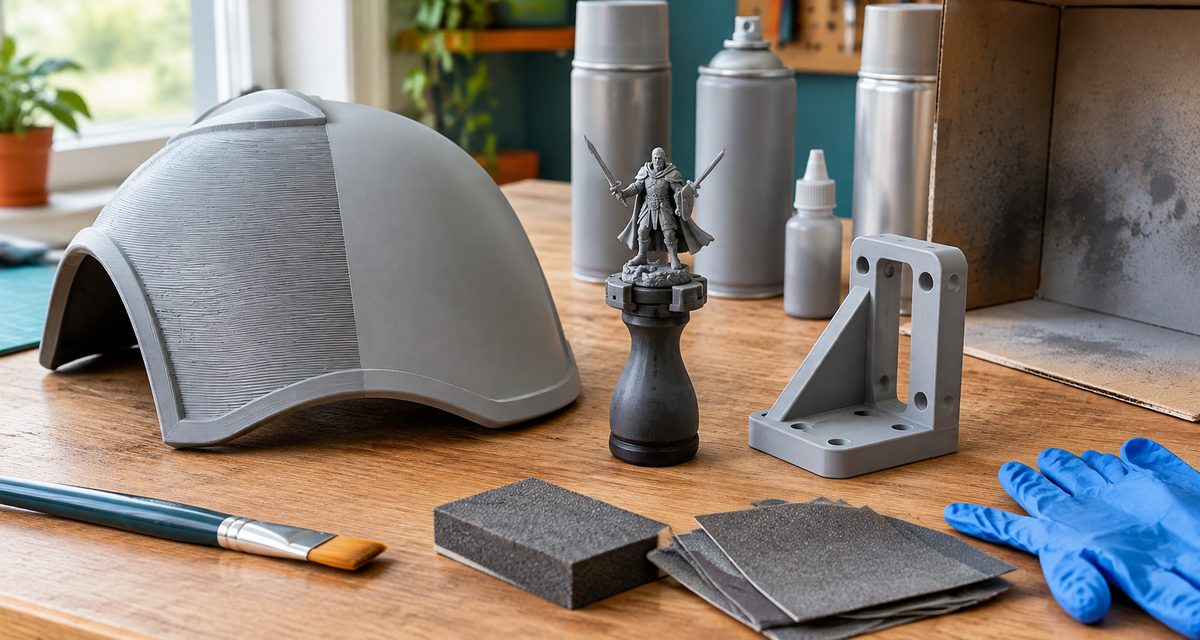
Primer is the step that turns a painted print from "obviously 3D printed" into a finished piece. It gives paint something to grip, shows up flaws before you paint, and with the right type it can hide layer lines. The best primer for 3D prints depends on the material and the part: a general spray primer for most PLA, a filler primer for visible layer lines, an adhesion primer for slick PETG, and a fine primer for resin miniatures. This guide compares six specific primers and explains sanding, compatibility and drying.
Quick Answer
For most PLA prints, the best primer is a plastic-rated spray such as Rust-Oleum Painter's Touch 2X Ultra Cover Primer. Use a filler primer to hide layer lines on larger FDM parts, a thin plastic adhesion primer first on PETG, and a fine model primer such as Tamiya Fine Surface Primer L or The Army Painter Colour Primer for resin and miniatures. Sand and clean the print before any primer.
Amazon buttons open Amazon.com search results for that exact product name in a new tab, not a single product page. Results can include multipacks, other colors and similar items, so match the brand, product and color before you buy. Amazon affiliate links. As an Amazon Associate I earn from qualifying purchases.
TL;DR — Quick Summary
Best Primer for 3D Prints — 2026 Picks
- 1🏆 Best overall and for PLA: Rust-Oleum Painter's Touch 2X Ultra Cover Primer — plastic-rated, large can
- 2🎯 Best fine spray primer: Tamiya Fine Surface Primer L — keeps small details sharp
- 3🖌️ Best brush-on primer: Vallejo Surface Primer — water-based, brush or airbrush
- 4🧴 Best for PETG: Rust-Oleum Specialty Plastic Primer — one thin adhesion coat
- 5🧙 Best for resin prints: The Army Painter Colour Primer — made for resin miniatures
- 6📏 Best filler for layer lines: Rust-Oleum 2-in-1 Filler & Sandable Primer — spray, sand, repeat
What is Filler Primer?
Filler Primer A thick, high-build primer that leaves enough material on the surface to fill small scratches and fine layer lines. You spray it, let it dry, and sand it back, repeating until the surface is smooth. Regular primers go on thinner and mainly improve paint adhesion.
🔧 Rough surface before you even start?
Primer hides fine flaws, not print problems. If your prints come off the bed rough or blobby, fix the cause first with our rough-print guide.
Primers for 3D Prints Compared
Drying times and limits below come from each maker's data sheet or product page, checked on November 20, 2026. Times are for about 70°F and moderate humidity; allow longer when it is cool or damp. We do not publish prices; the buttons open current Amazon listings.
Best overall and best primer for PLA
Rust-Oleum Painter's Touch 2X Ultra Cover Primer (Flat Gray)
Best for: Most PLA prints, props and larger parts
Drying: Touch dry in 20 minutes; recoat within 1 hour or after 48 hours
Avoid: Polyethylene parts without a test; heavy single coats
Read why we picked it →Best fine spray primer for detail
Tamiya Fine Surface Primer L (Light Gray, 87064)
Best for: Miniatures, small parts and detailed PLA or resin prints
Drying: Not listed on Tamiya's product page; follow the can label
Avoid: Large props (small 180 ml can)
Read why we picked it →Best brush-on primer
Vallejo Surface Primer Grey (73.601, 60 ml)
Best for: Brushing or airbrushing indoors; miniatures and small parts
Drying: Dries quickly; Vallejo says a hard film forms within a few hours
Avoid: Filling layer lines; one thick coat
Read why we picked it →Best primer for PETG
Rust-Oleum Specialty Plastic Primer (White, 209460)
Best for: PETG and other slick, hard-to-paint plastics
Drying: Touch dry in 20–30 minutes; oil-based topcoat after 1 hour, latex after 4 hours
Avoid: Building up thickness (one thin coat only)
Read why we picked it →Best primer for resin prints
The Army Painter Colour Primer Uniform Grey
Best for: Resin miniatures, busts and figures
Drying: Fast drying; spray thin coats and let each one dry
Avoid: Spraying in extreme heat, cold or humidity
Read why we picked it →Best filler primer for layer lines
Rust-Oleum Automotive 2-in-1 Filler & Sandable Primer (Gray, 260510)
Best for: Hiding FDM layer lines on PLA props, cosplay and terrain
Drying: Touch dry in 10 minutes; recoat or wet sand when dry; dry sand after 2–4 hours
Avoid: Miniatures and fine detail; untested plastics
Read why we picked it →Spray, Brush-On or Filler Primer?
Pick the type of primer before the brand. The right type depends on how big the part is, how much detail it has and whether you can spray outdoors.
| Question | Spray primer | Brush-on primer | Filler primer |
|---|---|---|---|
| Coverage | Fast and even | Slow on large parts | Fast, heavy coats |
| Detail | Good with light coats | Good if thinned and applied thinly | Softens fine detail |
| Layer lines | Shows them up; does not hide them | Does not hide them | Fills fine lines after sanding |
| Where to use it | Outdoors or a ventilated space | At a desk (water-based types) | Outdoors or a ventilated space |
| Best for | Most PLA prints, props, terrain | Miniatures, small batches, touch-ups | Cosplay, props, larger FDM parts |
Color matters too. Gray is the most useful all-round choice because it shows flaws and works under most colors. White makes light and bright colors look cleaner, and black suits dark schemes and metallic paints.
An adhesion primer, such as a plastic primer, is a fourth type. It is a very thin coat that helps paint grip slick plastics, and it is meant to be painted over, not sanded smooth.
The Best Primers for 3D Prints
Each pick below covers one job. Most people need one general spray primer, plus a filler primer for FDM props or a fine primer for miniatures. We have not lab-tested these primers: the specifications come from each manufacturer, and we say where a maker limits what its primer is designed for.
General-purpose spray primer
Rust-Oleum Painter's Touch 2X Ultra Cover Primer (Flat Gray)
Best for: Most PLA prints, props and larger parts. Drying: Touch dry in 20 minutes; recoat within 1 hour or after 48 hours.
For most people painting FDM prints, the first primer to buy is an inexpensive, widely sold spray that the maker rates for plastic, and Painter's Touch 2X Ultra Cover Primer is our pick. Rust-Oleum's data sheet describes it as a base for painting wood, metal and plastic, and says primer promotes topcoat adhesion and helps prevent chipping, cracking and peeling. The 12 oz can goes a long way on helmets, props and terrain, and the flat gray color shows up remaining layer lines and sanding marks before you commit to paint. It is a primer, not a heavy filler, so pair it with sanding or a filler primer when layer lines are deep.
Maker's specifications
- Rust-Oleum: a base for wood, metal and plastic; the 2X line is described as covering most plastic
- Acrylic-modified alkyd, 12 oz aerosol with an any-angle spray tip
- Rust-Oleum: for the smoothest base, wet sand with #400 grit after at least 30 minutes
Watch out for
- Recoat window: Rust-Oleum says apply the next coat within 1 hour or after 48 hours
- On plastic, Rust-Oleum says maximum adhesion and durability take 5–7 days
- Rust-Oleum notes some polyethylene plastics resist paint; test a hidden spot first
Amazon buttons open Amazon.com search results for that exact product name in a new tab, not a single product page. Results can include multipacks, other colors and similar items, so match the brand, product and color before you buy. Amazon affiliate links. As an Amazon Associate I earn from qualifying purchases.
Details from the Rust-Oleum Painter's Touch 2X Ultra Cover Primer Sprays technical data sheet (PT2X-03).
Fine spray primer for models
Tamiya Fine Surface Primer L (Light Gray, 87064)
Best for: Miniatures, small parts and detailed PLA or resin prints. Drying: Not listed on Tamiya's product page; follow the can label.
When a print has fine detail, such as a miniature, a scale model part or a small figure, a fine model primer is the better spray. Tamiya's Fine Surface Primer L is a scale-model primer that Tamiya rates for plastic and metal. Tamiya says the light gray undercoat suits dark plastic and helps give a smooth surface and true tones from your topcoats. Because it goes on thinner than a hardware-store filler primer, it keeps sharp edges and small details, which also means it will not hide visible FDM layer lines on its own.
Maker's specifications
- Tamiya: formulated for plastic and metal
- 180 ml spray can in light gray
- Tamiya: a light gray undercoat suited to dark plastic for true topcoat tones
Watch out for
- The 180 ml can is small, so it is costly to cover large prints
- A fine primer does not fill layer lines; sand first or use a filler primer underneath
- Tamiya's product page does not list drying times, so follow the instructions on the can
Amazon buttons open Amazon.com search results for that exact product name in a new tab, not a single product page. Results can include multipacks, other colors and similar items, so match the brand, product and color before you buy. Amazon affiliate links. As an Amazon Associate I earn from qualifying purchases.
Details from the Tamiya product page (item 87064).
Water-based brush-on or airbrush primer
Vallejo Surface Primer Grey (73.601, 60 ml)
Best for: Brushing or airbrushing indoors; miniatures and small parts. Drying: Dries quickly; Vallejo says a hard film forms within a few hours.
If you cannot spray outdoors, or you want to prime a few small parts without a rattle can, a brush-on primer is the answer. Vallejo Surface Primer is a water-based acrylic-polyurethane primer that you can brush on straight from the bottle or thin for an airbrush. Vallejo says it can be applied on all surfaces, naming resin, PVC, brass, white metal and wood, that it preserves fine detail, and that it is not flammable and contains no solvents. That makes it the easiest primer here to use at a desk, as long as you apply several thin layers.
Maker's specifications
- Vallejo: for all surfaces, including resin, PVC, brass, white metal and wood
- Use straight by brush, or thin with Vallejo Airbrush Thinner or Flow Improver for an airbrush at about 15–20 PSI
- Vallejo: not flammable and contains no solvents
Watch out for
- Vallejo recommends several thin layers rather than one thick coat
- Let it cure before handling hard; Vallejo says the film reaches its strength within a few hours
- A thin brush-on film will not hide FDM layer lines
Amazon buttons open Amazon.com search results for that exact product name in a new tab, not a single product page. Results can include multipacks, other colors and similar items, so match the brand, product and color before you buy. Amazon affiliate links. As an Amazon Associate I earn from qualifying purchases.
Details from the Vallejo Primers range page.
Adhesion primer for plastics
Rust-Oleum Specialty Plastic Primer (White, 209460)
Best for: PETG and other slick, hard-to-paint plastics. Drying: Touch dry in 20–30 minutes; oil-based topcoat after 1 hour, latex after 4 hours.
PETG is harder to paint than PLA because its surface is slick and slightly flexible, so ordinary primer can peel. An adhesion primer made for plastics is the safer first coat. Rust-Oleum designed its Specialty Plastic Primer for plastics including polypropylene, polystyrene, resin, PVC and vinyl, and its Amazon.com listing adds that it adheres to some 3D printer filaments. Rust-Oleum does not name PETG specifically, so scuff-sand the part, apply one thin coat, and test it on a scrap print before a big job. Then top it with paint, or with a regular primer if you still need to smooth the surface.
Maker's specifications
- Rust-Oleum: for polypropylene, polystyrene, resin, PVC, fiberglass and vinyl plastics
- Amazon.com listing: adheres to hard-to-paint surfaces including some 3D printer filaments
- 12 oz aerosol in white; fully dry in 24 hours
Watch out for
- Rust-Oleum says one thin coat gives the best adhesion, not a heavy coat or several coats
- It is not a filling or full-coverage primer, so it will not hide layer lines
- Rust-Oleum warns some polyethylene plastics resist paint; test in a hidden spot
Amazon buttons open Amazon.com search results for that exact product name in a new tab, not a single product page. Results can include multipacks, other colors and similar items, so match the brand, product and color before you buy. Amazon affiliate links. As an Amazon Associate I earn from qualifying purchases.
Details from the Rust-Oleum Specialty Plastic Primer technical data sheet (SPC-26) and Amazon.com listing.
Acrylic primer and base coat spray
The Army Painter Colour Primer Uniform Grey
Best for: Resin miniatures, busts and figures. Drying: Fast drying; spray thin coats and let each one dry.
Resin prints have fine detail and very smooth surfaces, so they need a primer that sticks well without filling recesses. The Army Painter says its Colour Primer formula was developed to work on metal, plastic and resin miniatures, with fine pigment and a nozzle designed to cover without hiding detail. It doubles as a base coat, and Uniform Grey is a neutral starting color. Before you prime any resin print, make sure it has been washed and fully post-cured: leftover uncured resin can stop paint from sticking.
Maker's specifications
- The Army Painter: developed for metal, plastic and resin miniatures
- Acrylic primer and base coat in one, 400 ml can
- Maker directions: shake for 1 minute and spray from 15–20 cm in several thin coats
Watch out for
- The safety label lists acetone and an extremely flammable aerosol; spray outdoors or in a well-ventilated area
- The Army Painter advises against spraying in extreme heat, cold or humidity
- Wash and fully cure resin prints first, or the primer may not adhere
Amazon buttons open Amazon.com search results for that exact product name in a new tab, not a single product page. Results can include multipacks, other colors and similar items, so match the brand, product and color before you buy. Amazon affiliate links. As an Amazon Associate I earn from qualifying purchases.
Details from the The Army Painter Colour Primer page and Uniform Grey product page.
High-build filler primer spray
Rust-Oleum Automotive 2-in-1 Filler & Sandable Primer (Gray, 260510)
Best for: Hiding FDM layer lines on PLA props, cosplay and terrain. Drying: Touch dry in 10 minutes; recoat or wet sand when dry; dry sand after 2–4 hours.
Visible layer lines are the main reason FDM prints look printed after painting, and a filler primer is the quickest way to hide them. Rust-Oleum describes this one as a hi-build formula that fills minor imperfections and sands smooth. The usual method is to spray a coat, sand it back, and repeat until the lines disappear. One honest caveat: Rust-Oleum lists metal, wood and fiberglass, not plastic, so try it on a scrap print first, and keep it for larger parts, because a thick coat also softens fine detail.
Maker's specifications
- Rust-Oleum: hi-build formula that fills minor imperfections and sands smooth
- Wet sand, recoat or topcoat once dry; dry sand after 2–4 hours for best results
- 12 oz flat gray aerosol with an any-angle spray system
Watch out for
- Rust-Oleum lists metal, wood and fiberglass surfaces, not plastic; test it on a scrap print
- Thick coats soften sharp details, so it is a poor choice for miniatures
- Solvent-based; clean up wet paint with mineral spirits or xylene and spray with good ventilation
Amazon buttons open Amazon.com search results for that exact product name in a new tab, not a single product page. Results can include multipacks, other colors and similar items, so match the brand, product and color before you buy. Amazon affiliate links. As an Amazon Associate I earn from qualifying purchases.
Details from the Rust-Oleum 2 in 1 Filler & Sandable Primer product page and technical data sheet.
Primer Compatibility by Material
Primer makers rarely list filament names, so treat this as a starting point. Always check the can for surfaces it should not be used on, and spray a scrap print or a hidden area first.
PLA
What to use: General spray primer (Rust-Oleum 2X); filler primer for layer lines; Tamiya for fine detail
The easiest filament to prime. Sand lightly, and wet-sand at finer grits so friction heat does not soften the surface. PLA softens at fairly low temperatures, so do not force-dry it with a heat gun.
PETG
What to use: Thin coat of a plastic adhesion primer (Rust-Oleum Specialty Plastic Primer), then paint or regular primer
Slick and slightly flexible, so paint peels more easily. Scuff-sand the whole surface and test on a scrap print.
ABS and ASA
What to use: General spray primer or filler primer
Both take primer well once sanded. They dissolve in acetone, and some aerosols list acetone, so build up light coats rather than one wet, heavy coat.
Resin (SLA/MSLA)
What to use: Fine primer: The Army Painter Colour Primer, Tamiya Fine Surface Primer L or Vallejo Surface Primer
Wash and fully post-cure first. Tacky, uncured resin can stop primer from sticking.
TPU (flexible)
What to use: Test first; rigid primers tend to crack
Hard primer films crack when the part bends. Leave flexible parts unpainted or test a flexible paint on a scrap.
Nylon
What to use: Test first
Nylon absorbs moisture, which can affect how coatings stick. Dry the part, sand it, and try primer on a scrap print before a full coat.
Surface Preparation and Sanding
Primer shows every scratch, speck of dust and fingerprint, so preparation decides how good the finish looks. These steps follow the same order Formlabs gives in its guide to preparing prints for painting, adapted for FDM prints too.
- 1Remove supports and trim: Cut supports away with flush cutters and clean up brims, blobs and support scars with a hobby knife or file.
- 2Sand in stages: Start coarse on support marks, then go finer over the whole part. Formlabs suggests 220 or 320 grit followed by 400 or 600 grit for its prints; rough FDM surfaces may need a coarser start. Wet-sand PLA at finer grits to keep friction heat down.
- 3Wash off the dust: Formlabs suggests a soft toothbrush and water. Let the part dry completely.
- 4Wipe it clean: Use a tack cloth, or a wipe of isopropyl alcohol, to remove dust and skin oil. Handle the part with gloves from here on.
- 5Mount it: Fix the print on a dowel, stick or painting handle so you can spray every side without touching it.
- 6Prime in light coats: Spray from the distance on the can in short passes, starting and stopping off the part. Two light coats beat one heavy coat.
- 7Inspect, fix, repeat: The first coat shows remaining flaws. Sand or fill them, clean off the dust, and prime again.
Drying and Curing
"Dry to the touch" is not the same as ready to sand or paint. Several primers also have a recoat window: paint too late and the next coat may not bond well. These are the makers' published times at about 70°F; cold or humid weather slows everything down.
Rust-Oleum 2X Ultra Cover Primer
Touch 20 min; handle 1 hour; fully dry 24 hours; recoat within 1 hour or after 48 hours; best adhesion on plastic after 5–7 days
Rust-Oleum Specialty Plastic Primer
Touch 20–30 min; handle 1 hour; fully dry 24 hours; oil-based topcoat after 1 hour, latex after 4 hours
Rust-Oleum 2-in-1 Filler & Sandable Primer
Touch 10 min; recoat, topcoat or wet sand once dry; dry sand after 2–4 hours
Vallejo Surface Primer
Dries quickly; forms a hard film within a few hours
The Army Painter Colour Primer
Fast drying; let each thin coat dry before the next
Tamiya Fine Surface Primer L
Not listed on Tamiya's product page; follow the can label
- Stay inside the recoat window: If a maker gives one, either paint within it or wait until the longer time has passed.
- Let it cure before sanding hard: Primer that is only touch-dry clogs sandpaper and can lift.
- Do not speed it up with heat: PLA softens at fairly low temperatures, and a heat gun or hot car can warp a thin print. Warm room temperature is enough.
- Give plastic time: Rust-Oleum says paint on plastic reaches maximum adhesion and durability after 5–7 days, so handle freshly painted parts gently.
Buying Guide: How to Choose a Primer
- 1Start with the part: Large props and terrain need a full-size aerosol. Miniatures need a fine primer that keeps detail.
- 2Decide whether you need filling: If layer lines are visible after sanding, add a filler primer. If the surface is already smooth, a regular primer is enough.
- 3Match the material: PLA is easy. PETG needs an adhesion primer and a scuff-sand. Resin needs a full wash and cure first.
- 4Check where you can spray: Aerosols need outdoor space or strong ventilation. If you have neither, choose a water-based brush-on primer.
- 5Pick a color: Gray for most jobs, white under bright colors, black under dark or metallic paint.
- 6Read the can's surface list and recoat window: Makers say which surfaces they support and when to recoat. If plastic is not on the list, test first.
Common mistakes
- One heavy coat: It runs, pools in detail and takes longer to dry. Use several light coats.
- Priming over dust or oil: Primer locks every speck in place. Clean the part right before you spray.
- Expecting primer to fix bad prints: Primer hides fine flaws, not blobs, gaps or deep layer lines. Sand or fill those first.
- Priming uncured resin: Sticky resin stops primer bonding. Finish washing and curing first.
Safety
Primers are everyday products, but aerosols in particular deserve care. Read the label and safety data sheet for the product you buy.
Ventilation
Rust-Oleum directs users to spray outdoors or in a well-ventilated area, and The Army Painter's label warns not to breathe the spray mist. A cardboard spray box outdoors works well for small parts.
Flammability
Solvent-based aerosols are flammable. Keep them away from a hot printer, heat guns, heaters and open flames, and store cans away from heat. Water-based brush-on primers such as Vallejo's avoid this.
Skin and eyes
Wear disposable gloves to keep paint and skin oil off the part, and eye protection when spraying. Wear gloves when handling uncured resin, too.
Sanding dust
Wet sanding keeps plastic and primer dust down. Sand cured resin only once it is fully post-cured, and clean up dust with a damp cloth rather than blowing it around.
Frequently Asked Questions
What is the best primer for 3D prints?
For most PLA prints, a general-purpose spray primer that is rated for plastic, such as Rust-Oleum Painter's Touch 2X Ultra Cover Primer, is the best place to start. Add a filler primer when you need to hide layer lines, and use a fine model primer such as Tamiya Fine Surface Primer L for miniatures and detailed parts.
Do you need to prime PLA before painting?
You do not strictly need to, because acrylic paint will stick to clean PLA, but primer gives paint a more even surface to grip, shows up flaws before you paint, and helps the finish resist chipping. For anything you want to look good or handle often, prime it.
What primer works on PETG?
PETG is slick, so scuff-sand it and start with a thin coat of an adhesion primer made for plastics, such as Rust-Oleum Specialty Plastic Primer. Rust-Oleum does not name PETG specifically, so test on a scrap print first, then paint or add a regular primer on top.
What is the best primer for resin prints?
A fine primer that keeps detail, such as The Army Painter Colour Primer, Tamiya Fine Surface Primer L or a brush-on Vallejo Surface Primer. Wash and fully post-cure the resin print first, because leftover uncured resin can stop primer from adhering.
Can filler primer hide layer lines?
Yes, for fine to moderate layer lines. Spray a coat of filler primer, let it dry, sand it back, and repeat until the lines disappear. Deep lines or gaps need sanding or putty first, and filler primer is too thick for miniatures with fine detail.
Is spray or brush-on primer better for 3D prints?
Spray primer is faster and more even, especially on large prints, but needs outdoor space or good ventilation. Brush-on primer is better for a few small parts or for working indoors; apply several thin coats so it does not pool in the details.
How long should primer dry before painting a 3D print?
Follow the maker's times. Rust-Oleum says its 2X primer is dry to the touch in 20 minutes and should be recoated within 1 hour or after 48 hours, and its Plastic Primer can take an oil-based topcoat after 1 hour or latex paint after 4 hours. Allow more time in cool or humid weather.
Should you sand 3D prints before priming?
Yes, at least lightly. Remove support marks first, then sand the surface; Formlabs suggests 220 or 320 grit followed by 400 or 600 grit for its prints. Clean off the dust before priming, because primer shows every scratch and speck.
The Bottom Line
For most PLA prints, start with a plastic-rated spray primer such as Rust-Oleum Painter's Touch 2X Ultra Cover Primer. If you print props or cosplay, add a filler primer and get used to the spray-sand-repeat routine; it is the most reliable way to hide layer lines. For miniatures and resin, switch to a fine primer such as Tamiya Fine Surface Primer L or The Army Painter Colour Primer.
Use a thin plastic adhesion primer first on PETG, choose a water-based brush-on primer if you cannot spray outdoors, and above all sand and clean the print first. Preparation decides how good the paint job looks.
Start With These
One everyday primer, one filler for FDM props, one fine primer for detail.
Amazon buttons open Amazon.com search results for that exact product name in a new tab, not a single product page. Results can include multipacks, other colors and similar items, so match the brand, product and color before you buy. Amazon affiliate links. As an Amazon Associate I earn from qualifying purchases.
How We Chose These Primers
We started from the jobs people prime prints for: everyday PLA parts, fine-detail miniatures, slick PETG, resin prints, painting indoors and hiding layer lines. For each job we picked a specific, widely sold primer from an established maker whose own data sheet or product page supports that use, and on November 20, 2026 we confirmed that each one is sold on Amazon.com under the exact name the button searches for.
Specifications, drying times and limits quoted here come from the manufacturers and, where noted, an Amazon.com listing, not from our own testing. We do not claim to have tested these primers, and we do not publish prices or star ratings. Where a maker does not list plastic or a specific filament, we say so.
Affiliate Disclosure: This post contains affiliate links. If you purchase through these links, we may earn a small commission at no extra cost to you. We only recommend products we stand behind. See our full disclosure for details.
As an Amazon Associate I earn from qualifying purchases.