Best 3D Printer Ventilation and Air Purifiers (2026)
By Chris Avery, Publisher / Editor
Desktop 3D printers release tiny particles and gases while they print, and resin printers add vapors from the resin and the wash. The good news is that the fix is well understood: capture the air at the printer and send it outside, then use filtration as a second layer. This guide explains what to buy for enclosed printers, printing rooms, resin and small spaces, what HEPA and carbon filters can and cannot do, and why no purifier makes emissions disappear.
Quick Answer
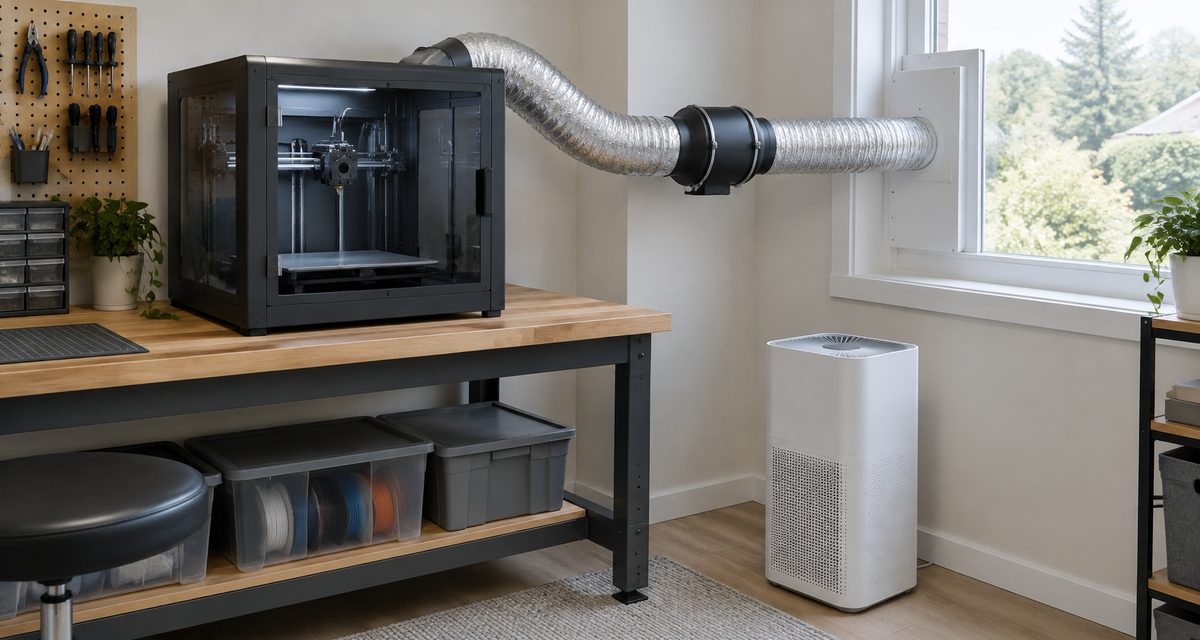
The best 3D printer ventilation is an enclosure vented outdoors: a 4-inch inline fan such as the AC Infinity CLOUDLINE S4 pulling air from the enclosure through a duct to a window. Add an air purifier with HEPA and a large carbon stage, such as the IQAir HealthPro Plus XE, as a second layer. HEPA captures particles; only a substantial carbon bed helps with gases. No purifier removes all 3D printing emissions, and recirculating filtered air is not equivalent to venting outside.
Amazon buttons open Amazon.com search results for that exact product name in a new tab, not a single product page. Results can include bundles, other sizes and similar items, so match the brand and model before you buy. Amazon affiliate links. As an Amazon Associate I earn from qualifying purchases.
TL;DR — Quick Summary
Best 3D Printer Ventilation and Air Purifiers — 2026 Picks
- 1🌬️ Best for enclosed printers: AC Infinity CLOUDLINE S4 — 4" inline fan, vented outdoors
- 2🏠 Best room air purifier: IQAir HealthPro Plus XE — HyperHEPA plus 5 lb gas media
- 3💲 Best budget ventilation: AC Infinity RAXIAL S4 — short, unfiltered duct runs only
- 4🧪 Best for resin printing: AC Infinity Air Filtration Kit 4" — fan, carbon filter, 25 ft duct
- 5📦 Best for small spaces: Coway Airmega Mighty — compact HEPA, CADR 233 (smoke)
- 6⚠️ Key limit: HEPA is for particles; gases need lots of carbon or, better, outdoor exhaust
What is Clean Air Delivery Rate (CADR)?
Clean Air Delivery Rate (CADR) A purifier rating, in cubic feet per minute, for how much particle-free air it delivers against smoke, dust and pollen. The EPA notes that CADR covers particles only; there is no equivalent standard rating for removing gases such as VOCs.
🔥 Need the enclosure first?
Ventilation works best when the printer is enclosed. Our enclosure guide covers what to look for, including exhaust ports for a fan and duct.
What 3D Printers Emit
The research on this is more than a decade old and fairly consistent. In 2013, Stephens and colleagues measured large numbers of ultrafine particles (smaller than 100 nanometers) from desktop printers in an office, with higher emission rates from ABS than from PLA, and suggested caution when printing in inadequately ventilated or unfiltered rooms. A larger 2016 chamber study by Azimi and colleagues tested five printers with up to nine filaments and found that emissions varied mainly by filament material. The VOCs emitted in the largest amounts included caprolactam from nylon-based and some wood and brick-look filaments, styrene from ABS and HIPS, and lactide from PLA.
Resin printers are not exempt. A NIOSH-led study of five desktop resin printers measured both particles and total VOCs from every machine, with higher yields from the two DLP printers than from the three SLA printers tested.
Those studies measured emission rates in specific setups; they do not tell you your exposure at home, and they are not health-outcome studies. What they do show is why the official advice focuses on controlling emissions at the source. NIOSH's 3D printing poster lists HEPA-filtered local exhaust ventilation near the printer, gas and vapor filters if you are concerned about VOCs, and ventilated enclosures, and its guide to safe 3D printing describes enclosures with a fan that exhausts emissions to the outdoors.
Particles
Ultrafine particles from melting plastic. HEPA filters capture them; a purifier's smoke CADR is the best guide to how quickly it clears them from a room.
Gases and VOCs
Styrene, caprolactam, lactide and resin vapors pass straight through HEPA. Only a substantial bed of activated carbon or other sorbent reduces them, and venting outside removes them from the room.
Ventilation and Purifiers Compared
Specifications below come from each maker's product page, checked on November 19, 2026. Fan airflow is a free-air rating and drops once you add ducting and filters; purifier figures are the maker's own. We do not publish prices; the buttons open current Amazon listings.
Best ventilation setup for enclosed printers
AC Infinity CLOUDLINE S4 Quiet Inline Fan 4" with Speed Controller
Approach: Outdoor exhaust
What it handles: Removes particles and gases from the room by venting them outside
Maker's rating: 226 CFM fan rating (free air)
Noise: 26 dBA (maker's rating)
Read why we picked it →Best air purifier for a 3D printing room
IQAir HealthPro Plus XE Air Purifier
Approach: Room filtration (recirculating)
What it handles: Particles (HyperHEPA) plus a 5 lb sorbent stage for some gases
Maker's rating: 40 to 300 cfm airflow; up to 1,125 sq ft (maker)
Noise: 27 to 59 dB(A) at 3.3 ft
Read why we picked it →Best budget ventilation option
AC Infinity RAXIAL S4 Inline Booster Duct Fan 4"
Approach: Outdoor exhaust
What it handles: Vents air outside; no filtration
Maker's rating: 106 CFM fan rating (free air)
Noise: 28 dBA (maker's rating)
Read why we picked it →Best filtration setup for resin printing
AC Infinity Air Filtration Kit 4" with Speed Controller
Approach: Exhaust with carbon filter
What it handles: Vents air outside; 38 mm carbon bed cuts odor on the way out
Maker's rating: 165 CFM fan rating (free air)
Noise: 29 dBA (maker's rating)
Read why we picked it →Best option for small printing spaces
Coway Airmega Mighty AP-1512HH
Approach: Room filtration (recirculating)
What it handles: Particles (HEPA); thin deodorization layer for odors
Maker's rating: CADR 233 smoke / 246 dust / 240 pollen
Noise: 24 to 53 dB(A)
Read why we picked it →HEPA vs Activated Carbon
This is the most misunderstood part of 3D printer air cleaning. HEPA and activated carbon are not two grades of the same thing; they remove different pollutants. The EPA's guide to air cleaners puts it plainly: most filters are designed to filter either particles or gases, the CADR rating system is for particles only, and activated carbon filters can be effective provided there is a large amount of material in the filter.
| HEPA filter | Activated carbon | |
|---|---|---|
| Removes | Particles, including ultrafine particles | Some gases, VOCs and odors |
| Does not remove | Gases and VOCs | Particles (in any useful amount) |
| How to compare | Smoke CADR, matched to room size | Weight or depth of carbon, if the maker publishes it |
| Wears out by | Clogging gradually | Filling up; once saturated it stops adsorbing |
| Watch for | "HEPA-type" or "HEPA-like" filters that are not true HEPA | Thin carbon-coated sheets that mainly mask odor |
The practical lesson for 3D printing: a purifier with a strong smoke CADR will clear particles, but a purifier that only has a thin carbon sheet will do little for styrene from ABS or vapors from resin. The research backs this up. In a 2019 chamber study, Gu and colleagues found that a filter cover and an air purifier removed 74 to 93% of ultrafine particles from an ABS print, but had varying ability to remove the main VOCs, styrene and ethylbenzene. The new filters also released some VOCs of their own until they had been used for four to five days.
A smell test is not a reliable guide either. Some VOCs have little odor, and an odor-free room does not mean the air is clean.
Venting Outdoors vs Recirculating Filtered Air
There are two ways to deal with what a printer emits. You can exhaust it: capture the air at the printer and send it outside. Or you can recirculate it: pass room or enclosure air through filters and return it to the room. Exhaust is the stronger option because whatever the filters miss still leaves the room.
Venting outdoors
- Removes particles and gases from the room, whatever their size
- Works best with an enclosure that captures emissions at the source
- Needs a window panel or wall vent and a duct route
- Can pull warm air from the enclosure, so run the fan only as fast as needed
Recirculating filtration
- Returns cleaned air to the room, minus what the filters caught
- HEPA handles particles well; gases depend on how much carbon there is
- Filters saturate and need replacing to keep working
- Easier to set up when venting outside is not possible
The evidence points the same way. In a 2025 study of low-cost controls for ABS printing, exhaust ventilation to outdoor air was the most effective of the controls tested for particles. A 2017 modeling study found the most effective strategies for reducing both particles and VOCs were a high-flow spot ventilation system and a sealed enclosure with high-efficiency gas and particle filtration. Capturing emissions close to the source matters too: a NIOSH prototype that captured emissions at the print head reduced ultrafine particle concentrations from a single printer by 98% in a test chamber. NIOSH's guide says enclosure air can be exhausted outdoors, or filtered and recirculated provided the control has been evaluated to ensure contaminants are not released back into the room.
At home, few people can evaluate a filter system that way. That is why we recommend venting outdoors whenever you can, and using a room purifier as an extra layer rather than the main control. UL Research Institutes' classroom checklist takes the same approach: vent the printer outside, then add HEPA and activated carbon filtration.
The Best 3D Printer Ventilation Picks
Each pick covers one situation. We have not tested these products ourselves, and none of their makers rate them against 3D printer emissions specifically. The specifications come from each maker, and we point out where a product's limits matter for printing.
4-inch inline duct fan for outdoor exhaust
AC Infinity CLOUDLINE S4 Quiet Inline Fan 4" with Speed Controller
Best for: Pulling air out of an enclosure with a 4-inch port and sending it outdoors. Approach: Outdoor exhaust.
If you print ABS, ASA or nylon in an enclosure, the most effective home setup is the one researchers keep coming back to: capture the air at the printer and send it outside. A small inline fan on a 4-inch duct, run from the enclosure's exhaust port to a window or wall vent, does that quietly. AC Infinity lists the CLOUDLINE S4 at 226 CFM and 26 dBA, with a 10-speed wired controller, so you can turn it down until the enclosure stays slightly below room pressure without cooling your print too much. AC Infinity also says its mixed-flow design keeps moving air in high-resistance setups, which matters once you add bends, duct length or a filter.
Maker's specifications
- Duct size 4"; fan 6.9" x 11.9" x 7.4"
- Rated airflow 226 CFM; rated noise 26 dBA
- Wired 10-speed controller; EC motor with dual ball bearings
- Mixed-flow design that AC Infinity says handles high-resistance installs
Watch out for
- This is the fan only: ducting, an enclosure port adapter and a window or wall vent are separate
- 226 CFM is a free-air rating; real airflow through ducts, bends and filters is lower
Amazon buttons open Amazon.com search results for that exact product name in a new tab, not a single product page. Results can include bundles, other sizes and similar items, so match the brand and model before you buy. Amazon affiliate links. As an Amazon Associate I earn from qualifying purchases.
Details from the AC Infinity CLOUDLINE S4 product page (model AI-CLS4).
HEPA purifier with a large gas-and-odor stage
IQAir HealthPro Plus XE Air Purifier
Best for: A room you print in regularly, as a second layer behind ventilation. Approach: Room filtration (recirculating).
Most air purifiers are particle machines with a thin layer of carbon for odors. That is a problem for 3D printing, where the gases matter as much as the particles. The EPA says activated carbon filters can be effective provided there is a large amount of material in the filter. IQAir's HealthPro Plus XE is one of the few home purifiers whose maker states the amount: its V5-Cell gas stage contains 5 lb of granular media (bituminous coal-based carbon and a potassium permanganate chemisorbent), behind a HyperHEPA particle filter. It is big, heavy and expensive, and it still recirculates room air, so treat it as a backup to venting, not a replacement.
Maker's specifications
- Three stages: PreMax prefilter, V5-Cell gas and odor filter, HyperHEPA
- V5-Cell media: 5 lb (bituminous coal carbon and potassium permanganate chemisorbent)
- Six fan speeds, 40 to 300 cfm; sound pressure 27 to 59 dB(A)
- 28 x 15 x 16 in, 35 lb; IQAir lists coverage up to 1,125 sq ft
Watch out for
- IQAir publishes airflow, not an AHAM CADR, so you cannot compare it directly with CADR-rated purifiers
- Gas media has a finite capacity and must be replaced; it will not remove every compound a printer emits
Amazon buttons open Amazon.com search results for that exact product name in a new tab, not a single product page. Results can include bundles, other sizes and similar items, so match the brand and model before you buy. Amazon affiliate links. As an Amazon Associate I earn from qualifying purchases.
Details from the IQAir HealthPro Plus product page and V5-Cell filter page.
Budget 4-inch booster fan
AC Infinity RAXIAL S4 Inline Booster Duct Fan 4"
Best for: A short, straight duct run from an enclosure to a nearby window, with no filter. Approach: Outdoor exhaust.
If the printer sits next to a window and the duct run is short, you do not need a powerful fan. AC Infinity's RAXIAL S4 is a small 4-inch booster rated at 106 CFM and 28 dBA, with a speed knob, and it is the cheapest way we found to get a proper outdoor exhaust from a hobby enclosure. Read the limits, though: AC Infinity says it is not suitable for restricted-airflow applications, including systems with carbon filters. Use it only for short, simple runs, and step up to the CLOUDLINE S4 if your duct is long, has several bends or needs a filter.
Maker's specifications
- Duct size 4"; fan 7.28" x 3.95" x 3.95"
- Rated airflow 106 CFM; rated noise 28 dBA
- Variable fan speed controller included
Watch out for
- AC Infinity: not suitable for restricted airflow, such as systems using carbon filters
- No filtration of its own; ducting and a window vent are separate
Amazon buttons open Amazon.com search results for that exact product name in a new tab, not a single product page. Results can include bundles, other sizes and similar items, so match the brand and model before you buy. Amazon affiliate links. As an Amazon Associate I earn from qualifying purchases.
Details from the AC Infinity RAXIAL S4 product page (model AC-RXS4).
Inline fan, carbon filter and 25 ft of ducting
AC Infinity Air Filtration Kit 4" with Speed Controller
Best for: A resin printer and wash station inside a vented enclosure or cabinet. Approach: Exhaust with carbon filter.
Resin printing gives off vapors as well as particles, and NIOSH researchers measured both from desktop resin printers. The washing and curing steps count too. The setup we would build is a closed cabinet or tent around the printer and wash station, with this kit pulling air through its carbon filter and out through the duct to a window. AC Infinity's kit includes a CLOUDLINE fan with a 10-speed controller, a carbon filter with a 38 mm bed of 1200+ IAV activated charcoal, and 25 ft of ducting, so it is nearly everything you need in one box. Venting outside does the main job; the carbon reduces the smell leaving the window.
Maker's specifications
- Kit duct size 4"; 25 ft of ducting included
- Fan rated 165 CFM and 29 dBA, with a 10-speed controller
- Carbon filter: 38 mm bed of 1200+ IAV activated charcoal, with a prefilter cloth
- Includes duct clamps, hanging straps and other installation accessories
Watch out for
- Designed for grow tents; AC Infinity does not rate it against resin vapors, and it has no HEPA stage
- Recirculating the air back into the room instead of venting it is not a safe substitute for exhaust
Amazon buttons open Amazon.com search results for that exact product name in a new tab, not a single product page. Results can include bundles, other sizes and similar items, so match the brand and model before you buy. Amazon affiliate links. As an Amazon Associate I earn from qualifying purchases.
Details from the AC Infinity Air Filtration Kit 4" product page (model AC-FKS4).
Compact HEPA purifier with a published CADR
Coway Airmega Mighty AP-1512HH
Best for: A small room or office with one PLA or PETG printer. Approach: Room filtration (recirculating).
In a small room you want something compact that clearly helps with particles. Coway's Airmega Mighty AP-1512HH has a published CADR of 233 for smoke, the rating that best matches very fine particles, and Coway sizes it at 361 sq ft for 4.8 air changes an hour. It is small enough to sit near the printer. Be clear about what it is: a particle purifier. Its deodorization filter is a thin layer, and Coway does not publish how much carbon it contains, so it is not a gas solution. It pairs well with a window fan or with an enclosure that vents outside.
Maker's specifications
- CADR 233 (smoke), 246 (dust), 240 (pollen)
- 361 sq ft at 4.8 air changes per hour (Coway also lists 1,748 sq ft at 1 ACH)
- Prefilter, deodorization filter, HEPA filter and a bipolar ionizing device
- 16.8 x 18.3 x 9.6 in, 12.3 lb; 24 to 53 dB(A); 77 W
Watch out for
- Coway does not publish its carbon content; expect little effect on VOCs such as styrene
- Use the 361 sq ft figure, not the 1,748 sq ft figure, which assumes only one air change per hour
Amazon buttons open Amazon.com search results for that exact product name in a new tab, not a single product page. Results can include bundles, other sizes and similar items, so match the brand and model before you buy. Amazon affiliate links. As an Amazon Associate I earn from qualifying purchases.
Details from the Coway Airmega Mighty AP-1512HH product page.
What about small in-printer resin filters?
Several resin printer brands sell small battery or USB carbon purifiers that sit inside the printer's lid. They can cut the smell during a print, but they hold very little carbon and do nothing for the wash station, so treat them as odor reducers, not ventilation. We have not included one as a pick.
PLA, PETG, ABS, ASA and Resin: What Each Needs
Emissions depend on the material, the brand, additives and print temperature, so treat this as a starting point, not a safety rating. NIOSH suggests using PLA rather than ABS when possible as one way to lower potential exposure, but no material is emission-free.
| Material | What the research and chemistry say | Minimum setup we would use |
|---|---|---|
| PLA | Generally lower particle emissions than ABS in published tests, but not zero. Lactide was the main VOC from PLA in one chamber study. | Well-ventilated room; a HEPA purifier helps. Avoid printing where people sleep. |
| PETG | There is less published emissions data for PETG than for PLA and ABS. Emissions vary by brand and print temperature, so do not assume it behaves like PLA. | Well-ventilated room; a HEPA purifier helps. Vent an enclosure if you use one. |
| ABS | Higher particle emissions than PLA in early tests, and styrene was among the main VOCs measured from ABS. | Enclosure with outdoor exhaust. Add a purifier with real carbon as a second layer. |
| ASA | Also a styrene-based plastic (acrylonitrile styrene acrylate), printed hot like ABS. Treat it the same way. | Enclosure with outdoor exhaust, as for ABS. |
| Resin | NIOSH researchers measured particles and vapors from desktop resin printers. Washing and curing add solvent vapors and skin-contact risk. | Closed, vented enclosure for printer and wash station; nitrile gloves. |
Filaments with additives deserve extra care. NIOSH lists filaments containing metals, nanomaterials or carbon fibers as a printing consideration, and the 2016 chamber study found caprolactam came from nylon and from some wood and brick-look filaments as well.
🧱 Best ABS Filament (2026)
ABS brands compared, with what you need to print them well: an enclosure and ventilation.
☀️ Best ASA Filament
UV-resistant ASA for outdoor parts. It prints hot like ABS, so plan the same ventilation.
⚖️ PLA vs PETG
Which everyday filament to use, and how they differ in strength, heat resistance and ease of printing.
🧴 Best PETG Filament
PETG brands compared for strength, stringing and ease of printing.
Buying Guide: How to Choose
Work through these in order. The first two steps matter more than any product choice.
- 1Decide what you print: PLA and PETG in a well-ventilated room are a different problem from ABS, ASA, nylon or resin. The hotter, styrene-based and resin materials are the ones that most need outdoor exhaust.
- 2Plan to vent outdoors if you can: Find the shortest duct route from the printer to a window or wall. A window panel with a 4-inch port is the simplest option for renters. Short, straight runs need less fan.
- 3Enclose the printer: An enclosure captures emissions where they are made, so a small fan can remove them. Without one, a fan and duct do much less. Check that the enclosure has, or can take, an exhaust port.
- 4Size the fan for the real system: Fan ratings are in free air. Every bend, extra foot of duct and filter cuts airflow, so choose a mixed-flow inline fan for longer runs or carbon filters, and use the speed controller to set the airflow you need.
- 5Choose a purifier by CADR and carbon: For particles, compare smoke CADR against your room size. For gases, look for a maker that states how much carbon or sorbent the filter contains. A thin carbon sheet is an odor layer, not gas control.
- 6Budget for filters: Carbon and HEPA filters wear out. Check the replacement cost and schedule before you buy, and replace carbon on time: once it is saturated, it stops working without any obvious sign.
Good habits whatever you buy
- Print away from people: Keep printers out of bedrooms and away from where people sit for long periods, and leave the room during long prints where you can.
- Keep the enclosure closed: Let the fan run for a while after a print finishes before opening the door, so the air inside is cleared out first.
- Follow the maker's settings: Printing hotter than the filament maker recommends can increase emissions. Use the recommended temperature range.
- Mind the outlet: Point the exhaust away from open windows, air intakes and neighbors. Check any local rules if you share a building.
Frequently Asked Questions
Do I need ventilation for a 3D printer?
Yes, some. Research has found that desktop filament printers release ultrafine particles and volatile organic compounds, and NIOSH lists printing in a room with plenty of fresh air among the basic ways to reduce exposure. For ABS, ASA, nylon and resin, plan on venting the printer's air outdoors rather than relying on an open window alone.
Does an air purifier remove 3D printer fumes?
Partly. A HEPA purifier captures many of the particles, and one with a large activated carbon stage can reduce some gases. No purifier removes all of them: the EPA says no air cleaner or filter will eliminate all air pollutants, and one controlled study found that a purifier and a filter cover had varying success with styrene. Use a purifier as a backup to ventilation.
Is HEPA or activated carbon better for 3D printing?
You need both, because they do different jobs. HEPA filters capture particles, including the ultrafine particles printers release. Activated carbon adsorbs some gases and odors, but only works well when there is a lot of it, and it fills up over time. A purifier with HEPA and only a thin carbon sheet will do little for VOCs.
Is venting outside better than an air purifier?
Yes. Venting outside removes the captured air from your room, while a purifier cleans part of the room air and puts it back. In a 2025 study of ABS printing controls, outdoor exhaust was the most effective option for particles. NIOSH says filtered air should only be recirculated if the control has been checked to make sure contaminants are not released back into the room.
Is it safe to 3D print PLA in a bedroom?
We would not print in a room where someone sleeps, even with PLA. PLA generally emitted fewer particles than ABS in published tests, but it still emits some, and emissions vary by brand, color, additives and temperature. Print in a separate, well-ventilated room where you can, and leave the room while long prints run.
How do I vent a 3D printer enclosure?
Fit an exhaust port near the top or back of the enclosure, connect it with a duct to an inline fan, and run the duct to a window panel or wall vent so the air goes outside. Set the fan just fast enough to keep a slight negative pressure in the enclosure, so air leaks in rather than out, without cooling the print too much.
Do resin printers need ventilation?
Yes. NIOSH researchers measured particles and vapors from desktop resin printers, and washing and curing parts adds solvent vapors. Use the printer and wash station in a closed enclosure that vents outdoors, wear nitrile gloves, and treat small in-printer carbon filters as odor reducers, not ventilation.
Do enclosures with built-in carbon filters make printing safe?
They help, but they do not make emissions disappear. Built-in filters are usually small, and carbon filters lose capacity as they fill. One study also found new filters released some VOCs of their own until they had been used for several days. Check the maker's replacement schedule and still print in a ventilated room.
The Bottom Line
If you print ABS, ASA, nylon or resin, the setup to aim for is an enclosure vented outdoors. The AC Infinity CLOUDLINE S4 is a quiet, controllable 4-inch fan that copes with longer duct runs; the RAXIAL S4 is a cheaper option for short, unfiltered runs; and the Air Filtration Kit 4" bundles a fan, carbon filter and ducting for a vented resin cabinet.
Then add room filtration as a second layer. The IQAir HealthPro Plus XE is the pick when you want real gas media as well as HEPA; the Coway Airmega Mighty is a compact particle purifier for a small room with PLA or PETG. Just do not expect any purifier to make printing emissions disappear, and do not treat recirculating filtration as a substitute for venting outside.
Start Here
Vent the enclosure outdoors first, then add room filtration.
Amazon buttons open Amazon.com search results for that exact product name in a new tab, not a single product page. Results can include bundles, other sizes and similar items, so match the brand and model before you buy. Amazon affiliate links. As an Amazon Associate I earn from qualifying purchases.
How We Chose and What We Cite
We started from the research on 3D printer emissions and controls, then chose one product for each common situation: an enclosed printer, a printing room, a tight budget, resin and a small space. Each product's maker publishes its airflow or CADR and filter details, and on November 19, 2026 we checked that an Amazon.com search for its exact name returned that product as the first result.
We have not tested these products and do not publish measurements, prices or star ratings. This guide is general information, not medical or occupational-safety advice; for a workplace or classroom, follow your organization's safety requirements. Sources cited:
- NIOSH (2020), 3D Printing with Filaments: Health and Safety Questions to Ask
- NIOSH (2023), Approaches to Safe 3D Printing: A Guide for Makerspace Users, Schools, Libraries, and Small Businesses
- NIOSH Science Blog (2018), Characterizing 3D Printing Emissions and Controls in an Office Environment
- NIOSH (2022), Reducing exposures during 3D printing with plastics
- Stephens et al. (2013), Ultrafine particle emissions from desktop 3D printers, Atmospheric Environment
- Azimi et al. (2016), Emissions of ultrafine particles and VOCs from desktop 3D printers with multiple filaments, Environmental Science & Technology
- Azimi, Fazli and Stephens (2017), Predicting concentrations of UFPs and VOCs from desktop 3D printers and the impact of control strategies, Journal of Industrial Ecology
- Gu et al. (2019), Emission control of desktop 3D printing: the effects of a filter cover and an air purifier, Environmental Science & Technology Letters
- Stefaniak et al. (2019), Particle and vapor emissions from vat polymerization desktop-scale 3D printers, Journal of Occupational and Environmental Hygiene
- Dunn et al. (2020), Reducing ultrafine particulate emission from multiple 3D printers in an office environment using a prototype engineering control, Journal of Nanoparticle Research
- Barnes et al. (2025), Reducing particulate emissions from 3D printers using low-cost enclosures and engineering controls, Rapid Prototyping Journal
- U.S. EPA, Guide to Air Cleaners in the Home
- UL Research Institutes (2026), 3D printer safety in classrooms
Affiliate Disclosure: This post contains affiliate links. If you purchase through these links, we may earn a small commission at no extra cost to you. We only recommend products we stand behind. See our full disclosure for details.
As an Amazon Associate I earn from qualifying purchases.