Best Enclosed 3D Printers (2026): Top Picks Compared
By Chris Avery, Publisher / Editor
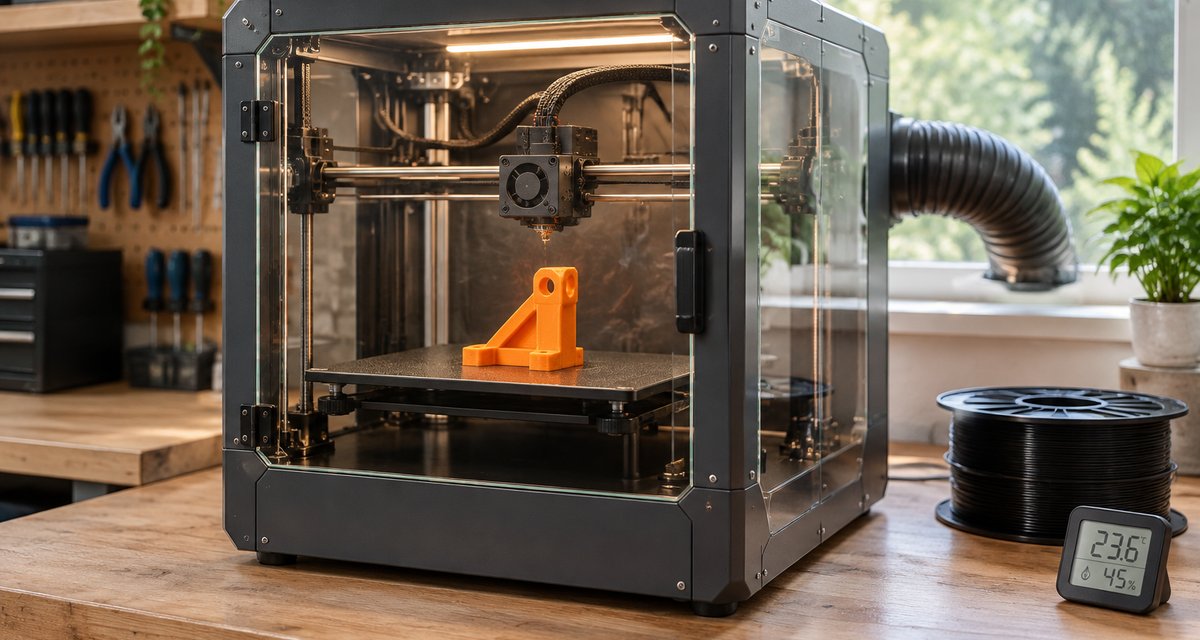
An enclosed 3D printer keeps the air around a print warm and still, which is what ABS, ASA, nylon and PC need to stop warping and cracking. It also keeps dust, drafts and curious hands away from a hot machine. But "enclosed" covers everything from a plastic box that warms up from the bed to a chamber with its own heater, and that difference matters more than the brand. This guide compares six current enclosed printers for different jobs and explains chamber heating, filtration and ventilation in plain terms.
Quick Answer
The best enclosed 3D printer for most people is the Bambu Lab P2S: fully enclosed, with a hardened steel nozzle, a carbon filter and a built-in camera. The Elegoo Centauri Carbon 2 is the budget pick, the Bambu Lab P1S is the easiest start for beginners, and if you print ABS, ASA or nylon often, pay for a heated chamber: the QIDI Q2 holds up to 65°C. Go to the Creality K2 Plus Combo for large parts. An enclosure contains fumes; it does not remove them, so plan ventilation too.
Amazon buttons open Amazon.com search results for that exact printer name in a new tab, not a single product page. Results can include Combo bundles, older models and accessories, so match the model name before you buy. Amazon affiliate links. As an Amazon Associate I earn from qualifying purchases.
TL;DR — Quick Summary
Best Enclosed 3D Printers — 2026 Picks
- 1🏆 Best overall: Bambu Lab P2S — enclosed, hardened nozzle, carbon filter, camera
- 2💵 Best budget: Elegoo Centauri Carbon 2 — 350°C nozzle, HEPA plus carbon filter
- 3🌱 Best for beginners: Bambu Lab P1S — the most documented enclosed printer
- 4🔥 Best for ABS and ASA: QIDI Q2 — chamber actively heated to 65°C
- 5📦 Best large: Creality K2 Plus Combo — 350 mm cube with a 60°C heated chamber
- 6🏭 Best for small businesses: QIDI Plus5 — 65°C chamber, HEPA filter, Ethernet, published power draw
What is Actively Heated Chamber?
Actively Heated Chamber An enclosed print area with its own heater and temperature control, so it holds a set air temperature, such as 60°C or 65°C, regardless of the bed. A passive enclosure has no heater; it only traps the warmth that comes off the heated bed.
🧰 Already own an open-frame printer?
You may not need a new printer. Our enclosure guide compares add-on tents and cabinets that fit around the printer you already have.
Enclosed 3D Printers Compared
Specifications below come from each maker's spec sheet, product page or wiki, checked on November 20, 2026. We do not publish prices because they change daily; the buttons open current Amazon listings. The most important column is the chamber: three of these printers are passive, three have their own heater.
Best overall
Bambu Lab P2S
Build volume: 256 × 256 × 256 mm
Chamber: Enclosed, passive (no chamber heater listed)
Max temps: Nozzle 300°C, bed 110°C
Filtration: Activated carbon
Read why we picked it →Best budget
Elegoo Centauri Carbon 2
Build volume: 256 × 256 × 256 mm
Chamber: Enclosed, passive with an auto-controlled grille
Max temps: Nozzle 350°C, bed 110°C
Filtration: HEPA + coconut shell activated carbon
Read why we picked it →Best for beginners
Bambu Lab P1S
Build volume: 256 × 256 × 256 mm
Chamber: Enclosed, passive (Bambu: not actively heated)
Max temps: Nozzle 300°C, bed 100°C
Filtration: Activated carbon
Read why we picked it →Best for ABS and ASA
QIDI Q2
Build volume: 270 × 270 × 256 mm
Chamber: Actively heated, up to 65°C
Max temps: Nozzle 370°C, bed 120°C
Filtration: G3 pre-filter + H12 HEPA + activated carbon
Read why we picked it →Best large
Creality K2 Plus Combo
Build volume: 350 × 350 × 350 mm
Chamber: Actively heated, up to 60°C
Max temps: Nozzle 350°C, bed 120°C
Filtration: Not detailed in the specs we checked
Read why we picked it →Best for small businesses
QIDI Plus5
Build volume: 320 × 320 × 300 mm
Chamber: Actively heated, up to 65°C
Max temps: Nozzle 370°C, bed 120°C
Filtration: G3 pre-filter + H12 HEPA + activated carbon
Read why we picked it →Left out: Bambu Lab's X2D and H2D also have 65°C heated chambers, but their Amazon.com listings showed as currently unavailable when we checked on November 20, 2026, so we did not include them.
The Best Enclosed 3D Printers
Each pick below covers one kind of buyer. We have not lab-tested these printers: the specifications come from each manufacturer, and we say where a maker's own documentation limits what a printer can do.
Bambu Lab P2S
Best for: Most people who want one enclosed printer for PLA, PETG, ABS, ASA and fiber-filled filaments. Chamber: Enclosed, passive (no chamber heater listed).
The P2S is the enclosed printer we would recommend to most people, because it removes the two usual compromises of a mid-priced enclosed machine. Bambu Lab fits a hardened steel nozzle and hardened steel extruder gear from the factory, so carbon- and glass-fiber filaments are on the supported list without a hotend swap, and it pairs that with a fully enclosed body, an activated carbon filter, a built-in 1080p camera and a door sensor. Bambu Lab presents it as the refined successor to its best-selling P1S. The trade-off is that the chamber is passive: it warms from the bed rather than from a dedicated heater, which is enough for most ABS and ASA parts but not a substitute for the heated chambers further down this list.
Maker's specifications
- Bambu Lab: 256 × 256 × 256 mm build volume in a plastic and glass enclosure
- Hardened steel nozzle and extruder gear; 300°C nozzle and 110°C bed
- Activated carbon filter; Bambu lists VOC and particulate filtration as supported
- Built-in 1920 × 1080, 30 fps camera, door sensor and filament tangle sensor
- Listed materials include PLA, PETG, ABS, ASA, TPU, PC, PA and fiber-filled blends
Watch out for
- No chamber heater is listed, so very large ABS parts and nylon or PC can still warp or crack
- Multicolor printing needs the AMS 2 Pro, which comes with the Combo version, not the printer-only version
- A carbon filter reduces some VOCs; it does not make the printer emission-free or replace ventilation
Amazon buttons open Amazon.com search results for that exact printer name in a new tab, not a single product page. Results can include Combo bundles, older models and accessories, so match the model name before you buy. Amazon affiliate links. As an Amazon Associate I earn from qualifying purchases.
Details from the Bambu Lab P2S technical specifications.
Elegoo Centauri Carbon 2
Best for: Buyers who want an enclosure, a hot hardened nozzle and HEPA filtration for the least money. Chamber: Enclosed, passive with an auto-controlled grille.
If you want an enclosed printer for occasional ABS, ASA or carbon-fiber filament without paying for a heated chamber, the Centauri Carbon 2 gives you the most hardware per dollar of the printers here. Elegoo lists a 350°C hardened steel nozzle, the highest nozzle temperature among the passive printers in this guide, a 110°C heated bed, and a composite HEPA plus coconut shell activated carbon filter. An auto-controlled grille on the chamber lets heat out when you print low-temperature materials and keeps it in for ABS. Like the P2S, the chamber is not actively heated, so it suits small and mid-size engineering parts better than large flat ones. Elegoo's optional CANVAS unit adds four-color printing later.
Maker's specifications
- Elegoo: 256 × 256 × 256 mm build volume, CoreXY motion rated to 500 mm/s
- 350°C hardened steel nozzle and 110°C heated bed
- Enclosed chamber with an auto-controlled smart grille
- HEPA plus coconut shell activated carbon filter, which Elegoo says removes ultrafine particles, VOCs and odors
- Elegoo advertises printing under 45 dB, plus full-auto calibration
Watch out for
- No chamber heater, so large ABS, nylon and PC parts are harder than on an actively heated printer
- Multicolor needs Elegoo's CANVAS unit, sold separately or in the Combo version
- Elegoo does not claim the filter removes all printing emissions, so plan room ventilation anyway
Amazon buttons open Amazon.com search results for that exact printer name in a new tab, not a single product page. Results can include Combo bundles, older models and accessories, so match the model name before you buy. Amazon affiliate links. As an Amazon Associate I earn from qualifying purchases.
Details from the Elegoo US store (Centauri Carbon 2 product page and specifications).
Bambu Lab P1S
Best for: First-time owners who want an enclosed machine with the largest library of guides and print profiles. Chamber: Enclosed, passive (Bambu: not actively heated).
The P1S is the enclosed printer we would hand a beginner. It has been Bambu Lab's mainstream enclosed model for years, so the most common problems a new owner hits have already been answered in Bambu's wiki, in its slicer profiles and in the community, and it uses the same Bambu Studio, Bambu Handy app and MakerWorld model library as Bambu's beginner A1 series. Bambu rates PLA, PETG, TPU, ABS and ASA as ideal materials, with PA and PC as capable. Bambu's own FAQ is clear that the chamber is not actively heated: it warms with the bed and cannot be precisely controlled. For a first printer that is fine. If you know you will print fiber-filled filaments, the P2S above is the better buy because the P1S ships with a stainless steel nozzle.
Maker's specifications
- Bambu Lab: 256 × 256 × 256 mm build volume, enclosed plastic and glass shell
- All-metal hotend with stainless steel nozzle; 300°C nozzle and 100°C bed
- Activated carbon air filter and closed-loop chamber temperature regulator fan
- Ideal materials: PLA, PETG, TPU, PVA, PET, ABS and ASA; capable: PA and PC
- Works with Bambu's AMS for multicolor printing (Combo version or sold separately)
Watch out for
- Stainless steel nozzle: abrasive carbon- or glass-fiber filaments need a hardened steel hotend
- Built-in camera is low frame rate (1280 × 720 at 0.5 fps), fine for timelapses and checks, not live video
- Bambu now sells the P2S as its successor, so check which model the listing actually is
Amazon buttons open Amazon.com search results for that exact printer name in a new tab, not a single product page. Results can include Combo bundles, older models and accessories, so match the model name before you buy. Amazon affiliate links. As an Amazon Associate I earn from qualifying purchases.
Details from the Bambu Lab P1S specifications and P1 Series FAQ.
QIDI Q2
Best for: Anyone who prints ABS, ASA, nylon or PC regularly and wants a heated chamber without a large machine. Chamber: Actively heated, up to 65°C.
ABS and ASA warp because the part cools unevenly, and the most reliable fix is a chamber that is actively held warm, not one that warms only from the bed. The QIDI Q2 is the most compact printer here with a real chamber heater: QIDI lists second-generation PTC chamber heating up to 65°C, controlled independently of the bed, plus a 370°C nozzle and a 120°C bed, which covers ABS, ASA, nylon and PC on paper. QIDI also fits a three-stage filter with a G3 pre-filter, an H12 HEPA layer and coconut shell activated carbon; the Plus5 below uses the same design. If most of your prints are engineering materials, this is the printer to start with.
Maker's specifications
- QIDI: 270 × 270 × 256 mm build volume, CoreXY, up to 600 mm/s
- 2nd-generation PTC chamber heating up to 65°C, independent of the bed
- 370°C bimetal nozzle with hardened steel extruder gears; 120°C bed
- 3-in-1 air filter: G3 pre-filter, H12 HEPA and coconut shell activated carbon
- AI camera, load-cell auto leveling in the hotend, Wi-Fi and Ethernet
Watch out for
- Multicolor printing and tangle detection need the separate QIDI Box
- QIDI sells region-specific 110 V and 220–240 V versions; check the listing matches your outlets
- The chamber heater adds 280 W to the printer's rated power, so expect higher running costs on ABS jobs
Amazon buttons open Amazon.com search results for that exact printer name in a new tab, not a single product page. Results can include Combo bundles, older models and accessories, so match the model name before you buy. Amazon affiliate links. As an Amazon Associate I earn from qualifying purchases.
Details from the QIDI Q2 technical specifications.
Creality K2 Plus Combo
Best for: Helmets, cosplay armor, big enclosures and full plates of parts in ABS or ASA. Chamber: Actively heated, up to 60°C.
The K2 Plus has the largest build volume in this guide, a 350 mm cube, and it pairs that size with an actively heated chamber. That combination matters, because large ABS and ASA parts are the ones most likely to warp and crack. Creality lists a 60°C chamber, a 350°C nozzle and a 120°C bed, and the Combo version includes one CFS unit for four-color printing, expandable to 16 colors with four units. Creality's own wiki is candid about the limits: below about 15°C ambient on 110 V power, the chamber may not reach its 60°C target, so a cold garage is not the ideal place for it.
Maker's specifications
- Creality: 350 × 350 × 350 mm build volume, up to 600 mm/s and 30,000 mm/s²
- Active chamber heating to 60°C; 350°C nozzle; 120°C bed
- Combo includes one CFS (4 spools); up to four CFS units for 16 colors
- Dual AI cameras for print monitoring and flow calibration
- Creality lists ABS, ASA, PC and carbon-fiber nylons among materials that benefit from a hot chamber
Watch out for
- Creality: at 110 V with room temperature below about 15°C, the chamber may not reach 60°C
- A big, heavy machine; check Creality's listed dimensions against your bench or stand before buying
- Filter type is not detailed in the specs we checked, so plan ventilation as if there were none
Amazon buttons open Amazon.com search results for that exact printer name in a new tab, not a single product page. Results can include Combo bundles, older models and accessories, so match the model name before you buy. Amazon affiliate links. As an Amazon Associate I earn from qualifying purchases.
Details from the Creality K2 Plus Combo product page, K2 Plus FAQ and chamber temperature guide.
QIDI Plus5
Best for: Small shops printing functional parts, jigs and fixtures in engineering materials. Chamber: Actively heated, up to 65°C.
A small business needs a printer that can run long jobs in demanding materials, share a room with people, and be costed accurately. The QIDI Plus5 is the best fit here for a shop that makes functional parts: a 320 × 320 × 300 mm build plate for batches, a third-generation chamber heater rated to 65°C, a 370°C nozzle, the same three-stage HEPA and carbon filter as the Q2, and both dual-band Wi-Fi and Ethernet. QIDI also publishes something most makers do not: steady-state power draw of about 190 W printing PLA and 500 W printing ABS at 25°C room temperature, which makes it easier to price jobs. If your business sells multicolor products rather than functional parts, choose the Bambu Lab P2S Combo or the K2 Plus Combo instead.
Maker's specifications
- QIDI: 320 × 320 × 300 mm build volume, CoreXY, up to 600 mm/s
- 3rd-generation chamber heating up to 65°C, independent of the bed
- 370°C bimetal nozzle with hardened steel extruder gears; 120°C bed
- 3-in-1 air filter: G3 pre-filter, H12 HEPA and coconut shell activated carbon
- 2.4/5 GHz Wi-Fi, Ethernet, 32 GB storage, AI camera; QIDI lists steady-state draw of 190 W (PLA) and 500 W (ABS)
Watch out for
- Multicolor needs the optional QIDI Box; Tom's Hardware's August 2026 review reported problems with it, so treat the Plus5 as a single-material machine
- Rated power includes 550 W for the chamber heater and 500 W for the bed; put it on a circuit with headroom
- QIDI sells region-specific 110 V and 220–240 V versions
Amazon buttons open Amazon.com search results for that exact printer name in a new tab, not a single product page. Results can include Combo bundles, older models and accessories, so match the model name before you buy. Amazon affiliate links. As an Amazon Associate I earn from qualifying purchases.
Details from the QIDI Plus5 technical specifications.
🌱 Not sure you need an enclosure yet?
Our beginner guide compares open and enclosed first printers and explains when an enclosure is worth paying for.
💵 Shopping on a strict budget?
Our under-$500 guide compares open-frame, enclosed and multicolor printers by price.
📦 Need more than a 350 mm cube?
Our large 3D printer guide compares open and enclosed printers up to a 500 mm cube, with space and power needs explained.
Fully Enclosed vs Partially Enclosed Printers
Listings use "enclosed" loosely. Before you buy, check how much of the printer is actually closed in, because heat escapes through every open top, missing door and cable gap.
| Question | Fully enclosed | Partially enclosed | Open frame + add-on enclosure |
|---|---|---|---|
| What it is | Walls, door and lid on all sides | Side panels with an open top, missing door or large gaps | An open printer inside a tent or cabinet |
| Heat retention | Best; can include a chamber heater | Limited; heat escapes upward | Good if the enclosure is well sealed |
| Built-in filtration | Common (carbon, sometimes HEPA) | Rare | Only if you add a filter or exhaust fan |
| ABS and ASA | Yes; large parts best with a heater | Small parts only | Yes, with care around electronics and heat |
| Best for | Buying a new printer for engineering materials | Mostly PLA and PETG with some protection | Upgrading a printer you already own |
All six printers in this guide are fully enclosed. If a printer's multicolor unit sits on top, check whether the lid stays closed when it is fitted, and whether the printer is sold with the lid as standard.
Chamber Heating and Temperature Control
This is the single most useful spec to compare. A passive enclosure traps warmth from the heated bed. Bambu Lab says plainly that the P1S chamber is not actively heated: its temperature rises with the bed temperature and cannot be precisely controlled. An actively heated chamber has its own heater and holds a set temperature, like the Q2's and Plus5's 65°C or the K2 Plus's 60°C.
Passive enclosure
Bambu Lab P2S, Bambu Lab P1S and Elegoo Centauri Carbon 2. Lower cost and lower power use. Works for small and mid-size ABS and ASA parts, especially if you let the chamber warm up before printing.
Actively heated chamber
QIDI Q2, QIDI Plus5 and Creality K2 Plus Combo. Holds a set temperature, which helps most with large ABS and ASA parts, nylon and PC. Uses more power while printing hot materials.
Higher is not always better. Creality's chamber temperature guide says higher chamber temperatures improve ABS, ASA, PC and carbon-fiber nylons, but it advises against high chamber temperatures for PLA, PETG and TPU, recommending 30 to 35°C for those materials because they can soften in the extruder and jam.
PLA
Enclosure: Not needed
Chamber: Keep it cool
Open the door or lid. Too much chamber heat can soften PLA in the extruder and cause clogs.
PETG
Enclosure: Optional
Chamber: Keep it cool
Prints well open. An enclosure helps against drafts; keep the chamber near room temperature.
TPU
Enclosure: Not needed
Chamber: Keep it cool
Flexible filament prefers a cool path to the nozzle.
ABS and ASA
Enclosure: Yes
Chamber: Passive works for small parts; active helps large ones
The classic reason to buy an enclosed printer. Large, flat or tall parts warp and crack less with a heated chamber.
Nylon (PA) and PC
Enclosure: Yes
Chamber: Active heating recommended
Both shrink strongly as they cool. Dry the filament first; nylon absorbs moisture quickly.
Carbon- or glass-fiber blends
Enclosure: Depends on the base plastic
Chamber: Follow the base material
Needs a hardened steel nozzle. CF-PLA prints like PLA; CF-nylon prints like nylon.
Ventilation Considerations
An enclosure contains what a printer releases; it does not make it disappear. In a 2016 chamber study, Azimi and colleagues measured ultrafine particles and VOCs from five desktop printers and found that emissions varied mainly by filament, with styrene among the largest VOC emissions from ABS. NIOSH's 3D printing poster recommends controlling emissions at the source, and its guide to safe 3D printing describes enclosures with a fan that exhausts to the outdoors.
Built-in filters help, but they are not equal. HEPA layers target particles, and activated carbon targets gases. In a 2019 study, Gu and colleagues found that a filter cover and an air purifier removed 74 to 93% of ultrafine particles from an ABS print but had varying ability to remove the main VOCs. No printer in this guide is sold as emission-free, and none of these filters makes room ventilation unnecessary.
Ventilate the room
Print ABS and ASA in a room with an open window or exhaust fan, not a closed bedroom.
Vent outdoors if you can
A duct and inline fan from the enclosure to a window removes gases instead of recirculating them.
Maintain the filters
Carbon saturates over time. Replace filters on the schedule the maker gives.
🌬️ Planning ventilation for an enclosed printer?
Our ventilation guide compares inline exhaust fans and room air purifiers, and explains HEPA vs activated carbon with the research behind it.
Buying Guide: How to Choose an Enclosed 3D Printer
- 1Start with your materials: PLA and PETG only? You may not need an enclosure at all. ABS and ASA? Any printer here works. Nylon, PC or large ABS parts? Choose an actively heated chamber.
- 2Compare the chamber, not the word "enclosed": Check whether the maker lists a chamber heater and a maximum chamber temperature. If it does not, the enclosure is passive.
- 3Check the nozzle: Carbon- and glass-fiber filaments wear out brass and stainless nozzles. Look for a hardened steel nozzle, or budget for one.
- 4Read the filter spec: Activated carbon alone targets odors and some VOCs. HEPA plus carbon covers particles too. Neither replaces ventilation.
- 5Size it for your parts and your space: Measure your largest likely part, then check the printer's outside dimensions, weight and the bench or stand it will sit on.
- 6Decide on multicolor now: Every printer here offers multicolor through an add-on unit. Buying the Combo version up front is usually simpler than adding it later.
- 7Plan for power and networking: Heated chambers draw extra power on hot materials. For a business, wired Ethernet and published power figures make life easier.
Common mistakes
- Buying an enclosure for PLA: It costs more and can cause heat-related clogs. Leave the door open for PLA, or buy an open-frame printer.
- Assuming enclosed means heated: Most enclosed printers are passive. Check for a listed chamber heater and temperature.
- Treating a filter as ventilation: A filter reduces some emissions. The room still needs fresh air, especially for ABS and ASA.
- Ignoring the multicolor box on top: Some units sit on the lid. Plan the height of the shelf or cabinet with it fitted.
Frequently Asked Questions
What is the best enclosed 3D printer?
For most people, the Bambu Lab P2S: it is fully enclosed, has a hardened steel nozzle and an activated carbon filter, and handles PLA through ABS and ASA. Choose the Elegoo Centauri Carbon 2 to spend less, the QIDI Q2 if you print ABS, ASA or nylon often and want a heated chamber, and the Creality K2 Plus Combo for large parts.
Do I need an enclosed 3D printer?
Only if you plan to print warp-prone materials such as ABS, ASA, nylon or PC, or you want a barrier against dust, drafts, curious pets and small hands. If you print PLA, PETG and TPU, an open-frame printer works well and usually costs less.
What is the difference between a passive enclosure and a heated chamber?
A passive enclosure is a closed box that warms up from the heated bed, so the chamber temperature depends on the bed and the room. A heated chamber has its own heater and holds a set temperature, such as 60°C or 65°C, which helps most with large ABS and ASA parts, nylon and PC.
Is an enclosed 3D printer safer?
It keeps hot parts and moving parts behind a door and stops drafts, and a built-in filter can reduce some particles and VOCs. An enclosure does not eliminate printing emissions, though. It contains them, so you still need ventilation in the room.
Do enclosed 3D printers need ventilation?
Yes. NIOSH recommends controlling emissions at the source, for example with local exhaust or an enclosure that vents outdoors. Built-in HEPA and carbon filters help, but research shows filters handle particles more reliably than gases, so keep the room ventilated, especially when printing ABS or ASA.
Can you print PLA in an enclosed 3D printer?
Yes, but keep the chamber cool, because too much heat can soften PLA in the extruder and cause clogs. Open the door or lid, or use the printer's cooling settings; Creality recommends a chamber temperature of 30 to 35°C for PLA, PETG and TPU on its K2 Plus.
Is a heated chamber worth it for ABS and ASA?
For small ABS and ASA parts, a passive enclosure is usually enough. For large, tall or flat parts, and for nylon and PC, an actively heated chamber is worth it because it keeps the whole part warm and reduces warping and layer cracking. Creality lists ABS, ASA and PC among the materials that benefit from higher chamber temperatures.
Should I buy an enclosed printer or add an enclosure to my open printer?
If you already own an open-frame printer and only print ABS occasionally, an add-on enclosure is the cheaper route. If you are buying a new printer and want ABS or ASA from the start, a printer with a built-in enclosure is tidier and usually comes with filtration and better sealing.
The Bottom Line
For most people, the Bambu Lab P2S is the enclosed printer to buy: it prints everything from PLA to fiber-filled ABS without upgrades. Spend less with the Elegoo Centauri Carbon 2, or start with the Bambu Lab P1S if you want the most hand-holding as a beginner.
If ABS, ASA, nylon or PC is the reason you want an enclosure, pay for a heated chamber: the QIDI Q2 for most parts, the Creality K2 Plus Combo for big ones, and the QIDI Plus5 for a small shop making functional parts. Whatever you choose, ventilate the room. The enclosure keeps heat in; it does not clean the air.
Start With These
One all-rounder, one budget pick, one heated chamber for ABS and ASA.
Amazon buttons open Amazon.com search results for that exact printer name in a new tab, not a single product page. Results can include Combo bundles, older models and accessories, so match the model name before you buy. Amazon affiliate links. As an Amazon Associate I earn from qualifying purchases.
How We Chose These Printers
We started from the reasons people buy an enclosed printer: one machine for everything, the lowest price, an easy first printer, ABS and ASA, large parts, and steady business use. For each job we picked a current, fully enclosed printer whose maker documents the features that job needs, and on November 20, 2026 we confirmed that each one is sold on Amazon.com under the exact name the button searches for. We left out printers whose Amazon.com listings were unavailable that day.
Specifications and limits quoted here come from the manufacturers' spec sheets, product pages and wikis, not from our own testing. Where we mention an outside review, we name it. We do not claim to have tested these printers, and we do not publish prices or star ratings.
Sources
- Bambu Lab, P2S technical specifications
- Bambu Lab Wiki, P1 Series FAQ
- Elegoo, Centauri Carbon 2 product page
- QIDI, Q2 technical specifications
- QIDI, Plus5 technical specifications
- Creality, K2 Plus Combo product page
- Creality, K2 Plus and CFS FAQ
- Creality Wiki, K2 Pro and K2 Plus chamber temperature guide
- NIOSH, 3D printing safety poster (2020-115)
- NIOSH, Approaches to safe 3D printing (2024-103)
- Azimi et al. (2016), Environmental Science & Technology
- Gu et al. (2019), Environmental Science & Technology Letters
Affiliate Disclosure: This post contains affiliate links. If you purchase through these links, we may earn a small commission at no extra cost to you. We only recommend products we stand behind. See our full disclosure for details.
As an Amazon Associate I earn from qualifying purchases.