Best 3D Printer Filament Maker 2025 — Top 5 Machines Reviewed
By Chris Avery, Publisher / Editor
Want to make your own 3D printer filament at home? We compared the specifications, workflows, and tradeoffs of leading extruder machines — including Filastruder, Felfil Evo, Recreator 3D, and 3Devo — so you know what to consider before spending your money.
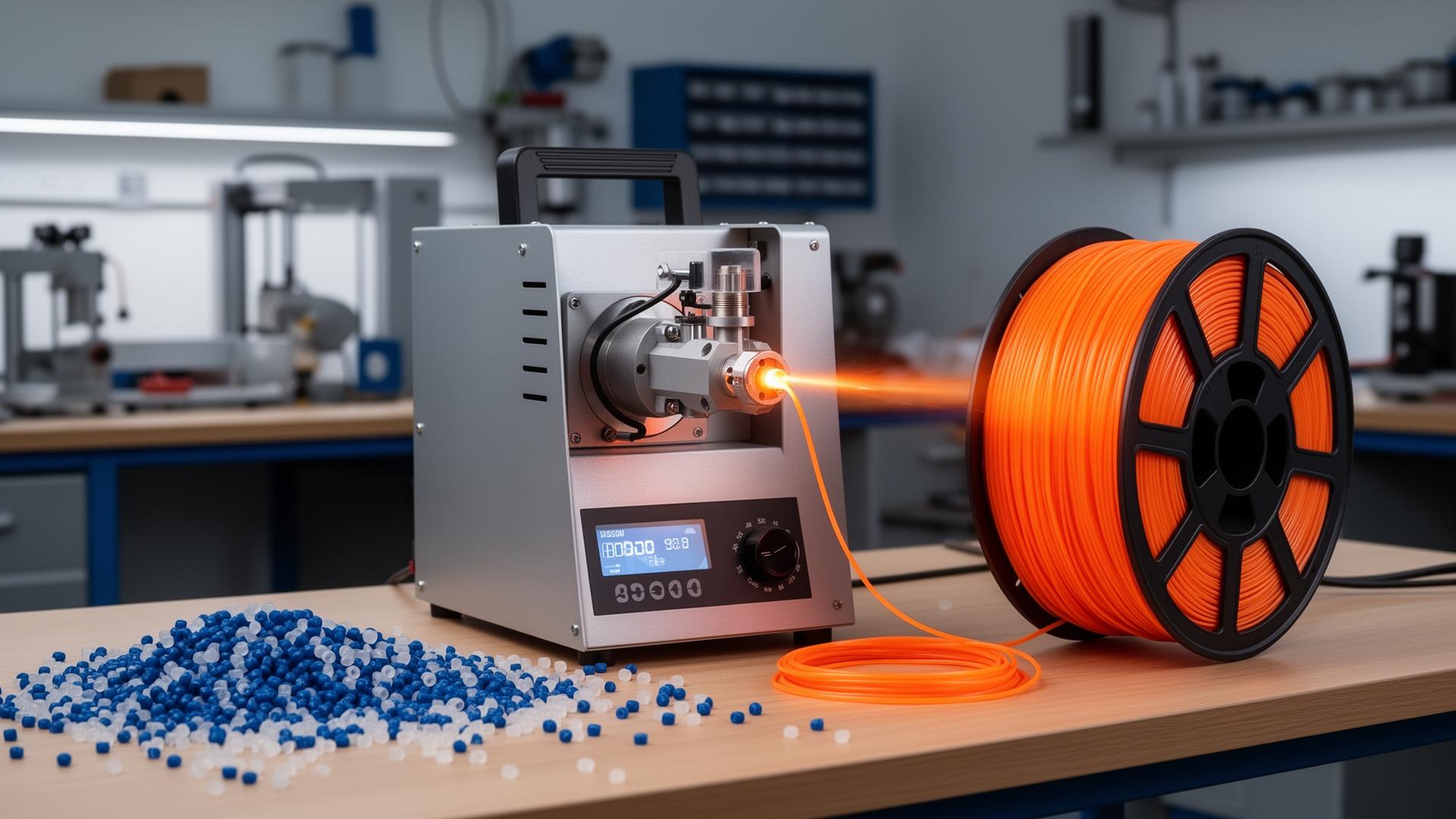
Quick Answer: What Is the Best 3D Printer Filament Maker?
A 3D printer filament maker (extruder) lets you create filament from plastic pellets or recycled prints. The best option for most hobbyists is the Filastruder Kit. Expect a learning curve — for most makers, buying quality filament from Polymaker remains faster and cheaper overall.
TL;DR — Quick Summary
Here's what you need to know about 3D printer filament makers before you buy:
- 1Best overall: Filastruder Kit — proven, community-supported, handles PLA/PETG/ABS/Nylon
- 2Best for recycling: Recreator 3D — built-in diameter sensor, designed for recycled plastic input
- 3Best pro/lab: 3Devo Filament Maker ONE — industrial-grade consistency for researchers
- 4Cost reality: Pellets are far cheaper per kg than spools, but machine cost, time and failed batches erase the saving for most users
What Is a 3D Printer Filament Maker?
A 3D printer filament maker — also called a filament extruder — is a machine that melts raw plastic pellets and forces them through a precision die to produce a continuous strand of filament in a specific diameter (typically 1.75mm or 2.85mm). The filament is then cooled, measured, and wound onto a spool for use in your FDM printer.
What is Filament Extruder?
Filament Extruder A machine that melts raw thermoplastic pellets using a heated barrel and screw mechanism, then forces the molten material through a precision die nozzle to produce continuous 3D printer filament at a controlled diameter. Most desktop units produce 1.75mm or 2.85mm filament at rates of 100–200g per hour.
3D Printer Filament Types and Uses — Complete Guide 2025
Understand all filament types before deciding which material to extrude — covers PLA, PETG, ABS, TPU, Nylon, and specialty materials.
How Does a Filament Extruder Work?
The process has four main stages:
- Feeding: Plastic pellets drop into a hopper and feed into a rotating screw inside a heated barrel.
- Melting: The barrel heats the pellets to the material's melt temperature (e.g., 180–220°C for PLA).
- Extrusion: The molten plastic is forced through a precision die — the die diameter determines your filament diameter.
- Cooling & Winding: The extruded strand cools in air (or a water bath on pro models) and is wound onto a spool, sometimes with an automatic winder.
What Materials Can You Use in a Filament Maker?
Most desktop filament extruders support these pellet types:
PLA
Easiest — low temp, forgiving, widely available pellets
PETG
Good mid-range option — slightly higher temps, moisture-sensitive pellets
See best PETG filament →ABS
Requires higher temps and ventilation — warping during extrusion is common
Nylon
Challenging — hygroscopic pellets must be pre-dried; high-temp extrusion required
See best Nylon filament →CF-blends
Requires hardened steel die — abrasive on standard brass components
Best Hardened Steel Nozzle 2025
Carbon fiber and abrasive filament blends wear out brass nozzles fast — a hardened steel nozzle is essential for CF-blended extrusion.
Complete 3D Printer Filaments Guide
Our complete filaments guide covers properties, ideal use cases, and print settings for every major material type.
Is Making Your Own Filament Worth It?
This is the most important question — and the honest answer is: for most hobbyists, no. Here's why the math often doesn't add up.
How Much Does a Filament Maker Cost to Run?
| Cost Factor | DIY Filament | Polymaker Retail |
|---|---|---|
| Raw material cost | Pellets — lowest per kg | Finished spool — higher per kg |
| Machine amortized (over 2 years) | Significant added cost per kg | None |
| Your time (30–60 min setup/batch) | Real cost if your time has value | None |
| Failed batches / waste | Ongoing material loss | None |
| Diameter consistency | ±0.05–0.10mm | ±0.02mm |
| Effective total cost | Pellets plus wasted material and machine time | Current per-kg spool price at checkout |
The Break-Even Reality
Once you account for machine cost, your time, and failed batches, DIY filament typically only becomes cost-effective if you're printing 10kg+ per month consistently. Most hobbyists print 1–3kg/month — in that range, buying quality filament is almost always cheaper.
Best Budget PLA Filament Under $15 (2025)
Ready-made premium PLA filament — often cheaper than the true cost of DIY extrusion once you factor in machine and time.
When DIY filament makes sense:
- You want to experiment with custom material blends (color mixing, additive pellets)
- You're recycling failed prints and plastic waste at high volume
- You need exotic materials not sold as retail filament
- You're in a research or educational lab setting
What Are the Best 3D Printer Filament Makers in 2025?
Here are the five best filament extruder machines available right now, covering every budget and use case from hobbyist to professional lab.
Filastruder Kit
Approx. retail price
Throughput
~150g/hr
Diameter
1.75mm / 2.85mm
Best For
Best Overall DIY
Key Features
- Open-source design
- Community-proven for years
- Supports PLA, PETG, ABS, Nylon
- DIY kit format with full instructions
✓ Pros
- Proven reliability over many years
- Active community with constant upgrades
- Affordable entry price
- Highly customizable
✗ Cons
- Requires self-assembly
- No display or automated controls
- Needs separate winder
Felfil Evo
Approx. retail price
Throughput
~100g/hr
Diameter
1.75mm / 2.85mm
Best For
Best Desktop Extruder
Key Features
- Open-source hardware
- Modular design
- Digital temperature control
- Supports multiple materials
✓ Pros
- Clean desktop form factor
- Open-source and hackable
- Good temperature control
- European-made quality
✗ Cons
- Lower throughput than Filastruder
- Pricier for the output rate
- Limited US support
Recreator 3D
Approx. retail price
Throughput
~120g/hr
Diameter
1.75mm
Best For
Best for Recycling
Key Features
- Designed for recycled plastic input
- Integrated filament diameter sensor
- Automatic speed adjustment
- Compatible with ground-up failed prints
✓ Pros
- Best for recycling failed prints
- Automatic diameter correction
- Eco-friendly angle
- Good build quality
✗ Cons
- Requires shredder as companion purchase
- Consistency varies with mixed plastics
- Higher upfront cost
3Devo Filament Maker ONE
Approx. retail price
Throughput
~200g/hr
Diameter
1.75mm / 2.85mm
Best For
Best for Research & Labs
Key Features
- Professional-grade 4-zone heater
- Optical filament sensor
- Automated spooling
- Data logging and connectivity
✓ Pros
- Research-grade diameter consistency
- Fully automated process
- Handles exotic materials
- Excellent data logging
✗ Cons
- Very expensive — not for hobbyists
- Overkill for home use
- Requires training to operate
Noztek Pro
Approx. retail price
Throughput
~120g/hr
Diameter
1.75mm / 2.85mm
Best For
Best Value
Key Features
- Plug-and-play operation
- Digital temperature display
- Pre-assembled unit
- UK-made construction
✓ Pros
- No assembly required
- Simple operation
- Good build quality
- Reasonable price
✗ Cons
- Manual spooling required
- No diameter sensor
- Older design
How Do You Choose the Right Filament Maker?
If you've decided a filament extruder is right for you, here are the key factors to evaluate:
What Diameter Filament Does Your Printer Use?
Almost all modern FDM printers use 1.75mm filament. Some older or professional machines use 2.85mm (sometimes called 3mm). Confirm your printer's specification before purchasing an extruder — most quality machines support both diameters with die swaps, but verify before buying.
Best 3D Printers — Complete Buyers Guide
Choosing a printer to pair with your DIY filament? Our printers buyers guide covers the best FDM options for every budget and use case.
What Throughput Speed Do You Need?
Desktop extruders produce 100–200g of filament per hour. At 150g/hr, producing a single 1kg spool takes roughly 6–7 hours of unattended run time. For most hobbyists this is perfectly acceptable — but if you need multiple spools per week, look at higher-throughput machines like the 3Devo Filament Maker ONE.
Budget
Under $400: Filastruder or Noztek Pro. $400–600: Felfil Evo or Recreator. $3,000+: 3Devo ONE.
Recycling Focus
Recreator 3D is purpose-built for recycled plastic input. Requires a companion shredder.
Material Range
All handle PLA. For Nylon or high-temp materials, ensure the machine reaches 250°C+.
Automation
Manual winding: Filastruder, Noztek. Auto-winding: 3Devo ONE. Semi-auto: Felfil Evo.
Best Filament Dryer 2025
Whether you're extruding or buying filament, a good filament dryer is essential — especially for hygroscopic materials like Nylon and PETG.
Frequently Asked Questions About 3D Printer Filament Makers
How much does it cost to make your own 3D printer filament?
Raw plastic pellets cost substantially less per kilogram than retail filament spools, but the machine itself, electricity, your time and failed batches all count against the saving. For most hobbyists printing under about 5kg a month, buying quality filament remains cheaper overall. High-volume users may eventually break even; run the numbers with current pellet and spool prices.
What plastic pellets can you use in a filament maker?
Most desktop filament extruders support PLA, PETG, ABS, TPU, and Nylon pellets. PLA is the easiest to extrude due to its low melting temperature and forgiveness. Nylon and ABS require higher temperatures and a more controlled environment. TPU needs a slower extrusion speed. Exotic pellets like PC or carbon-fiber reinforced materials require professional-grade machines like the 3Devo Filament Maker ONE.
Can I make 1.75mm filament at home?
Yes — most consumer filament extruders including the Filastruder, Felfil Evo, and Noztek Pro support both 1.75mm and 2.85mm nozzle diameters, switched by swapping the die. Achieving consistent diameter within ±0.05mm tolerance (the industry standard) requires careful temperature control and a constant feed rate. Cheaper machines may produce filament that clogs your printer if diameter varies too much.
Is recycling failed 3D prints into new filament possible?
Yes, but it requires two machines: a plastic shredder (to grind failed prints into pellet-sized pieces) and a filament extruder. The Recreator 3D is specifically designed for this use case. Be aware that each recycling cycle slightly degrades the plastic, affecting print quality over time. Mixed-material recycling (PLA + PETG together) produces unusable filament — sort your waste by material type.
Are DIY filaments as good as commercial filaments like Polymaker?
Honestly, no — not for most users. Commercial filaments like Polymaker undergo industrial extrusion with precise diameter control (±0.02mm), consistent material blending, and quality testing. Home extruders typically produce filament with more variance (±0.05–0.10mm), which can cause under/over-extrusion and clogs. DIY filament makes sense for custom material experiments or recycling, not for replacing quality retail filament for everyday printing.
Our Verdict: Should You Buy a 3D Printer Filament Maker?
If you print at high volume, want to experiment with custom materials, or are passionate about recycling your plastic waste — a filament extruder is a worthwhile investment. Start with the Filastruder Kit for the best balance of cost, community support, and proven reliability.
For everyone else — especially makers printing under 5kg per month — buying quality retail filament from Polymaker delivers better consistency at lower effective cost, with none of the setup headache. The Polymaker PolyTerra and PolyLite lines are produced to ±0.02mm diameter tolerance that no desktop extruder can match.
Skip DIY — Buy Instead of Build
Sovol sells FDM 3D printers and printing supplies, so there's no extruder to set up.
Shop 3D Printing Supplies at SovolAffiliate Disclosure: This post contains affiliate links to Polymaker and Sovol3D. If you purchase through these links, we may earn a small commission at no extra cost to you. This helps us keep 3D Print Geek running. We only recommend products and brands we genuinely believe in. All opinions are our own.
Related Articles
Best 3D Printing Temperature Settings (What Actually Worked for Me)
Best 3D printing temperature settings for PLA, PETG, and ABS. Real-world numbers, US filament picks, and dialed-in starting points — no guessing.
Best Filament for Functional Parts (What Actually Holds Up)
The best filament for functional 3D parts — real picks for strength, heat, and impact. US pricing, honest experience-based recommendations.
Why Your 3D Prints Have Stringing (And How I Fixed It Fast)
3D printing stringing fix that actually works. Real causes, real settings, and the simple changes that finally kill stringing on prints.