Best Filament Storage Container 2025 — Top 5 Dry Boxes Reviewed
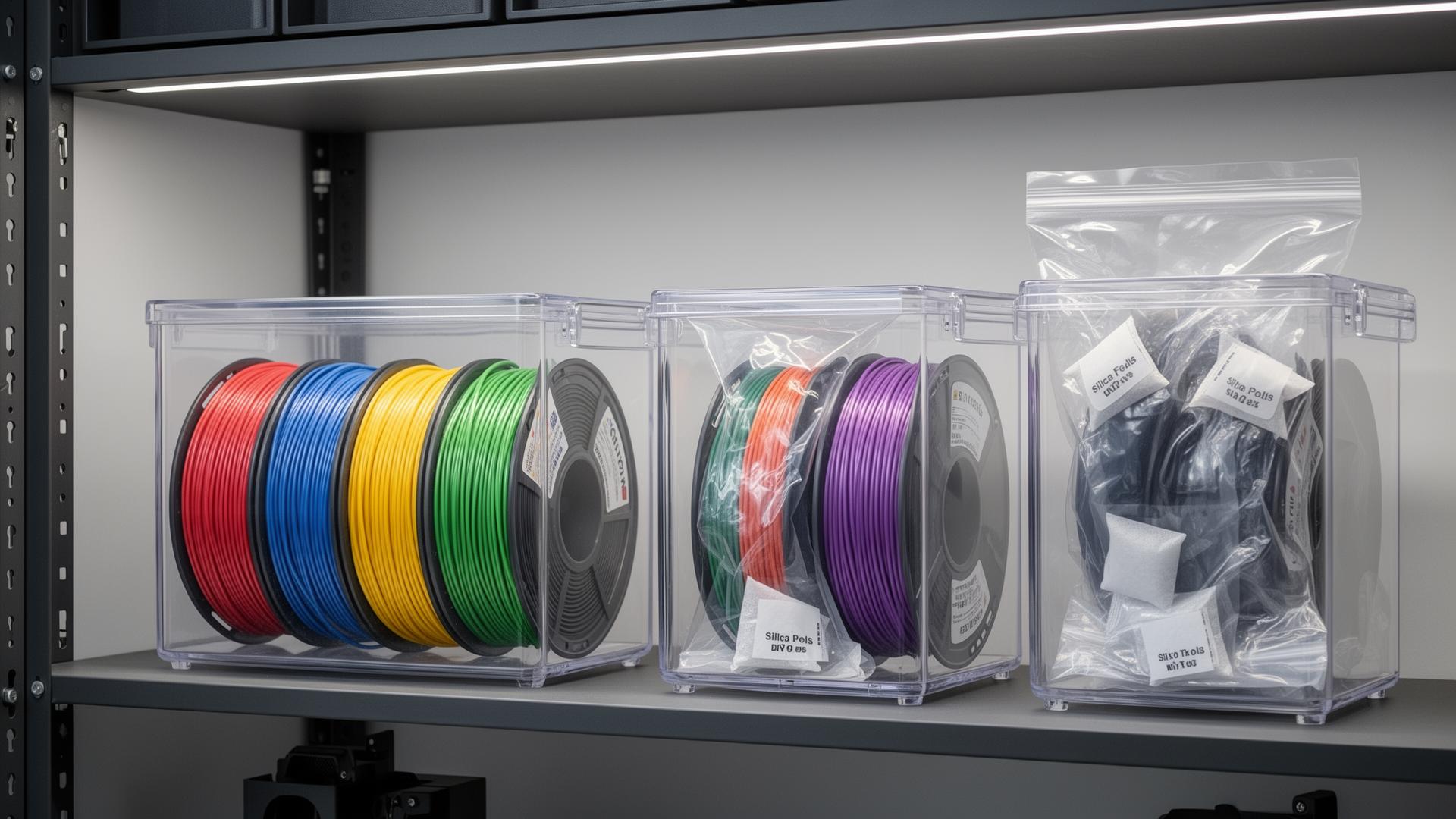
Moisture is the silent killer of 3D printer filament. The best filament storage container in 2025 keeps your spools dry, prevents print quality degradation, and can even dry wet filament while you print. We reviewed the top five storage solutions from vacuum bags to heated dry boxes.
Quick Answer: What Is the Best Filament Storage Container?
The SUNLU FilaBox S2 is the best filament storage container for most users in 2025. It combines airtight storage with active heating and a feed-through port for printing directly from the sealed box. For budget buyers, Wisely Vacuum Bags ($25 for 10) offer the cheapest effective moisture protection.
Stock up on quality filament worth protecting
Polymaker filament is vacuum-sealed from the factory — pair it with proper storage for perfect prints every time.
TL;DR — Quick Summary
Here's what you need to know about filament storage before you buy:
- 1Best overall: SUNLU FilaBox S2 — active drying, feed port, humidity display
- 2Best for Polymaker: Polymaker PolyBox II — holds 2 spools, great build quality
- 3Best budget: Wisely Vacuum Bags ($25/10-pack) — cheapest effective moisture protection
- 4Best dryer combo: EIBOS Dryer & Storage — strongest drying with precision temp control
- 5Key rule: Keep filament below 20% relative humidity — desiccant or active heating required
Why Does Filament Storage Matter?
Most 3D printer filaments are hygroscopic — they absorb moisture from the air. This absorbed water turns to steam inside your printer's hot end, causing popping, stringing, poor layer adhesion, and surface defects. Materials like Nylon, TPU, and PETG can absorb enough moisture in 24–48 hours to noticeably degrade print quality.
What is Hygroscopic?
Hygroscopic A property of materials that readily absorb moisture from the surrounding air. In 3D printing, hygroscopic filaments (Nylon, TPU, PETG, PVA) absorb water vapor even in normal room humidity (40–60% RH). This absorbed moisture causes printing defects including popping, bubbling, stringing, and reduced layer adhesion. Proper storage below 20% RH prevents moisture absorption.
Best Filament Dryer 2025
Already have wet filament? A dedicated dryer rescues moisture-damaged spools — then store them properly to keep them dry.
Which Filaments Need Storage the Most?
ABS/ASA
Benefits from storage but less sensitive than PETG
PLA
Most forgiving — but still degrades over months open
PLA+
Slightly more sensitive than standard PLA
3D Printer Filament Types and Uses — Complete Guide
Understand moisture sensitivity across all filament types in our comprehensive material guide.
What Are the Best Filament Storage Containers in 2025?
Here are the five best filament storage solutions, from budget vacuum bags to heated print-while-dry boxes.
SUNLU FilaBox S2
Approx. retail price
Capacity
1 spool (1kg)
Best For
Best Overall
Key Features
- Built-in filament feed port
- Real-time humidity display
- Heater dries while printing
- Airtight silicone seal
✓ Pros
- Print directly from the dry box
- Active heating keeps filament dry during use
- Clear humidity readout
- Compact and stackable
✗ Cons
- Only holds 1 spool
- Fan can be audible
- Heating element uses extra power
Polymaker PolyBox II
Approx. retail price
Capacity
2 spools (2kg)
Best For
Best for Polymaker Users
Key Features
- Holds 2 spools simultaneously
- Built-in hygrometer
- Filament output ports on both sides
- Compatible with all 1kg spool sizes
✓ Pros
- Dual-spool capacity saves space
- High-quality Polymaker build
- Feed filament directly to printer
- Works with any brand filament
✗ Cons
- No active heating element
- Slightly bulky footprint
- Desiccant packs sold separately
Wisely Vacuum Bags 10-Pack
Approx. retail price
Capacity
10 individual spool bags
Best For
Best Budget Solution
Key Features
- Vacuum-seal with hand pump
- Reusable zip-lock design
- Includes humidity indicator cards
- Fits standard 1kg spools
✓ Pros
- Cheapest per-spool storage option
- No shelf space needed
- Vacuum removes moisture effectively
- 10 bags covers a large collection
✗ Cons
- No active drying capability
- Bags can puncture over time
- Manual vacuum pump is tedious
EIBOS Filament Dryer & Storage
Approx. retail price
Capacity
1 spool (1kg)
Best For
Best Dryer + Storage Combo
Key Features
- Heated drying up to 70°C
- Print-while-drying PTFE port
- 360° even heat distribution
- Digital temperature and timer
✓ Pros
- Strongest drying capability of any box
- Precise temperature control
- Can rescue badly wet filament
- Double-duty as dryer and storage
✗ Cons
- Most expensive single-spool option
- Bulkier than passive storage
- Overkill for PLA-only users
JAYO Filament Dry Box
Approx. retail price
Capacity
1 spool (1kg)
Best For
Best Value Active Box
Key Features
- Mild heating element
- Feed-through filament port
- Simple one-button operation
- Compact design
✓ Pros
- Good balance of price and features
- Active heating at a budget price
- Simple to operate
- Lightweight and portable
✗ Cons
- Lower max temperature than EIBOS
- Basic humidity display
- Heating element less powerful
How Do You Choose the Right Filament Storage?
Active vs Passive
Active boxes heat filament to remove moisture. Passive containers just prevent new absorption. Wet filament needs active drying first.
Collection Size
1–3 spools: Individual dry boxes. 5–10: Vacuum bags. 10+: Large airtight tubs with desiccant.
Material Sensitivity
PLA-only users can use basic vacuum bags. Nylon/TPU users should invest in heated dry boxes.
Budget
$25: Vacuum bags for 10 spools. $35–45: Single-spool active boxes. $55: Premium dryer-storage combo.
Best Filament Dryer 2025
Need to rescue wet filament first? Our dedicated dryer guide reviews the top drying machines.
Complete 3D Printer Filaments Guide
Explore filament properties and storage needs across all material types.
Frequently Asked Questions About Filament Storage
How do I know if my filament has absorbed moisture?
Wet filament produces popping or crackling sounds during printing as moisture turns to steam in the hot end. You may also see stringing, poor layer adhesion, bubbling on the surface, and a rough matte finish instead of a smooth one. Nylon, TPU, and PETG are the most moisture-sensitive materials — they can absorb enough moisture in 24–48 hours of open-air exposure to cause print quality issues.
Do I need a filament dry box if I only print PLA?
PLA is the least hygroscopic common filament, but it still absorbs moisture over weeks of open storage — especially in humid climates (above 50% relative humidity). If you print regularly and use spools within 1–2 weeks, simple vacuum bags are sufficient. For long-term storage or if you live in a humid area, an airtight container with desiccant is worth the investment even for PLA.
Can I use regular airtight containers instead of dedicated filament boxes?
Yes — any food-grade airtight container large enough to fit a filament spool works. Cereal containers, large Tupperware, or 5-gallon buckets with gamma seal lids are popular DIY options. Add silica gel desiccant packs (rechargeable ones are best) and a cheap hygrometer. The advantage of dedicated filament boxes is the built-in feed port for printing directly from the sealed container.
How long does desiccant last in a filament storage container?
Standard silica gel desiccant packs last 1–3 months in a sealed container before needing regeneration. Color-indicating silica gel turns from orange to green when saturated. To regenerate, bake the packs at 120°C (250°F) for 2–3 hours in a conventional oven. Rechargeable electric desiccant units regenerate with a button press and last indefinitely.
Is a filament dryer the same as a filament storage container?
No — a filament dryer actively heats filament to remove absorbed moisture (typically at 40–70°C for several hours). A storage container passively prevents moisture absorption using an airtight seal and desiccant. Some products like the SUNLU FilaBox and EIBOS combine both functions — they dry filament while you print from them. For best results, dry wet filament first in a dedicated dryer, then store it in an airtight container.
Our Verdict: Which Filament Storage Should You Buy?
The SUNLU FilaBox S2 is the best filament storage container for active users who want to print directly from a sealed, heated box. For Polymaker fans, the PolyBox II holds two spools and pairs perfectly with PolyTerra and PolyLite filaments.
Related Articles
Best 3D Printing Temperature Settings (What Actually Worked for Me)
Best 3D printing temperature settings for PLA, PETG, and ABS. Real-world numbers, US filament picks, and dialed-in starting points — no guessing.
Best Filament for Functional Parts (What Actually Holds Up)
The best filament for functional 3D parts — real picks for strength, heat, and impact. US pricing, honest experience-based recommendations.

Why Your 3D Prints Have Stringing (And How I Fixed It Fast)
3D printing stringing fix that actually works. Real causes, real settings, and the simple changes that finally kill stringing on prints.
Affiliate Disclosure: 3D Print Geek is reader-supported. When you buy through links on our site, we may earn an affiliate commission at no extra cost to you. This helps us keep creating free content. We only recommend products we genuinely believe in.