Best 3D Printer Lubricant (2026): Grease, Oil and Maintenance Picks
By Chris Avery, Publisher / Editor
There is no single best 3D printer lubricant, because printers do not all want the same thing. Bambu Lab oils one rail and forbids grease on another. Prusa greases its rods but says to leave the Z lead screws dry. Sovol and Creality ban liquid lubricants on their motion parts. This guide picks five lubricants that printer makers actually name, then shows where each one goes, where nothing should go, and how often to do it.
Quick Answer
Use the lubricant your printer maker specifies for each part. When the manual calls for grease, a synthetic PTFE grease such as Super Lube 21030 is the best all-round choice: Prusa names Super Lube 210XX greases for its i3 printers and Sovol calls for PTFE grease on its rails. Grease lead screws only if your maker says to (Bambu Lab, Creality and Sovol do; Prusa does not), use oil where it specifies oil, and never lubricate belts unless the manual tells you to.
Amazon buttons open Amazon.com search results for that exact product name in a new tab, not a single product page. Results can include other sizes, multi-packs and similar items, so match the brand, product number and size before you buy. Amazon affiliate links. As an Amazon Associate I earn from qualifying purchases.
TL;DR — Quick Summary
Best 3D Printer Lubricants — 2026 Picks
- 1🏆 Best overall: Super Lube 21030 PTFE grease — named by Prusa for i3 printers, fits Sovol's PTFE grease spec
- 2🛤️ Best for linear rails: Super Lube 21030 — where your printer maker specifies grease on rails
- 3🔩 Best for lead screws: Lucas Oil 10533 white lithium grease — listed by Bambu Lab as an equivalent
- 4💧 Best lightweight oil: Super Lube 52004 ISO 68 oil — suggested in Bambu Lab's X1 guide for steel rods
- 5🧪 Best PTFE-based: Super Lube 92003 silicone grease with PTFE — plastic-compatible, Bambu-listed
- 6💲 Best budget: Lucas Oil 10533 — 8 oz tube, and a lead screw needs only a thin film
- 7🅰️ Bambu A1 series only: WD-40 Multi-Use Product — approved by Bambu Lab for the A1 Y rail; Sovol forbids it
What is 3D Printer Lubricant?
3D Printer Lubricant A grease or oil applied in a thin film to a printer's motion parts, such as linear rails, smooth rods, bearings and lead screws, to reduce friction, wear, noise and rust. Which lubricant goes where, and which parts get none, is set by each printer maker's maintenance instructions.
🩺 Not sure lubrication is the problem?
Grinding, layer shifts and banding have several causes. Our troubleshooter walks through the likely ones before you buy anything.
3D Printer Lubricants Compared
Specifications come from each lubricant maker's data sheet or product page; printer compatibility comes from Bambu Lab, Prusa, Creality and Sovol maintenance guides, checked on November 20, 2026. We do not publish prices; the buttons open current Amazon listings.
Best overall 3D printer lubricant · Best grease for linear rails
Super Lube 21030
Type: Synthetic PTFE grease, NLGI 2
Fits: Linear rails, smooth rods and bearings, and lead screws where the printer maker calls for grease
Read why we picked it →Best grease for lead screws · Best budget option
Lucas Oil 10533
Type: White lithium grease, NLGI 2
Fits: Z-axis lead screws on printers whose maker calls for grease there
Read why we picked it →Best PTFE-based lubricant
Super Lube 92003
Type: Silicone grease with PTFE
Fits: Lead screws, and metal-to-plastic or plastic-to-plastic contact the printer maker says to grease
Read why we picked it →Best lightweight oil
Super Lube 52004
Type: Synthetic lightweight oil, ISO 68
Fits: Steel rods, shafts and guide rails where the printer maker specifies oil or an anti-rust oil film
Read why we picked it →Best for the Bambu Lab A1 series Y rail
WD-40 Multi-Use Product
Type: Light lubricant spray
Fits: The Y-axis guide rail on the Bambu Lab A1 and A1 mini, following Bambu's WD-40 guide
Read why we picked it →The Best 3D Printer Lubricants
Three greases, one light oil and one spray. Every pick is named in at least one printer maker's maintenance guide, and each card says which printers it suits and which it does not. We have not lab-tested these products: specifications come from the lubricant makers, and compatibility comes from the printer makers.
Synthetic PTFE grease, NLGI 2
Super Lube 21030 Multi-Purpose Synthetic Grease with Syncolon (PTFE), 3 oz Tube
Best for: Most owners who want one tube of grease for the parts their printer's manual says to grease.
Printer makers: Prusa names Super Lube 210XX for i3 printers; Sovol specifies PTFE grease for its rails.
If you only buy one lubricant, make it a grease that printer makers already point to. Prusa's maintenance guide for its i3 printers names Super Lube 210XX greases as a recommended alternative to its own lubricant, and Sovol's maintenance guide calls for PTFE lubricating grease on its linear rails. Super Lube 21030 is that grease in a 3 oz tube: a synthetic, NLGI grade 2 grease with Syncolon, Super Lube's PTFE powder. Super Lube says it does not evaporate or form gummy deposits and contains no silicone. It is a sensible default for rails, rods, bearings and lead screws, but only on printers whose manual asks for grease on that part.
Maker and listing specifications
- Synthetic base fluid with Syncolon (PTFE) micro powder; NLGI grade 2
- Super Lube: -45°F to 450°F (-43°C to 232°C) operating range
- Super Lube: does not evaporate or form gummy deposits; contains no silicone
- NSF H1 registered food-grade lubricant; 3 oz (85 g) tube
Watch out for
- Grease, not oil: do not use it where your printer maker specifies oil, such as the Bambu Lab A1 Y-axis rail
- Prusa says not to lubricate the Z-axis lead screws or trapezoid nuts on its MK4 and i3 printers
- A small brush or syringe makes thin coats easier than squeezing straight from the tube
Amazon buttons open Amazon.com search results for that exact product name in a new tab, not a single product page. Results can include other sizes, multi-packs and similar items, so match the brand, product number and size before you buy. Amazon affiliate links. As an Amazon Associate I earn from qualifying purchases.
Details from the Super Lube product page and technical data sheet, Prusa and Sovol maintenance guides, and the Amazon.com listing.
White lithium grease, NLGI 2
Lucas Oil 10533 White Lithium Grease, 8 oz Squeeze Tube
Best for: Bambu Lab, Creality and Sovol owners refilling grease for Z-axis lead screws.
Printer makers: Bambu Lab lists Lucas Oil 10533 as an equivalent to its own lubricant grease.
Lead screws need a grease that stays put on the threads while the bed travels up and down. Bambu Lab's lubricant guide lists Lucas Oil 10533 White Lithium Grease by name as an equivalent to its own lubricant grease, which Bambu describes as the one for lead screws. Lucas describes it as a multi-purpose NLGI 2 grease with a stay-in-place formula that will not drip or run. It comes in an 8 oz squeeze tube, larger than the 3 oz Super Lube tubes in this guide, and a lead screw only needs a thin film, so one tube goes a long way. That makes it our budget pick: a widely sold garage grease that a printer maker names directly.
Maker and listing specifications
- Lucas: multi-purpose NLGI #2 white lithium grease with a simple lithium thickener
- Lucas: stay-in-place formula that will not drip or run
- 8 oz squeeze tube
- Named by Bambu Lab as an equivalent alternative to Bambu Lubricant Grease
Watch out for
- Use it on lead screws, not on Bambu carbon rods or rails that call for oil
- Prusa MK4 and i3 owners should not grease the Z lead screws at all
- Do not mix it on the same part with a different grease; clean the old grease off first
Amazon buttons open Amazon.com search results for that exact product name in a new tab, not a single product page. Results can include other sizes, multi-packs and similar items, so match the brand, product number and size before you buy. Amazon affiliate links. As an Amazon Associate I earn from qualifying purchases.
Details from the Lucas Oil product data sheet, Bambu Lab Wiki lubricant guide and the Amazon.com listing.
Silicone grease with PTFE
Super Lube 92003 Silicone Lubricating Grease with PTFE, 3 oz Tube
Best for: Owners who want a PTFE grease that is compatible with most plastics and quieter in operation.
Printer makers: Bambu Lab lists Super Lube 92003 as an equivalent to its own lubricant grease.
Many printers have plastic nuts, sleeves or carriages near the parts you grease, so plastic compatibility matters. Super Lube 92003 is a non-curing silicone grease with Syncolon (PTFE). Super Lube's data sheet says it is compatible with most plastics and rubbers, lists metal-to-plastic and plastic-to-plastic contact, bushings and plastic gears among its uses, and notes good sound dampening. Bambu Lab's lubricant guide names it as an equivalent to Bambu Lubricant Grease for lead screws. It is a thick grease, so it belongs in the same places as other greases, not where a manual specifies oil.
Maker and listing specifications
- Non-curing silicone compound with Syncolon (PTFE) micro powder
- Super Lube: compatible with most plastics and rubbers; will not harden, dry out or melt
- Super Lube: listed uses include plain bearings, bushings, plastic gears and metal-to-plastic contact
- NSF H1 registered food-grade lubricant; 3 oz tube
Watch out for
- Silicone grease is hard to remove from surfaces; keep it off build plates and anything you plan to paint or glue
- Thick consistency: not a substitute for oil on rails or rods that call for oil
- Still check your printer's manual; one grease is not right for every printer
Amazon buttons open Amazon.com search results for that exact product name in a new tab, not a single product page. Results can include other sizes, multi-packs and similar items, so match the brand, product number and size before you buy. Amazon affiliate links. As an Amazon Associate I earn from qualifying purchases.
Details from the Super Lube silicone grease technical data sheet, Bambu Lab Wiki lubricant guide and the Amazon.com listing.
Synthetic lightweight oil, ISO 68
Super Lube 52004 Synthetic Lightweight Oil (ISO 68), 4 oz Bottle
Best for: Bambu Lab owners maintaining steel rods, and any printer whose manual calls for a light oil.
Printer makers: Bambu Lab's X1 maintenance guide suggests Super Lube 52004 for its Y and Z linear rods.
Where a printer maker asks for oil rather than grease, you want a thin, clean oil that will not gum up. Bambu Lab's X1 maintenance guide recommends regular anti-rust care for the Y and Z linear rods, done by wiping them with oil on a dust-free cloth, and says you can refer to Super Lube 52004 Synthetic Lightweight Oil for better performance. Super Lube rates 52004 at ISO 68, a light machine-oil grade, and lists rust and corrosion protection, oxidation resistance and use on bearings, slideways and sensitive instruments. It contains no PTFE. It is the oil pick, so it does not belong on printers whose makers forbid liquid lubricants.
Maker and listing specifications
- Synthetic lightweight oil, ISO viscosity grade 68
- Super Lube: prevents rust and corrosion, viscosity stable, oxidation resistant
- Super Lube: typical uses include bearings, horizontal slideways and sensitive instruments
- NSF H1 registered food-grade lubricant; 4 oz bottle
Watch out for
- Sovol says liquid lubricants must not be used on its rails
- Creality says never to use liquid lubricants on its K1 series
- Oil migrates and evaporates sooner than grease, so expect to reapply more often
Amazon buttons open Amazon.com search results for that exact product name in a new tab, not a single product page. Results can include other sizes, multi-packs and similar items, so match the brand, product number and size before you buy. Amazon affiliate links. As an Amazon Associate I earn from qualifying purchases.
Details from the Super Lube lightweight oil technical data sheet, Bambu Lab Wiki X1 maintenance guide and the Amazon.com listing.
Light lubricant spray
WD-40 Original Formula Multi-Use Product with Smart Straw
Best for: A1 and A1 mini owners who have run out of the oil in the accessory box.
Printer makers: Bambu Lab approves it for the A1 and A1 mini Y-axis rail; Sovol says WD-40 must not be used.
This pick is here to make a point: the right lubricant depends on the printer. Bambu Lab switched the A1 series Y-axis guide rail from grease to oil because grease attracted dust, and its wiki says that besides the oil in the accessory box, you can use WD-40 Multi-Use Product on that rail, with a dedicated guide showing how. Bambu specifies the original Multi-Use Product only and warns against other WD-40 branded products such as WD-40 Specialist sprays or greases. Sovol's maintenance guide says the opposite for its printers: WD-40 and other liquid lubricants must not be used on its rails. Buy this only if you own an A1 or A1 mini.
Maker and listing specifications
- Bambu Lab: approved for the A1 and A1 mini Y-axis guide rail, large or small can
- Bambu Lab: original WD-40 Multi-Use Product only, not WD-40 Specialist products
- Smart Straw sprays a wide pattern or a narrow stream
Watch out for
- Sovol says WD-40 must not be used on its printers' rails
- Creality says never to use liquid lubricants on its K1 series motion parts
- Spray onto a cloth or follow Bambu's guide exactly; overspray reaches belts and electronics
Amazon buttons open Amazon.com search results for that exact product name in a new tab, not a single product page. Results can include other sizes, multi-packs and similar items, so match the brand, product number and size before you buy. Amazon affiliate links. As an Amazon Associate I earn from qualifying purchases.
Details from the Bambu Lab Wiki A1 and A1 mini lubrication guides, Sovol maintenance guide and the Amazon.com listing.
Already have a sample in the box? Bambu Lab, Prusa and Creality ship lubricant with their printers, and Bambu and Prusa sell refills in their own stores. Using the maker's own product is always the safest choice; the picks above are for when it runs out or is not sold near you.
Rails, Rods, Lead Screws and Belts: Where to Lubricate and Where Not To
Before you open a tube, identify which motion parts your printer has. They look similar from a distance but need very different care.
Linear rails
A steel rail with a carriage of recirculating balls, common on CoreXY printers such as the Sovol SV08
Lubricant: Grease or oil, whichever the printer maker specifies
Sovol specifies PTFE grease and forbids liquid lubricants; Bambu Lab uses oil on guide rails and slide rails
Smooth rods and linear bearings
Polished steel rods with ball bearings or bushings sliding along them, as on Prusa MK4 and i3 printers
Lubricant: The printer maker's grease, lubricant or anti-rust oil, as a thin film
Prusa uses Prusa Lubricant on rods and bearings; Bambu Lab and Creality wipe Y and Z rods with anti-rust oil or grease
Carbon rods and graphite sleeves
Dark carbon fiber rods (Bambu X1 and P1) or rods running in graphite copper sleeves (Creality K1 X axis)
Lubricant: None on Bambu carbon rods; on the K1 X shaft, only a thin layer of Creality's included grease after cleaning
Bambu Lab warns that grease on carbon rods causes extra resistance and buildup; clean with isopropyl alcohol
Lead screws
Threaded rods that raise and lower the bed or gantry on the Z axis
Lubricant: A thin coat of grease where the maker calls for it
Bambu Lab, Creality and Sovol grease them; Prusa says not to lubricate Z lead screws or trapezoid nuts on the MK4 and i3
Belts
Rubber timing belts that drive the X and Y axes
Lubricant: Never, unless the printer maker explicitly instructs it
Sovol says belts must not contact oil or grease; it can damage the rubber and cause skipping or breakage
Extruder gears
The drive gears and idler that grip the filament
Lubricant: Only where the maker says so
Prusa says the MK4 extruder's primary gear and idler bearings need no lubricant; clean filament dust out instead
Belts stay dry. Do not put oil or grease on timing belts unless your printer maker explicitly tells you to. Sovol's guide warns that lubricant damages belt rubber and can cause skipping or breakage. Bambu Lab lists its grease for lead screws and belt pulleys in specific guides; that is a pulley job, not a reason to grease the belt itself.
Lubricants for Bambu Lab, Prusa, Creality and Sovol Printers
These are the instructions each maker publishes for its printers, from the Bambu Lab Wiki, Prusa Knowledge Base, Creality Wiki and Sovol Wiki. Models change, so check the maintenance page for your exact printer before you start.
Bambu Lab X1 and P1
Grease: Z-axis lead screws (thin coat)
Oil: Anti-rust oil wiped onto the Y and Z steel rods (the X1 guide suggests Super Lube 52004)
Never: X-axis carbon rods: clean only
Maker's own product: Bambu Lubricant Grease and Lubricant Oil
Interval: Lead screws greased and Y/Z rods anti-rusted every 3 months; carbon rods checked monthly
Bambu Lab A1 and A1 mini
Grease: Lead screws
Oil: Y-axis guide rail: oil, not grease (WD-40 Multi-Use Product approved)
Never: Grease on the Y-axis rail; other WD-40 products
Maker's own product: Bambu Lubricant Oil from the accessory box
Interval: A1 mini Y rail monthly, or when the printer prompts
Prusa MK4/S and MK3.9/S
Grease: Smooth rods and linear bearings (Prusa Lubricant)
Oil: Not specified
Never: Z-axis threaded lead screws and trapezoid nuts
Maker's own product: Prusa Lubricant; for i3 printers Prusa also names Super Lube 210XX
Interval: Axes check every 200 printing hours
Creality K1 series
Grease: Lead screws, rods and linear bearings, with only a thin layer on the X and Y axis surfaces (included grease)
Oil: Never liquid lubricants
Never: Liquid lubricants on motion parts
Maker's own product: The grease included with the printer
Interval: K1C checks every 300 printing hours
Sovol
Grease: X, Y and Z linear rails (PTFE grease) and the Z lead screw
Oil: Must not be used
Never: WD-40 or liquid lubricants on rails; any lubricant on belts
Maker's own product: Sovol original solid lubricating grease
Interval: Every 500 printing hours or 2–3 months; halve it for abrasive filaments
Bambu Lab. Bambu's lubricant guide lists Lucas Oil 10533 White Lithium Grease and Super Lube 92003 as equivalents to its own grease, and says any alternative should have similar viscosity and temperature resistance. Newer models such as the H2 and P2S series have their own guides, so do not carry the X1 and P1 rules across to them.
Prusa. For the MK4/S and MK3.9/S, Prusa lists Prusa Lubricant for the smooth rods and linear bearings. For the older i3 printers it also names Super Lube 210XX, GLEIT-µ HF 400 and Mogul LV 2-EP, and says it does not recommend very high-viscosity lubricants. On both, it says not to lubricate the Z-axis lead screws or trapezoid nuts.
Creality. For the K1 series, Creality says to use the grease included with the printer on the lead screws, rods and linear bearings, only a thin layer on the X and Y axis surfaces because the X shaft runs in graphite copper sleeves, and never liquid lubricants. Other Creality lines have different hardware, so check your model's wiki page.
Sovol. Sovol's maintenance guide recommends its own solid grease or a PTFE grease on the linear rails, says WD-40 and other liquid lubricants must not be used, and says belts must never touch oil or grease. If you own an open-frame SV08, the rails and the Z lead screws are the parts to look after.
Grease vs Oil
Grease is oil held in a thickener, so it stays where you put it. Oil flows into tight gaps and spreads thinner, but it migrates and evaporates sooner. Bambu Lab sums up the trade-off: oil can lubricate lead screws in theory, but because it evaporates more easily it needs reapplying more often.
Choose grease when…
- Your printer maker specifies grease for that part
- The part is a lead screw, where grease stays on the threads
- The maker forbids liquid lubricants (Sovol rails, Creality K1)
- You want longer intervals between applications
Choose oil when…
- Your printer maker specifies oil for that part
- The part is a guide rail or shaft where grease attracts dust (Bambu A1 Y rail)
- The maker wants a thin anti-rust film on steel rods
- You are happy to reapply more often
The one rule that overrides both lists: if your printer's manual names a lubricant type for a part, use that type. Do not swap oil for grease or grease for oil because a forum post said so.
How to Lubricate a 3D Printer
The printer makers' guides follow the same pattern. These steps combine them; your model's guide wins where it differs.
- 1Power off and cool down. Let the hotend and bed cool, and switch off the printer unless the guide uses the screen to move an axis.
- 2Identify each part. Rail, smooth rod, carbon rod, lead screw or belt. Check the table above and your printer's maintenance page.
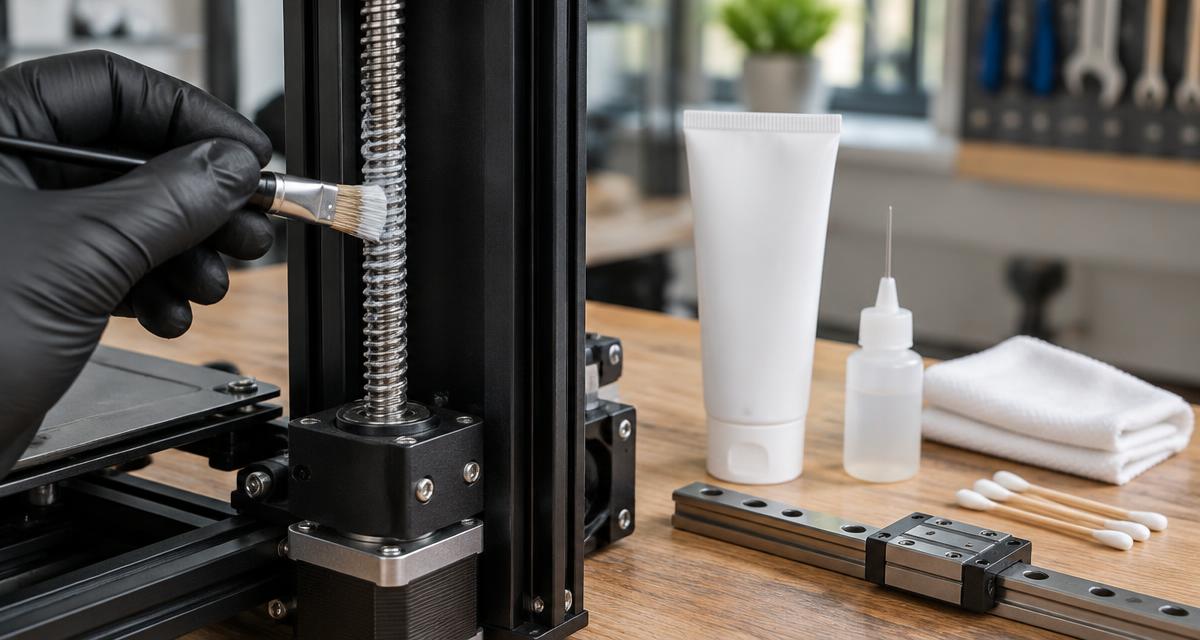
- 3Clean first. Wipe old lubricant, dust and plastic debris off with a lint-free or non-woven cloth. Bambu Lab and Creality use isopropyl alcohol for rods.
- 4Apply a thin film. A small amount of the specified grease or oil on the part. More is not better.
- 5Spread it by moving the axis. Move the toolhead or bed through its full travel several times so the lubricant distributes evenly.
- 6Wipe off the excess. Remove anything that has built up at the ends of travel or around nuts, where it would collect dust.
- 7Keep it off belts and plates. Check that no grease or oil reached the belts, pulleys you were not told to grease, or the build plate.
Nitrile gloves keep grease off your hands and the printer. For cleaning cloths, isopropyl alcohol and other basic maintenance supplies, see our 3D printer tools and accessories guide.
Maintenance Intervals
Every maker sets its own schedule, measured in printing hours or months. Dust, enclosed heat and abrasive filaments shorten them; Sovol halves its intervals for glass fiber, carbon fiber and metal-filled filaments.
Bambu Lab X1 and P1
Grease Z lead screws every 3 months
Check X carbon rods monthly; every 5 rolls of ABS or ASA on the X1
Bambu Lab A1 mini
Oil the Y-axis rail once a month
Also when the printer shows a lubrication prompt
Prusa MK4/S and MK3.9/S
Check and lubricate axes every 200 printing hours
Clean and lubricate rods sooner if motion feels rough
Creality K1C
Check rods and lead screws every 300 printing hours
Clean after every 5 kg of ABS or ASA; Y rods anti-rust every 6 months
Sovol
Clean and regrease rails and lead screw every 500 printing hours
Or every 2–3 months in a clean room; halve intervals for abrasive filaments
Between scheduled jobs, listen to the printer. New grinding or squeaking, an axis that feels rough when you move it by hand with the motors off, or Z banding that was not there before are all reasons to clean and check the motion parts early.
Common Mistakes
Greasing the belts
Belts slip, skip or degrade
Fix: Keep all lubricant off belts unless your printer maker says otherwise
Using one lubricant everywhere
Grease ends up where oil belongs, or on parts that need none
Fix: Check the manual for each motion part
Greasing Bambu carbon rods
Extra resistance, buildup and wear
Fix: Clean carbon rods with isopropyl alcohol only
Lubricating Prusa Z lead screws
Goes against Prusa's instructions for the MK4 and i3
Fix: Leave the Z lead screws and trapezoid nuts dry
Applying too much
Excess grease collects dust and becomes abrasive
Fix: Thin film, spread by moving the axis, then wipe off the excess
Not cleaning first
Old grease and dust mix into a gritty paste
Fix: Wipe off old lubricant and debris before reapplying
Using liquid oil on Sovol or Creality K1 rails
Both makers forbid liquid lubricants on those parts
Fix: Use the grease they specify
Spraying near electronics
Overspray reaches belts, boards and the build plate
Fix: Apply to a cloth or with a precise applicator
Buying Guide
Start with your manual. Look up your printer's maintenance page before buying anything. It tells you which parts get grease, which get oil and which get nothing.
Maker's product first. The lubricant in your accessory box, or the maker's refill, is designed for that printer. Alternatives are for when it runs out.
Choose alternatives the maker names. Bambu Lab names Lucas Oil 10533 and Super Lube 92003; Prusa names Super Lube 210XX for its i3 printers. A named alternative is a safer bet than a generic tube.
Grease consistency. Most general-purpose greases are NLGI grade 2, a soft, peanut-butter-like consistency. Prusa advises against very high-viscosity lubricants.
PTFE content. PTFE (often sold as Syncolon in Super Lube products) is a solid lubricant mixed into the grease or oil. It is common in printer greases but does not make a lubricant right for every part.
Plastic compatibility. If the lubricant will touch plastic nuts, sleeves or carriages, choose one the maker lists as plastic-compatible, such as Super Lube's silicone grease.
Applicator. A needle oiler, syringe or small brush makes thin coats far easier than a wide tube nozzle. Avoid aerosols near electronics and belts unless the guide calls for them.
Frequently Asked Questions
What is the best lubricant for a 3D printer?
The best lubricant is the one your printer maker specifies for that part. When the manual calls for grease, a synthetic PTFE grease such as Super Lube 21030 is a good default: Prusa names Super Lube 210XX greases for its i3 printers and Sovol calls for PTFE grease on its rails. Where the manual calls for oil, such as the Bambu Lab A1 Y-axis rail, use oil instead.
Should I use grease or oil on my 3D printer?
Follow the printer maker. Bambu Lab uses grease on lead screws and oil on its A1 series Y-axis rail. Creality says never to use liquid lubricants on its K1 series, and Sovol says liquid lubricants must not be used on its rails. Grease stays in place longer; oil spreads thinner but needs reapplying more often.
Can I use WD-40 on my 3D printer?
Only where the printer maker allows it. Bambu Lab approves the original WD-40 Multi-Use Product for the A1 and A1 mini Y-axis guide rail and warns against other WD-40 products. Sovol says WD-40 must not be used on its rails, and Creality says never to use liquid lubricants on its K1 series.
Should you lubricate 3D printer belts?
No, unless your printer maker explicitly tells you to. Sovol's maintenance guide says timing belts must not come into contact with any oil or grease, because it can damage the rubber and cause skipping or breakage. Keep belts clean and correctly tensioned instead.
Do I need to lubricate the lead screws on my 3D printer?
It depends on the printer. Bambu Lab, Creality and Sovol all call for a thin coat of grease on the Z-axis lead screws. Prusa says not to apply lubricant to the trapezoid nuts or threaded Z-axis lead screws on its MK4 and i3 printers.
How often should I lubricate my 3D printer?
Use your printer maker's schedule. Bambu Lab suggests checking lead screws and rails about every three months, Prusa checks the axes every 200 printing hours on the MK4, Creality checks K1C rods and lead screws every 300 printing hours, and Sovol relubricates rails every 500 printing hours or every two to three months.
Can I lubricate the carbon rods on a Bambu Lab printer?
No. Bambu Lab says the X-axis carbon rods on the X1 and P1 series do not use lubrication and warns not to use grease on them, because it causes extra resistance and buildup. Clean them with isopropyl alcohol instead.
How much lubricant should I use?
A thin film. Clean off the old lubricant and dust first, apply a thin even layer, move the axis back and forth to spread it, then wipe off the excess. Sovol warns that too much grease collects dust and becomes abrasive.
The Bottom Line
Read your printer's maintenance page first, and use the maker's own lubricant while you have it. When you need a replacement grease, Super Lube 21030 is the safest general pick for rails, rods and bearings that the manual says to grease. For Z lead screws on printers that call for grease, Lucas Oil 10533 and Super Lube 92003 are both named by Bambu Lab as equivalents to its own grease.
Where the manual calls for a light oil, such as the anti-rust wipe on Bambu Lab X1 steel rods, Super Lube 52004 is the oil Bambu suggests. Keep WD-40 Multi-Use Product for the Bambu Lab A1 series Y rail only. And whatever you buy: thin coats, clean first, nothing on carbon rods, nothing on Prusa Z lead screws, and nothing on belts.
Start With These
One all-round grease, a lead screw grease your printer maker names, and a light oil for parts that call for oil.
Amazon buttons open Amazon.com search results for that exact product name in a new tab, not a single product page. Results can include other sizes, multi-packs and similar items, so match the brand, product number and size before you buy. Amazon affiliate links. As an Amazon Associate I earn from qualifying purchases.
How We Chose These Products
We started from the maintenance instructions Bambu Lab, Prusa, Creality and Sovol publish for their printers and looked for lubricants those makers name directly or describe precisely, such as Sovol's PTFE grease. For each job we picked a specific product sold on Amazon.com, and on November 20, 2026 we confirmed that each one is listed on Amazon.com under the name the button searches for.
Specifications come from Super Lube, Lucas Oil and Bambu Lab documentation and the products' Amazon.com listings. We do not claim to have tested these products, and we do not publish prices or star ratings. No lubricant here is right for every printer; your printer maker's instructions always come first.
Affiliate Disclosure: This post contains affiliate links. If you purchase through these links, we may earn a small commission at no extra cost to you. We only recommend products we stand behind. See our full disclosure for details.
As an Amazon Associate I earn from qualifying purchases.