Sovol SV06 Review: What to Know About the Original SV06
This guide evaluates the original Sovol SV06 using its documented specifications, design and feature set, plus current product-family context — rather than presenting undocumented hands-on testing. Where print outcomes depend on individual setup, that is said plainly instead of being asserted as a measured result.
Quick Answer
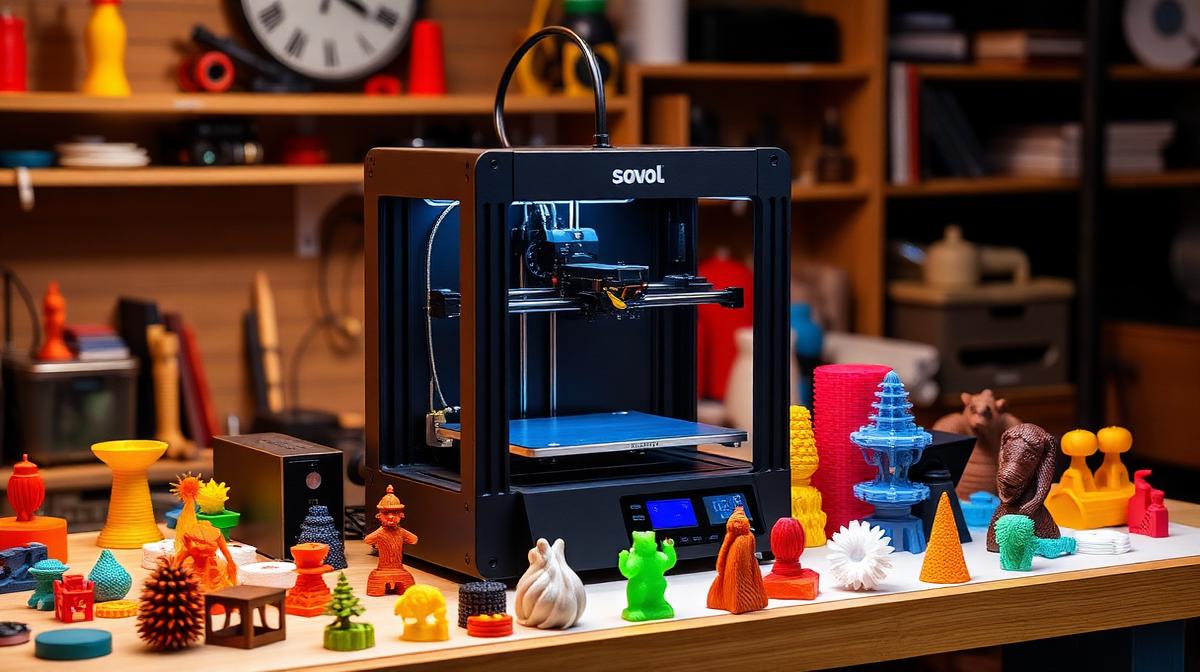
The original Sovol SV06 is an open-frame FDM printer whose appeal comes from its hardware choices: a direct drive extruder, an all-metal hotend, automatic bed leveling and a removable spring steel PEI plate on a machine aimed at entry-level buyers. It is now an earlier generation of Sovol's SV06 family — current shoppers should also compare Sovol's newer ACE-generation models. It suits existing owners, people assessing a used unit, and anyone who wants a well-documented platform they are willing to tune and maintain.
TL;DR — Quick Summary
What the original SV06 is, in short
- 1Type: Open-frame Cartesian FDM printer with a direct drive extruder
- 2Leveling: Automatic bed leveling; Z-offset still set by the user
- 3Build surface: Removable spring steel plate with PEI coating
- 4Generation: Earlier generation of the SV06 family; ACE-generation models are newer
- 5Best for: Existing owners, used-market buyers, and tinkering-friendly beginners
- 6Look elsewhere if: You want a current-generation machine or an appliance-like experience
What the Original Sovol SV06 Is
The SV06 is an open-frame, Cartesian-style FDM printer that Sovol positioned at the entry level. Its significance at launch was that it brought features usually found further up the market — direct drive extrusion, an all-metal hotend and automatic bed leveling — to a machine aimed at people buying their first printer or replacing an older budget one.
It ships partly assembled rather than fully built, and it is a machine you configure and maintain rather than one that hides its mechanics from you. That is the honest frame for evaluating it: capable hardware with a conventional, hands-on ownership model.
What is Direct drive extruder?
Direct drive extruder mounts the extruder motor directly on the printhead, so filament travels a very short distance before reaching the nozzle.
This is what makes flexible filament more practical than on a Bowden setup, where a long tube between motor and nozzle makes soft materials harder to push accurately.
The Original SV06 vs Today's SV06 Family
This matters more than any individual specification. The original SV06 is an earlier generation of Sovol's SV06 family; current shoppers should also compare Sovol's newer ACE-generation models. The lineup now centres on the SV06 ACE and the larger SV06 Plus ACE.
No claim is made here that the original SV06 has been discontinued — availability of any particular model varies by seller and region. What can be said safely is that it is not the machine Sovol currently leads its beginner range with, and that readers arriving from an older search result should know that before deciding.
Specifications also differ meaningfully between the SV06, SV06 Plus, SV06 ACE, SV06 Plus ACE, SV07 and SV08. They are distinct machines, and figures quoted for one should not be assumed to apply to another.
Best 3D Printers for Beginners Under $300: Sovol ACE Guide
The current-generation comparison — SV06 ACE and SV06 Plus ACE — for anyone shopping for a new machine rather than researching the original SV06.
Core Hardware and Design
The design characteristics that define the SV06 platform, and why each one matters:
Direct drive extruder
Short filament path from motor to nozzle, which makes flexible materials and retraction behaviour more manageable than on a Bowden machine.
All-metal hotend
No PTFE liner in the hot zone, which removes the temperature ceiling that constrains PTFE-lined budget hotends.
Automatic bed leveling
The printer probes and compensates for bed variation instead of requiring paper-and-knob levelling before every session.
Spring steel PEI build plate
Removable and flexible, so finished parts pop off by flexing the sheet rather than being prised off a fixed surface.
Exact figures — build volume, maximum temperatures and motion specifications — should be read from Sovol's documentation for the specific unit and revision you are looking at, since the SV06 family spans several distinct models.
Setup and Calibration Considerations
No setup time is promised here. What can be described accurately is what setting up a machine of this type involves:
- Assembly. A partly-assembled kit: the gantry is mounted to the base and the main cable looms are connected, following the supplied instructions.
- Mechanical checks. Belt tension, wheel or rail movement and fastener tightness are worth checking before the first print rather than after a failure.
- Bed leveling. Running the automatic leveling sequence so the printer maps the bed.
- Z-offset. The step most first-time owners underestimate. Automatic leveling handles bed variation, not nozzle height, and the first layer depends on getting this right.
- Filament loading. Heating the hotend and feeding filament through the direct drive extruder until extrusion is clean.
- Slicer profile. Using a profile matched to this printer and the material you are actually printing, rather than a generic one.
- First layer check. A test print, watched, with Z-offset adjusted in small increments until the layer looks properly squished rather than thin or smeared.
Re-checking the first layer after removing and refitting the build plate is sensible practice on any printer with a removable sheet.
First layer giving you trouble?
Diagnosing first-layer problems by cause — Z-offset, bed condition, temperature and flow — rather than guessing at settings.
Print-Speed Expectations
It is worth separating two different things that often get quoted interchangeably: the speed a manufacturer advertises a printer as capable of, and the speed at which you will actually run it for results you are happy with. No measured real-world speed figure is asserted here, because no documented testing supports one.
Usable speed on any FDM printer is determined by a stack of interacting factors:
- Material — PLA tolerates higher speeds than PETG or flexibles.
- Layer height and nozzle diameter — both change how much plastic has to flow per second.
- Hotend flow capability — the ceiling on how fast material can be melted and extruded.
- Acceleration — on small or detailed parts, acceleration limits matter far more than top speed.
- Geometry — long straight moves reach advertised speeds; short detailed moves never do.
- Cooling — faster printing needs more effective cooling to keep overhangs and small layers clean.
- Desired surface quality — the trade you are willing to make against finish.
If outright speed is your priority, a machine built around a CoreXY motion system and high-flow extrusion is a more sensible starting point than an older Cartesian design.
Print Quality: What the Hardware Can and Cannot Tell You
No print-quality results are claimed here. What hardware design can tell you is where the ceiling and the risks sit.
In the SV06's favour: direct drive gives more immediate control over retraction and extrusion, which tends to help with stringing and with materials that are hard to push down a long tube. An all-metal hotend removes a temperature constraint. Automatic leveling plus a PEI sheet removes two of the most common first-layer failure modes for beginners.
What hardware cannot tell you: the finished quality of your prints. That depends on Z-offset, slicer profile, filament condition and dryness, ambient temperature, cooling and how well the machine has been maintained. Two identical printers in two rooms can produce visibly different output.
Owner-reported results for this platform exist in community forums and marketplace reviews, and are worth reading — but they are owner reports, attributed to those owners, and are not 3D Print Geek test results.
Materials and Open-Frame Considerations
PLA and PETG are the straightforward everyday cases for an open-frame machine like this, and between them they cover most hobby printing. The direct drive extruder makes flexible filament more practical than on a Bowden printer, though flexibles still want slow speeds and careful retraction tuning regardless of the machine.
ABS, ASA and similar materials are a different proposition. An open frame is draughty, and those materials warp and split when layers cool unevenly, so they generally call for an enclosure to hold a stable warm environment. They also release fumes during printing, which makes ventilation a genuine requirement rather than a preference — print them in a well-ventilated space, not a closed bedroom.
Abrasive filaments — carbon-fibre filled, glow-in-the-dark, some composites — wear ordinary brass nozzles quickly and need a suitably hardened nozzle. Before committing to any specialty material, verify it against the specification for your exact unit rather than assuming family-wide compatibility.
Best Filament for Beginners (3D Printing Made Easy)
Which materials are forgiving to start with, and the settings tradeoffs between them.
Noise and Home-Use Considerations
No specific noise measurement is asserted for this printer. Qualitatively, perceived noise from an open-frame FDM machine comes from a handful of sources: the motion system as the axes move and change direction, the part-cooling and hotend fans, the power supply fan, and the speed at which you are printing — faster movement and sharper direction changes mean more noise.
Placement matters as much as the machine. A hollow desk acts as a soundboard and amplifies vibration; a solid surface, a paving slab or a dedicated anti-vibration mat reduces what you hear noticeably. If the printer will share a room you sleep or work in, plan the surface and position deliberately rather than assuming the machine will be unobtrusive.
Maintenance and Replacement Parts
No component failures are claimed here. These are the maintenance areas that apply to a printer of this design:
- Nozzle wear and clogs. Like other FDM printers, nozzle clogs can occur and should be diagnosed from filament condition, temperature, extrusion behaviour and nozzle condition. Nozzles are consumable, and abrasive materials shorten their life considerably.
- Bed cleanliness. Finger oils are a leading cause of adhesion failure on PEI. Clean with isopropyl alcohol and handle the sheet by its edges.
- Belts. Tension drifts over time and shows up as dimensional inaccuracy or ringing on printed corners. Check periodically.
- Fasteners. Vibration loosens screws on any moving machine; a periodic check of frame and gantry fasteners is cheap insurance.
- Lubrication. Lead screws and linear motion components benefit from lubrication using the type and interval the manufacturer specifies — not an arbitrary schedule.
- Extruder inspection. Check the drive gear for accumulated filament dust and the extruder assembly for cracks or play, particularly on a used machine.
- First-layer recalibration. Re-run leveling and re-check Z-offset after moving the printer or changing the build surface.
- Firmware and resources. Check Sovol's current documentation and firmware resources for your model; the platform also has an active community producing guides and upgrades.
The established parts ecosystem is one of the practical arguments for this platform, though availability of any specific component changes over time and is worth checking before you rely on it.
Strengths and Limitations
Strengths
- Direct drive architecture, which broadens practical material choice
- All-metal hotend without a PTFE temperature ceiling
- Automatic bed leveling on an entry-level machine
- Removable spring steel PEI build surface
- Established replacement-part and community ecosystem
- Conventional, well-documented design that is straightforward to service
Limitations
- An earlier generation of the SV06 family
- Open frame, which constrains warp-prone materials
- Newer ACE-generation alternatives exist for current buyers
- More setup and tuning than appliance-like modern systems
- Availability and support resources may differ from current models
- Not designed around the speeds newer CoreXY machines advertise
These are design characteristics, not scores. No rating, grade or percentage is assigned to this printer.
Where You Stand: Three Situations
You already own an original SV06
Everything above about setup, calibration, materials and maintenance applies to your machine. The most common improvements come from Z-offset discipline, dry filament and regular mechanical checks rather than from new hardware.
You are considering a used original SV06
Assess condition rather than the model name: hours of use, nozzle and hotend state, extruder condition, belt wear, build plate surface, which parts and accessories are included, what modifications have been made and whether they were done well, and whether the parts you may need are still readily available. The price should reflect that it is an earlier-generation machine.
You are shopping for a new Sovol printer
Compare the current ACE generation rather than assuming the original SV06 is still the obvious purchase. The SV06 ACE and SV06 Plus ACE are the current-family options, and our beginner guide covers that comparison in detail.
On price: no figure is quoted here. For an earlier-generation product, what you pay varies significantly with remaining new inventory, the seller, the used market, condition and any included upgrades or accessories. Shipping terms, return windows and availability are set by the seller — verify them at checkout rather than relying on anything written in an article.
The Sovol link above is an affiliate link to Sovol's current printer range, not to a specific original-SV06 product page.
Original SV06 vs the Current ACE Generation
Kept deliberately brief, because the detailed current comparison lives in the beginner guide:
- Original SV06 — the earlier generation of the family; the machine this guide is about.
- SV06 ACE — the newer current-family option, and the sensible starting point for a new purchase.
- SV06 Plus ACE — the larger current-family alternative for people who need more build volume.
Because these are distinct machines, do not carry specifications across between them. Check each model's own documentation for build volume, speed and feature claims.
A note on how this guide was written
This page does not present firsthand testing of the Sovol SV06. It is an editorial guide based on documented design characteristics, general FDM printing principles and product-family context. Where an outcome depends on your own setup, filament and environment, that is stated rather than turned into a result. Our affiliate relationship with Sovol does not mean this printer was purchased or tested by us.
Frequently Asked Questions
Is the original Sovol SV06 still worth considering?
It can be, but the context has changed. The original SV06 is an earlier generation of Sovol's SV06 family, and Sovol's current lineup has moved on to ACE-generation machines. It still makes sense for someone who already owns one, or for someone evaluating a used unit at a price that reflects its generation. Anyone shopping for a new printer should compare the current ACE-generation models before assuming the original SV06 is the obvious choice.
Is the Sovol SV06 good for beginners?
Its design leans beginner-friendly: a direct drive extruder, an automatic bed leveling system and a removable spring steel PEI build surface remove several of the manual steps that made older budget printers frustrating. It is still a partly-assembled, open-frame machine rather than a sealed appliance, so expect assembly, Z-offset adjustment, slicer profile setup and ongoing mechanical checks.
What is the difference between the original SV06 and the SV06 ACE?
They are different generations of the same family rather than the same machine at two prices. The original SV06 is the earlier model; SV06 ACE is the newer current-family option, and SV06 Plus ACE is the larger current-family alternative. For a current-generation comparison, see our beginner printer guide rather than treating original-SV06 information as applicable to the ACE machines.
Does the Sovol SV06 have automatic bed leveling?
Yes — automatic bed leveling is part of the SV06 design and is one of the reasons it was positioned as a step up from manually levelled budget printers. Automatic leveling compensates for bed variation; it does not set your Z-offset for you, so the first layer still needs checking after assembly and after the build plate is removed and refitted.
What materials can the Sovol SV06 print?
PLA and PETG are the straightforward everyday cases for this class of open-frame machine. The direct drive extruder makes flexible filament more practical than on a Bowden setup, though flexible materials still need slower speeds and careful tuning. Abrasive filaments require a suitable hardened nozzle. Check the current specification for your exact unit before committing to a specialty material.
Does the SV06 need an enclosure?
Not for PLA and PETG. An enclosure becomes relevant for materials such as ABS and ASA, which benefit from a stable warm environment and are prone to warping in a draughty room. Those materials also produce fumes that warrant proper ventilation, so treat an enclosure and ventilation as a combined decision rather than an accessory.
Is the Sovol SV06 noisy?
No specific noise measurement is asserted here. Perceived noise on an open-frame printer of this type depends on motion system behaviour, fan speeds, how fast you are printing, the surface the printer sits on, and where the machine is placed in the room. A hard hollow desk transmits vibration far more than a solid surface or a dedicated mat.
Can I still get replacement parts for the SV06?
The SV06 platform has an established parts and community ecosystem, which is one of the practical arguments for an earlier-generation machine. Availability for any specific component changes over time, so if long-term serviceability matters to you, check current availability of the parts you are most likely to need — nozzles, hotend components, extruder parts and build surfaces — before buying.
Should I buy a used SV06 or a newer Sovol model?
It depends on what you are optimising for. A used original SV06 can suit someone comfortable with maintenance who wants a known, well-documented platform, provided the condition, included parts and any prior modifications are properly assessed. Someone who wants a current machine with current support should compare Sovol's ACE-generation models instead.
Conclusion
The original Sovol SV06 earned its reputation on hardware choices that were unusual for its segment: direct drive, an all-metal hotend, automatic bed leveling and a proper removable PEI sheet. Those design decisions still hold up, and the platform's documentation and parts ecosystem make it a reasonable machine to own and maintain.
What has changed is its place in the lineup. It is an earlier generation, and anyone buying new should look at the ACE-generation machines before deciding. If you already own one, or you are weighing up a well-priced used unit, it remains a capable, serviceable printer — provided you go in expecting to tune and maintain it rather than to unbox an appliance.
Affiliate Disclosure: This post contains affiliate links. If you purchase through our links, we may earn a small commission at no extra cost to you. Affiliate relationships do not determine our editorial conclusions. Read our full affiliate disclosure.